By Zulfiqar Naqvi

The tradition of Urdu poetry in South Asia, particularly in India, has historically been shaped and dominated by male voices whose themes, aesthetics and emotional registers established the norms of the genre. From the romantic “ghazal” to philosophical and metaphysical poems (nazms), the canonical framework of Urdu literature long reflected male sensibilities and male interpretations of love, society and transcendence. Within this literary inheritance, woman often appeared as metaphor, muse, or moral symbol—but rarely as a speaking subject. The gradual emergence of women poets over the last century, therefore, marks not merely a demographic shift but a fundamental reorientation of the cultural imagination itself.
These women poets did not simply enter a male-dominated literary space; they reshaped it from within by inscribing their lived experiences—often marked by repression, silencing, emotional labour, domestic confinement and social inequality—into poetic discourse. For many of them, writing became an act of survival, resistance and reclamation. Their poetry interrogates entrenched patriarchal systems that regulate women’s identity, mobility, honour and selfhood, exposing the contradictions and violence embedded in everyday social life. At the same time, these female poets introduced into Urdu verse a nuanced emotional interiority and a sharpened political consciousness that significantly expanded the thematic scope of the tradition. The issues they raise—gender discrimination, coercive traditions, moral policing, emotional erasure and institutional power—are not abstract ideals but lived realities. Their poetry thus functions simultaneously as cultural document, political critique and spiritual lament.
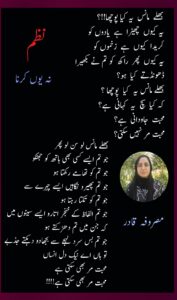
A large number of female poets emerged as powerful voices of protest against the deeply rooted structures of patriarchy—a subject vast enough to warrant extensive scholarly investigation. Within the limited scope of this essay, only a select group can be discussed, including Parveen Shakir, Kishwar Naheed, Naseem Syed, Ishrat Aafreen, Rafi‘ah Shabnam Abidi, Rukhsana Jabeen, Kahkashan Tabassum, Aleena Itrat and Dr. Ambar Abid. Their verses reveal varied yet interconnected strategies through which poetic language becomes an instrument of resistance and self-assertion. Each contributes a distinct register of feminist expression: Parveen Shakir’s tender yet piercing introspection, Kishwar Naheed’s unapologetic defiance, Naseem Syed’s self-constructive optimism, Ishrat Aafreen’s interrogation of internalized patriarchy, Rafi‘ah Shabnam Abidi’s reflective sorrow, Rukhsana Jabeen’s symbolic dismantling of gender myths, Kahkashan Tabassum’s haunting imagery of inherited inequality, Aleena Itrat’s metaphysical resilience and Dr. Ambar Abid’s historically conscious feminist reclamation. Together, they form a complex mosaic of feminist consciousness in contemporary Urdu poetry.
Parveen Shakir, one of the most celebrated female voices in Urdu literature, is known for infusing the ghazal with a feminine sensibility that foregrounds emotional vulnerability alongside sharp social critique. Introducing her is introducing a poet who mastered subtle rebellion: her diction is gentle, but her message penetrates deeply.
“Main nahin magar kuchh bhi ,
Sang dil rivaajo’n mein,
Aahani hisaaro’n mein,
Umar qaid ki mulzim,
Sirf aik ladki hoon”.
These lines present a devastating critique of the norms that govern a woman’s life. Shakir constructs the identity of the female subject as one trapped within “sang dil rivaaj”, stone-hearted customs that crush individuality. The metaphor of “aahani hisaar”, iron fortresses, extends the sense of entrapment: the girl is surrounded not by protection but by impenetrable restrictions masquerading as tradition. Declaring herself “Umar qaid ki mulzim”—a convict sentenced to life imprisonment—Shakir exposes how society criminalizes womanhood itself, punishing women for merely existing within imposed boundaries. This is not melodrama; it is a profound commentary on how gender norms are enforced through emotional, moral and physical punishments. The final line—“Sirf aik ladki hoon”—captures both the fragility and the strength of her critique. On the surface it reflects helplessness, but beneath it lies a powerful indictment of a culture that sees a girl as “lesser,” as someone whose life possibilities are predetermined by male-authored scripts. Transitioning from Shakir’s soft yet penetrating tone, we move towards a poet whose feminist stance is far more openly confrontational.
Kishwar Naheed, a towering figure of feminist poetry in the subcontinent, is known for her uncompromising stance against patriarchal and religious authority. Her introduction requires only one phrase: she is the voice of rebellion in Urdu poetry, unafraid to challenge structures many fear even to name. She says:
“Yeh hum gunahgaar auratein hain,
Jo ahl-e-jubbah ki tamkanat se na ro‘ab khaayen,
Na jaan bachaayen, Na sar jhukaayen, na haath joren”.
In these lines she captures the core of her defiant ethos. The line “Yeh hum gunahgaar auratein hain” uses satire to turn the patriarchal accusation of female guilt into a badge of resistance. These women are termed “sinners” not because they committed moral wrongs, but because they refuse obedience. By naming her adversaries as “ahl-e-jubbah”—religious patriarchs who wield spiritual authority to control women—Naheed directly confronts the theological underpinnings of gender oppression. The refusal to bow “na sar jhukaayen”, to plead “na haath joren”, or to escape “na jaan bachaayen” constructs a portrait of women who have reached a point of moral and emotional awakening where silence is no longer an option. The courage articulated in this poem stands in sharp contrast to the image of subdued femininity expected in conservative societies. Through this refusal, Naheed opens the door to a larger conversation on how religious and cultural institutions collaborate to sustain patriarchal dominance. Transitioning from Naheed’s fire and protest, we now encounter a poet who foregrounds self-definition as the essence of liberation.
Naseem Syed, a poet of introspection and self-formation, brings to feminist poetry an empowering emphasis on self-construction. Introducing her is introducing a poet concerned not only with resistance but with rebuilding identity from within. She says;
This poetry is a manifesto of autonomy. The central idea of “apni tasveer mujhe aap banani hai” asserts ownership over self-image, rejecting societal attempts to define or confine the woman. Syed lists the elements necessary for this reconstruction—awareness, courage of speech, clarity of vision, courage of love, the beauty of restraint—presenting a holistic model of female selfhood that incorporates intellect, passion, discipline and creativity. These qualities, she says, are “meri ta‘meer mein hain”—already part of her being, waiting to be recognized and manifested. Where patriarchal culture denies women the right to shape their destinies, Syed’s poem becomes an anthem for self-empowerment. Her tone is transformational rather than accusatory; suggesting that resistance also includes the internal labour of rebuilding one’s identity. Moving from Syed’s constructive optimism, we enter the realm of Ishrat Aafreen, whose poetry interrogates not only external patriarchy but the ways women themselves become enforcers of oppression.
Ishrat Aafreen, a powerful voice in contemporary feminist poetry, is known for confronting the internalized misogyny that perpetuates gender inequality. As an introduction, she is a poet who turns the gaze inward, challenging women to break the cycles they unknowingly sustain. How boldly she invokes the women folk in the following lines:
“Yeh aurat hai, Ke jo aurat ke haq mein ab bhi goongi hai,
Yeh aurat hai,
Ke jo aurat ki umeedo’n ki qatil hai,
To kya tareekh khud ko yunhi dohrati rahe gi?
Nahin aisa nahin ho ga!!”.
It is a bold indictment of how women become agents of patriarchal structures. The critique begins with “yeh aurat hai ke jo aurat ke haq mein ab bhi goongi hai”, calling attention to women who remain silent when they should speak for other women. Silence becomes complicity and complicity becomes oppression. The next line intensifies the accusation: some women become “aurat ki umeedo’n ki qatil”, killers of the hopes of other women, reinforcing restrictive norms, policing behaviour and undermining independence. Aafreen’s strength lies in exposing this painful truth: patriarchy survives not only through men’s authority but through women’s internalized belief systems. Yet the poem ends with hope: “Nahin aisa nahin ho ga”. The refusal to accept cyclical oppression signals a feminist future rooted in awareness and agency. This shift from internalized to externalized struggle sets the stage for the introspective sorrow and resilient dignity found in the poetry of Rafi‘ah Shabnam Abidi.
Rafi‘ah Shabnam Abidi, a poet of emotional depth and reflective gravity, explores themes of psychological exile, destiny and moral integrity. Introducing her requires acknowledging that she writes from the margins—where the personal and the societal intersect in quiet but devastating ways.
“Umar bhar zehn ke gumnaam jazeero’n mein rahi,
Be-gunaho’n ki tarah main bhi aseero’n mein rahi,
Mere qadmu’n tale jannat hui ta‘meer magar,
Meri qismat tere haathu’n ki lakeeru’n mein rahi,
Mere kirdaar ko kya qatl kare gi duniya?
Main jahan bhi rahi bedaar zameeru’n mein rahi”
These lines present a portrait of a woman simultaneously silenced and morally awake. The metaphor of “gumnaam jazeere”—nameless islands of the mind—evokes isolation and erasure, suggesting that women often live intellectually and emotionally in spaces unrecognized by society. The line “be-gunahu’n ki tarah aseeru’n mein rahi” further emphasizes her unjust captivity, linking her experience to the structural guilt imposed on women. Though “jannat” is constructed under her feet, symbolizing idealized motherhood or moral virtue, her destiny is dictated by the “lakeerein” of a man’s hand. In the second couplet she counters this injustice through moral resilience that society cannot kill her character because she has lived among “bedaar zameer”—awakened consciences. This shift from sorrow to dignity forms a natural transition to the poetry of Rukhsana Jabeen, who takes feminist critique into the realm of symbolism, myth and intellectual resistance.
Rukhsana Jabeen, a poet of sharp metaphorical intelligence, stands out for her ability to challenge gender myths and expose patriarchal double standards through symbolic language. Introducing her is introducing a poet who dismantles gender ideology at its roots.
“B’ham uss ko faza-e-aasmaani,
Main goya band kamre mein dhuaa’n hoon,
Main phooti us ki pasli se to terhi,
Woh seedha teer jaisa, main kamaa’n hoon”,
“Daleelein dheron saari tu zamee’n hai,
Bazid is par ke tera aasamaa’n hoon”,
“Yeh dunyadaar bachche jaante hain,
Mere qadmu’n mein jannat hai ke maa’n hoon”
These verses of Rukhsana Jabeen are rich with layered meanings. The first couplet contrasts male spatial freedom with female confinement: he occupies the vast sky; she suffocates like smoke trapped in a room. The second couplet transforms the patriarchal myth of woman’s creation from man’s rib: what men call “crookedness,” she reframes as the curvature of a bow, a tool of power and direction. The third couplet critiques intellectual inequality: the woman presents arguments grounded in reality “tu zameen hai” while the man claims superiority through baseless entitlement “tera aasamaan hoon”. The final couplet exposes the contradiction between the symbolic reverence of motherhood and the actual exploitation of mothers. Jabeen’s feminist strategy is subtle but devastating—she takes familiar cultural symbols and turns them into arguments against the very society that created them. This symbolic critique paves the way for another poet, Kahkashan Tabassum, whose imagery reveals the emotional inequality embedded in everyday life.
Kahkashan Tabassum, a poet of evocative imagery and understated poignancy, brings to feminist poetry a focus on emotional disparity and inherited inequality. She is a poet who captures the quiet tragedies of women’s lives through vivid symbols.
“Mausam, khushboo, rang, dhanak ke manzar saare us ke the,
Raat ki kaali chhaya meri, chaand sitaare us ke the”
Sehmi sehmi goongi, behri, aik gujriya meri thi,
Hanste gaate dhool udaate raaj dulare us ke the”.
These lines present a stark emotional contrast between the male and female experiences. The man enjoys colour, fragrance and cosmic beauty, while the woman is enveloped in darkness. The imagery of “goongi behri gujriya”—a mute and deaf doll-like girl—symbolizes women conditioned into silence and fear, stripped of voice and agency. Meanwhile, men are described as “raaj dulare”—privileged, carefree and celebrated. Tabassum’s poem reveals that gender inequality is not only structural; it is emotional, psychological and generational.
Aleena Itrat, another renowned contemporary poetic voice marked by resilience and metaphysical confidence, represents a stage in feminist Urdu poetry where resistance matures into self-mastery. Her poetry does not merely protest oppression; it demonstrates how a woman survives, adapts and ultimately transforms adversity into strength. The following verses articulate a philosophy of survival rooted in awareness, agency and elemental balance.
“Jab zameen reit ki manind sarakti paayi,
Aasmaan thaam liya jaan bacha li main ne.
Khak kar ke mujhe sehra mein uraane wale,
Dekh raqsaan hoon sar-e-dasht uraayi hui main.
Log afsana samajh kar mujhe sunte hi rahe,
Dar-haqeeqat hoon haqeeqat se banaayi hui main.”
Aleena Itrat’s poetry represents a mature phase of feminist consciousness in contemporary Urdu literature—one in which resistance is no longer limited to protest alone but evolves into existential self-possession and elemental strength. In these verses, the poet constructs a metaphorical journey of survival, transformation and inner sovereignty, presenting the woman not as a passive victim of circumstances but as an active agent who adapts, resists and ultimately transcends adversity.
The imagery of a slipping ground—“zameen reit ki maanind sarakti”—suggests a world devoid of stability, trust and moral assurance, a condition often experienced by women in patriarchal social structures where emotional, social and institutional support remains unreliable. Instead of collapsing with the ground beneath her feet, the poet claims the sky—“aasmaan thaam liya”—a symbolic act that signifies intellectual elevation, spiritual awareness and inner courage. Survival here is conscious and strategic; life is preserved through self-reliance rather than submission.
The poet then subverts the logic of annihilation imposed by oppressive forces. Those who attempt to reduce her to dust—“khaak kar ke mujhe sehra mein uraane waale”—intend erasure and invisibility. Yet Aleena Itrat transforms dispersion into motion and humiliation into celebration. To be scattered in the desert becomes a form of dance—“raqsaa’n hoon sar-e-dasht uraayi hui main”—suggesting that even in exile, a woman can reclaim agency and redefine freedom. The desert, typically a symbol of barrenness, is reimagined as a site of resilient existence. Then “Haqeeqat se banaayi hui main” is a declaration that challenges the patriarchal tendency to romanticize, mythologize, or trivialize women’s suffering rather than acknowledge it as social truth.
Dr. Ambar Abid, introduces a historically conscious feminist vision grounded in hope, struggle and collective memory.
Gardish-e-waqt se kyun khauf-zada ho Ambar,
Shab guzar jaane do suraj bhi dikhayi de ga.
Pehle haathon ki lakeero’n ko mitaaya hum ne,
Tab kahin ja ke yeh aanchal hua parcham ki tarah.
Hum pe jannat se nikalwaane ka ilzaam sahi,
Ghar ko gehwaara-e-jannat bhi banaaya hum ne.
These verses of Dr Ambar Abid articulate a hopeful yet historically conscious feminist vision rooted in endurance, struggl and self-assertion. She challenges fear of time’s turbulence, affirming that darkness is temporary and that dawn inevitably follows oppression. By erasing the “lines of fate” from the hands, she rejects deterministic patriarchal narratives that bind women to preordained roles. The transformation of the “aanchal” into a “parcham” powerfully symbolizes the politicization of domestic identity into collective resistance. The reference to the blame of exile from paradise reclaims the age-old misogynistic myth attached to womanhood. In reversing this accusation, the poet asserts women’s role as creators of nurture, continuity and moral space. Thus, the verses balance optimism with struggle, presenting feminist resistance as both historical correction and future hope.
The poetry of these selected women poets forms a powerful collective narrative that challenges the cultural, emotional, spiritual and intellectual foundations of patriarchy. Parveen Shakir exposes suffocating norms; Kishwar Naheed confronts institutional authority; Naseem Syed reclaims selfhood; Ishrat Aafreen dismantles internalized misogyny; Rafi‘ah Shabnam Abidi articulates dignified sorrow; Rukhsana Jabeen rewrites patriarchal symbols; Kahkashan Tabassum reveals emotional inequality; Aleena Itrat transforms erasure into resilience and Dr. Ambar Abid situates feminist struggle within historical hope and reconstruction. Together, they demonstrate that feminist Urdu poetry is not a monolithic movement but a rich, multidimensional discourse shaped by diverse strategies and lived realities. Their poetry is not merely literature—it is testimony, resistance, healing and vision. In giving language to suffering and strength, they transform silence into speech, captivity into consciousness and individual struggle into collective awakening.

