₹1,086 Cr Annual Rail Budget Powers ₹522 Cr Projects, ₹293 Cr Station Revamp in J&K
FIRDOUS AHMAD
SRINAGAR, Feb 3: Jammu and Kashmir’s railway sector is witnessing a decisive transformation, marked by higher budgetary support, accelerated infrastructure works, and improved passenger connectivity—signaling a clear departure from the modest allocations and slow progress of the past.
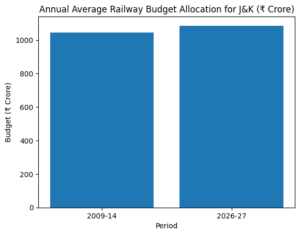
A comparison of historic budget allocations itself tells a compelling story. During the 2009–14 period, the annual average railway budget allocation for Jammu and Kashmir stood at ₹1,044 crore. In contrast, the allocation for 2026–27 has risen to ₹1,086 crore annually. While the numerical increase may appear incremental, the real shift lies in how efficiently and strategically these funds are being deployed on the ground, translating into visible assets and long-term economic value for the region.
Infrastructure Push Gains Momentum
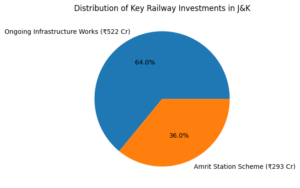
One of the most notable developments is the scale of infrastructure works currently underway. Railway projects worth ₹522 crore are under active execution across Jammu and Kashmir. These works span critical areas such as new track creation, station redevelopment, and comprehensive safety enhancements—components that were long pending or delayed in earlier decades due to difficult terrain, funding constraints, and execution bottlenecks.
This sustained investment is not merely about expanding rail lines; it is about creating a robust transport backbone capable of supporting economic growth, tourism, trade, and regional integration.
Amrit Station Scheme: Modern Stations for a Modern Economy
Under the ambitious Amrit Station Scheme, four key railway stations in Jammu and Kashmir have been identified for complete redevelopment, with an investment of ₹293 crore earmarked for station modernisation alone. These redeveloped stations are expected to offer world-class passenger amenities, improved accessibility, and enhanced commercial spaces.
For a region aspiring to boost tourism and business travel, modern railway stations serve as critical gateways, shaping first impressions and improving overall travel efficiency.
Better Connectivity Through Premium Services
Connectivity has also entered a new phase with the expansion of premium train services. At present, five pairs of Vande Bharat Express services are operational, significantly reducing travel time and offering passengers a faster, safer, and more comfortable travel option.
The introduction of such high-speed, semi-modern trains in Jammu and Kashmir underlines a broader policy shift—from merely providing connectivity to ensuring quality connectivity that meets national standards.
Network Expansion and 100% Electrification: A Historic Milestone
Perhaps the most transformative achievement is the rapid expansion and electrification of the railway network. Since 2014, approximately 150 kilometres of new railway tracks have been constructed in the Union Territory—a remarkable feat given the region’s challenging geography.
Even more significant is the achievement of 100% electrification of railway lines in Jammu and Kashmir. Around 407 kilometres of rail lines have been electrified since 2014, aligning the region with India’s broader goal of cleaner, more energy-efficient rail transport. Electrification not only reduces operating costs but also lowers carbon emissions and enhances reliability during harsh weather conditions.
Complementing this expansion, six flyovers and underpasses have been constructed, improving safety, reducing congestion, and ensuring smoother movement of both trains and road traffic.
A Clear Break from the Past
Taken together, these developments reflect a clear shift from earlier periods when budgetary allocations often failed to translate into timely execution. Today, Jammu and Kashmir’s railway sector stands as a key pillar of economic integration, infrastructure resilience, and future-ready development.
With consistent funding, modernisation initiatives, and a focus on execution, the railways are no longer just a transport service in Jammu and Kashmir—they are emerging as a catalyst for economic growth, employment generation, and regional stability.