KD NEWS SERVICE
MUMBAI, May 28: In a defining moment for India’s evolving commodity and financial markets, the National Stock Exchange of India (NSE) and Sequel Logistics have entered into a strategic partnership to enable the creation and vaulting of Electronic Gold Receipts (EGRs), marking a major leap toward the formalisation and financialisation of gold in the country.

The collaboration was formally unveiled through a ceremonial bell-ringing event at the NSE, symbolising not merely the launch of a business partnership, but the beginning of what market participants believe could become a transformative chapter in India’s centuries-old relationship with gold.
As India accelerates its journey toward digitised financial assets and transparent commodity markets, the NSE-Sequel alliance aims to establish a secure, scalable and institutionally trusted ecosystem for EGR trading — an innovation expected to reshape how gold is owned, traded and stored in the world’s second-largest consumer of the precious metal.
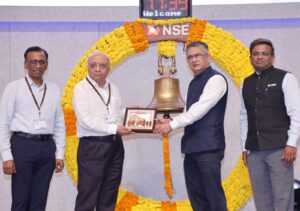
At the heart of the partnership lies Sequel Logistics’ extensive vaulting infrastructure spanning 23 secure vaults across India. These facilities will support the creation and extinguishment of Electronic Gold Receipts, ensuring that every digital receipt traded on the exchange is backed by physical gold held under tightly regulated custody systems.
Industry experts say the initiative could significantly modernise India’s fragmented gold ecosystem, bringing greater transparency, liquidity and investor confidence into a market historically dominated by informal transactions and physical holdings.
Electronic Gold Receipts are designed to function as exchange-traded instruments backed by physical gold. Investors can buy, sell and hold these receipts in dematerialised form, much like equities, without the logistical and security challenges associated with physical ownership. The framework is expected to reduce inefficiencies in pricing, improve purity standardisation and create seamless market access for both retail and institutional participants.
Speaking on the occasion, Sriram Krishnan, Chief Business Development Officer at NSE, described the partnership as a foundational step in building a credible and scalable EGR ecosystem in India.
“We are delighted to partner with Sequel Logistics on the Electronic Gold Receipts segment,” Krishnan said. “A trusted, secure and well-distributed vaulting network is foundational to the integrity of the EGR ecosystem, and Sequel’s established footprint across the country positions it well to support the creation and extinguishment of EGRs at scale.”
He added that Electronic Gold Receipts represent “a meaningful step in the financialisation of gold in India,” offering investors a transparent, exchange-traded and standardised instrument backed by physical gold.
The financialisation of gold has long remained a strategic priority for policymakers and market regulators seeking to channel India’s massive household gold holdings into the formal economy. Analysts believe the EGR mechanism could eventually deepen market participation, improve price discovery and integrate India’s gold trade more closely with global commodity markets.
For Sequel Logistics, one of India’s leading integrated logistics and vaulting service providers, the partnership represents a strategic expansion into the future architecture of precious metals trading.
Rajkumar S, Managing Director and Founder of Sequel Logistics, said the company was honoured to collaborate with the NSE on what he called a “landmark initiative for the Indian capital markets.”
“Sequel has built its vaulting infrastructure over the years with a clear focus on security, transparency and operational rigour,” he said. “We are pleased to bring this network of 23 vaults in support of EGR creation and extinguishment.”
He further noted that the company sees Electronic Gold Receipts playing “a defining role in the financialisation of gold in India,” while reaffirming Sequel’s commitment to supporting the broader ecosystem in building investor trust and operational scale.
The partnership arrives at a time when India’s commodity markets are witnessing rapid structural transformation through technology-led reforms, tighter regulation and increasing investor sophistication. Market observers note that while India has traditionally been one of the world’s largest gold-consuming nations, the absence of a unified and exchange-driven ecosystem has often limited efficiency, transparency and institutional participation.
By linking physical vaulting infrastructure with exchange-based digital trading, the NSE-Sequel model could bridge that gap and create an ecosystem comparable to mature international bullion markets.
Beyond trading convenience, the EGR framework is also expected to strengthen traceability and standardisation within the gold value chain — an increasingly important factor in global precious metals markets where provenance, compliance and quality assurance are gaining prominence.
Financial sector participants believe the initiative may also encourage younger investors to view gold not merely as a cultural asset or store of wealth, but as a modern financial instrument integrated with broader investment portfolios.
The ceremonial bell-ringing at NSE therefore carried symbolism beyond tradition. It reflected the convergence of India’s deep-rooted affinity for gold with the institutional credibility of modern capital markets — a convergence that could redefine how the metal is traded, stored and monetised in the years ahead.
As India positions itself for the next phase of capital market evolution, the NSE-Sequel Logistics partnership may well be remembered as one of the early milestones in building a transparent, technology-enabled and globally competitive digital gold ecosystem.

