spot_imgspot_img
spot_img
Home Blog Page 29

LG Manoj Sinha declares zero tolerance in anti-drug drive across J&K

0

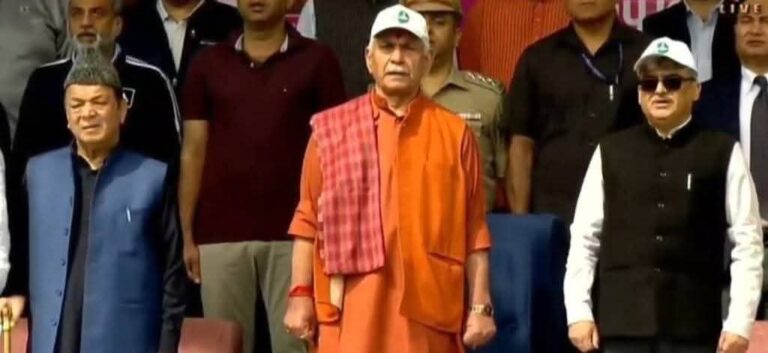
Srinagar, May 3: The Lieutenant Governor of Jammu and Kashmir, Manoj Sinha, on Sunday launched a sweeping campaign against drug abuse and narco-terrorism in Srinagar, vowing strict action against offenders and emphasizing that “no one will be spared.”

According to officials, the initiative aims to significantly intensify efforts to dismantle drug networks operating across the Union Territory. The campaign, led by the administration, will involve coordinated action by law enforcement agencies, enhanced surveillance, and widespread awareness programmes to identify and act against drug peddlers and their support systems.

The move is part of a broader strategy by the Jammu and Kashmir administration to build a drug-free society and safeguard the region’s youth.

Addressing the gathering, Sinha described narco-terrorism—the alleged link between drug trafficking and cross-border militancy—as a major threat to both security and the future of young people in the region. He reiterated the administration’s commitment to a zero-tolerance policy against those involved in such activities.

He also called on civil society, community leaders, and youth to play an active role in steering individuals away from substance abuse.

Meanwhile, a large number of people participated in a padyatra against drugs at the TRC Football Stadium, which was flagged off by the Lieutenant Governor, reflecting growing public support for the anti-drug campaign.

Anti-Drug Drive Becomes People’s Movement in Kashmir in 3 Weeks: Div Com

0

30K awareness programmes, 3K clerics join; focus shifts to supply crackdown, rehab support


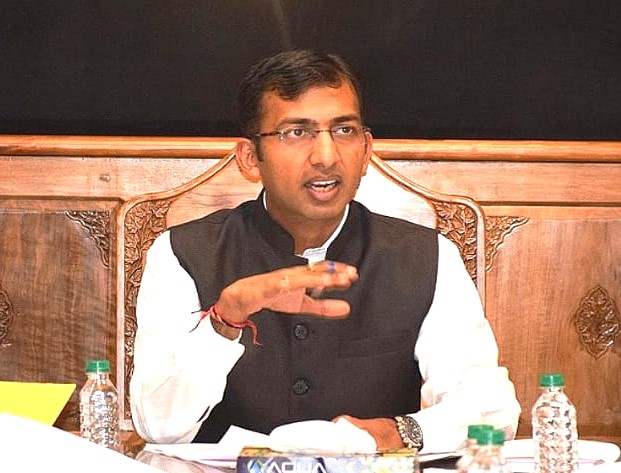
Srinagar, May 3: Divisional Commissioner Kashmir Anshul Garg (IAS) on Sunday said the ongoing Nasha Mukt Jammu & Kashmir Abhiyaan has rapidly evolved into a mass movement across the Valley within just three weeks of its launch.

Speaking at TRC Football Ground Srinagar after a padyatra, as pwr news agency JKNS, Garg said the campaign, launched on April 11, has witnessed widespread public participation, turning into what he described as a “jan andolan.”

He said more than 30,000 awareness programmes have been conducted across Kashmir, ensuring outreach to every village and ward. “The campaign has moved beyond schools and colleges, with over 3,000 religious leaders actively participating,” he said.

Emphasising a dual strategy, Garg said the administration is not only focusing on awareness but also intensifying action against the drug supply chain. “Hotspots are being identified and strict action is underway against traffickers and peddlers through FIRs, arrests and legal proceedings,” he said.

He added that authorities are also invoking measures linked to driving licences, Aadhaar, passports, property demolition and revenue records to deter those involved in narcotics-related activities.

At the grassroots level, Nambardar and Chowkidar networks have been activated, while district control rooms have received over 2,000 calls from the public, prompting action.

Garg said nearly 98 percent of public institutions have been integrated into the campaign, alongside steps to ensure transparency through open billing and stock registers.

He said the next phase of the drive will prioritise rehabilitation and counselling support for affected individuals, with counsellors being deployed at schools, colleges and block levels.

Thanking youth, NGOs, civil society and media for their role, Garg urged continued public participation to sustain the momentum against drug abuse.

LG Manoj Sinha Launches Anti-Drug, Anti-Narco-Terror Drive in Srinagar

0

Tauseef Ahmad

Srinagar, May 3: Lieutenant Governor Manoj Sinha on Sunday unveiled a comprehensive campaign aimed at tackling drug abuse and curbing narco-terrorism across Jammu and Kashmir, with a strong focus on protecting the region’s youth.

The initiative, launched in Srinagar, marks a renewed push by the administration to dismantle narcotics networks and cut off links between drug trafficking and terror financing. Officials said the drive will combine strict law enforcement measures with large-scale public awareness efforts.

Authorities plan to intensify surveillance, strengthen intelligence-sharing, and take decisive action against drug peddlers and organized networks operating in the region. The campaign will also involve outreach programs in schools, colleges, and communities to educate people about the dangers of substance abuse.

Addressing the gathering, Manoj Sinha stressed that eliminating drug abuse requires a collective effort. He called upon young people, parents, educators, and civil society groups to actively support the mission, highlighting that community participation is key to long-term success.

Reaffirming a zero-tolerance approach, the Lieutenant Governor warned that those involved in drug trafficking or aiding such activities would face strict legal consequences. He added that the administration remains committed to building a safer, drug-free environment for future generations.

The campaign forms part of a broader strategy by the Jammu and Kashmir administration to combat the dual threat of narcotics and terrorism, while ensuring social stability and public well-being across the Union Territory.

“Gram Sabha Hallan,Manzgam Declares 60 Sq Km Forest as Community Forest; Announces Blanket Ban on Plastic & Packaged Food in Chiranbal Meadows “

0

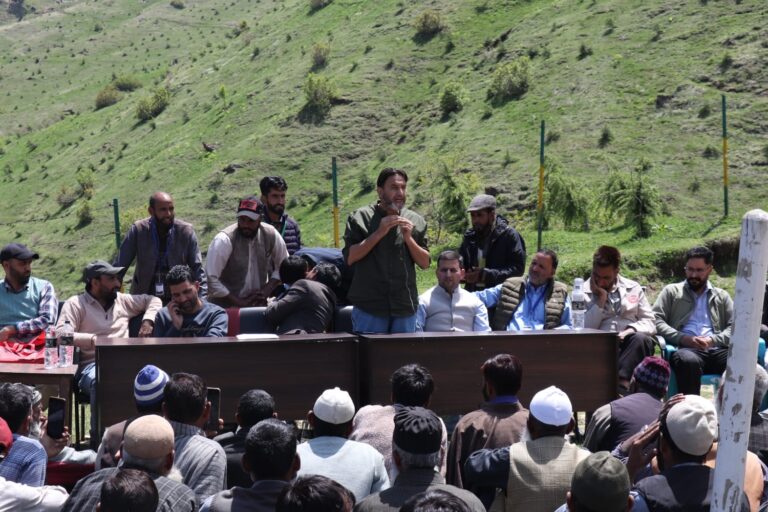
Kulgam: In a landmark assertion of people’s rights, ecological responsibility, and grassroots democracy, the 33rd Gram Sabha on Community Forest Rights (CFR) under the Forest Rights Act 2006 was successfully convened at Panchayat Halqa Hallan–Manzgam in District Kulgam. With an unprecedented participation of more than 700 members, the Gram Sabha emerged as a powerful platform of collective will, reclaiming both rights and responsibilities over forest landscapes.
In a historic resolution, the Gram Sabha declared approximately 60 square kilometres of forest land as Community Forest under CFR provisions and announced a complete ban on plastic and packaged food within this jurisdiction, with special emphasis on protecting the fragile alpine ecosystems of Chiranbal Meadow.
The Gram Sabha was facilitated by the Forest Rights Coalition J&K (FRC J&K), led by Dr Shaikh Ghulam Rasool (Founder), Zahid Parwaz Choudhary (Convenor), and Adv Naveed Bukhtiyar (Legal Advisor), in collaboration with RDD block Manzgam and FRC Hallan. The gathering witnessed participation from a diverse cross-section including local residents, school children, teachers, Forest Department officials, Rural Development staff, and Panchayat representatives.
The proceedings commenced with Tilawat-e-Quran, followed by a welcome address by Chowdary Isaq. The former Sarpanch highlighted pressing issues including closure of pastoral routes, denial of access to traditional grazing pastures, lack of adequate school infrastructure, and the continued disconnect and high-handed approach of certain sections of the Forest Department.
Delivering the keynote address, Dr. Shaikh Ghulam Rasool emphasized that the Forest Rights Act represents a historic corrective justice framework recognizing forest dwellers as rightful custodians of forests. He asserted that its implementation in Jammu & Kashmir is an irreversible reality and called upon the Forest Department to align with the spirit of the law.
He stated, “We need to understand that FRA is for the people dependent on forests and mountains—climate-resilient indigenous communities whose way of life and traditional wisdom offer the only sustainable path to protect forests in the larger interest of climate stability and water security.” He further underlined that CFR not only grants rights but also binds communities to conservation, restoration, and sustainable stewardship.
Advocate Naveed Bukhtiyar elaborated on the legal safeguards under FRA, stating that any intervention in forest areas without prior informed consent of the Gram Sabha is illegal and constitutes a violation of the law. He cautioned that obstruction of rights may attract legal consequences under the SC/ST (Prevention of Atrocities) Act.
Zahid Parwaz Choudhary, Convenor FRC J&K, reiterated the coalition’s commitment stating, “FRC J&K is committed to assist, educate, advocate, agitate, and monitor the implementation of the Forest Rights Act 2006 for indigenous pastoral and other forest-dwelling communities across Jammu & Kashmir and the Western Himalayas.” He further emphasized that, “The Forest Department must transform its approach, internalize the spirit of FRA, and work in partnership with communities for the greater welfare of people and conservation of forests.”
He also presented the Gram Sabha Resolution, extending full institutional support to communities in securing their CFR claims.
Key Highlights of the Gram Sabha Resolution:
Declaration of nearly 60 sq km of forest land as Community Forest under CFR.
Immediate reopening of all traditional routes leading to highland pastures.
Reopening of all the closed 30 dokes (traditional seasonal shelters).
Allocation of land for construction of High School and Middle School.
Community-led commitment to conservation, restoration, and sustainable forest management.
Complete ban on plastic and packaged food in forest areas, especially in Chiranbal Meadow and other trekking routes.
The people of Hallan–Manzgam expressed deep appreciation for FRC J&K’s continued support in strengthening Gram Sabhas through legal awareness, mobilization, and advocacy. This Gram Sabha stands as a defining moment in advancing community-led forest governance and ecological stewardship in Jammu & Kashmir.
FRC J&K reiterated its commitment to expanding support across the region, ensuring effective implementation of Community Forest Rights, and promoting a balanced framework of rights with responsibilities rooted in conservation, restoration, and sustainability.
In his concluding remarks, Mohd Altaf Poswal, District Coordinator Kulgam (FRC J&K), thanked all participants and emphasized the urgent need for a coexistence-based model where forest conservation and community rights move forward together.Forest Rights Coalition J&K (FRC J&K)

Eminent Kashmiri Scholar Late Abu Tariq Gh. Nabi Mir Honoured Posthumously

0

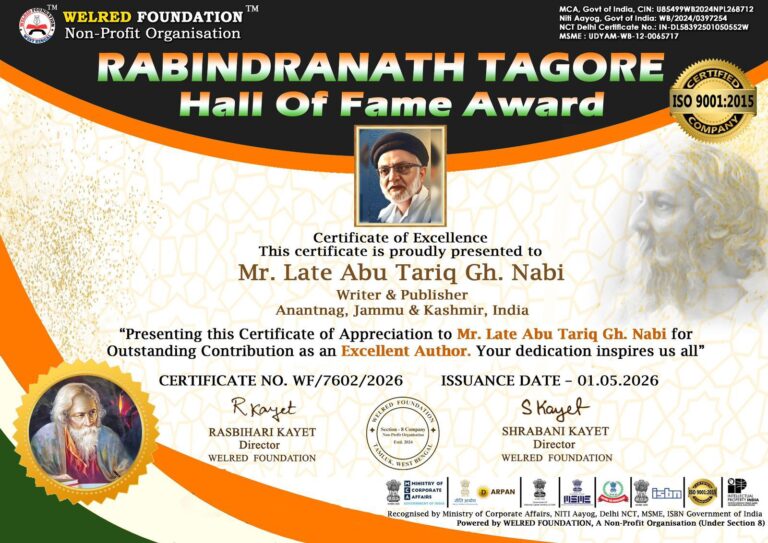
Srinagar, May 2: Renowned Kashmiri scholar and writer Late Abu Tariq Gh. Nabi Mir of Dooru Shahabad, Anantnag, has been posthumously conferred the prestigious Rabindranath Tagore Hall of Fame Award by the Welred Foundation in recognition of his lifelong contributions to literature, spirituality, and social service.

A distinguished author, Islamic scholar, publisher, and Naat Khawan, Mir was widely respected for his scholarly works on Islamic history, spiritual traditions, and Kashmir’s rich cultural heritage. His writings continue to inspire scholars and readers across the region.

He also founded the Institute of Research and Writers Academy in Dooru, Anantnag, and remained actively associated with several religious and intellectual organisations, playing an important role in promoting knowledge and community development.

Late Mir passed away in December 2024 and is remembered as a respected intellectual figure whose literary and spiritual legacy continues to guide future generations.

Mohd Ashraf Hakak, Tahleela Asmat, Dr Nadia Given Warm Farewell at GMC Srinagar

0

Srinagar, May 2: Government Medical College (GMC) Srinagar on Saturday accorded a warm and heartfelt farewell to noted administrator Mohd Ashraf Hakak, Financial Advisor Tahleela Asmat, and Chief Accounts Officer Dr. Nadia following their transfers and new assignments.

The farewell function was attended by Principal GMC Srinagar Dr. Iffat Hassan, senior faculty members, administrative officers, doctors, and staff, who gathered in large numbers to acknowledge the dedicated services and valuable contributions of the outgoing officers. The atmosphere was marked by appreciation and emotion as colleagues shared their experiences of working with them.

Speakers on the occasion described Mohd Ashraf Hakak as an efficient, dynamic, and people-friendly administrator who played a key role in streamlining administrative functioning at the institution. His tenure, they said, was marked by transparency, discipline, and a strong commitment to enhancing patient care and staff welfare.

Financial Advisor Tahleela Asmat and Chief Accounts Officer Dr. Nadia were also lauded for their professionalism, financial expertise, and dedication in ensuring efficient financial management and accountability at GMC Srinagar. Their role in strengthening institutional systems and processes was widely appreciated.

Several speakers highlighted that under their collective leadership, significant administrative and financial reforms were introduced, improving inter-departmental coordination and ensuring smoother functioning of hospital services. Their proactive approach in addressing the concerns of staff and patients earned them immense respect and admiration.

In his farewell address, Mohd Ashraf Hakak expressed heartfelt gratitude to the faculty, doctors, and staff for their unwavering support and cooperation. He termed his tenure at GMC Srinagar as a memorable and enriching phase of his career and expressed confidence that the institution would continue to scale new heights.

Colleagues extended their best wishes to all three officers for their future assignments, expressing hope that they would continue to serve with the same dedication, professionalism, and integrity.

The programme concluded with the presentation of mementos and tokens of appreciation as a mark of recognition for their exemplary service.

Crumbling Walls, Shared Toilets: Rawoocha Girls School in Distress

0

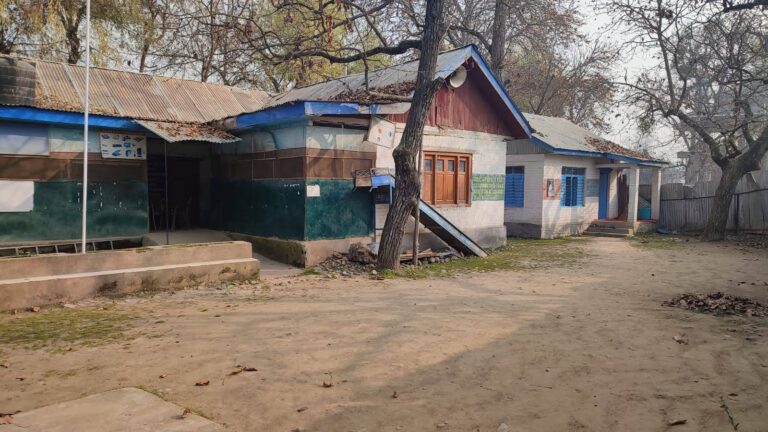
Rafiabad: The Government Girls Middle School Rawoocha in Rafiabad has been facing serious infrastructure challenges, leaving students to study in unsafe and inadequate conditions, sparking concern among residents and parents.

The school building has fallen into a dilapidated state, with damaged structures and a weakened boundary wall posing significant safety risks. Locals said that even the fencing around the campus is in poor condition, making the premises insecure.

A major issue highlighted by residents is the lack of proper sanitation facilities. The school has only a single common washroom for both male and female students, which itself is in a deteriorated condition. Parents expressed concern that the absence of separate washrooms is particularly affecting girl students and creating discomfort.

The situation worsens during the rainy season, as water seeps into classrooms, disrupting academic activities. Locals said that classrooms often get waterlogged, making it difficult for students to continue their studies. They added that the building has already been declared almost unsafe by school authorities.

Due to a shortage of space, the corridor of the school building has been converted into makeshift classrooms to accommodate students. Residents said this arrangement is far from suitable and hampers the overall learning environment.

Speaking with us, locals voiced strong concern over the condition of the school. “It is unfortunate that in the 21st century, schools are functioning in such a dilapidated state. Children deserve better facilities,” a resident said.

Another local resident, while speaking with us, appealed to the government for immediate intervention. “We demand a new school building, proper boundary walls, and separate washrooms for boys and girls so that students can study in a safe and healthy environment,” he added.

Residents have urged the authorities to prioritise the issue and take swift action to improve the infrastructure and ensure a safe learning environment for the students.

Safe Repatriation of 2,922 Indian Seafarers, 30 Rescued in Last 24 Hours

0

Vinod Bhat

New Delhi: In light of the evolving situation in West Asia, the Government of India remains actively engaged in ensuring preparedness and continuity across key sectors through coordinated response measures. The following update outlines the steps being taken with regard to energy supply, maritime operations, and support to Indian nationals in the region:

Energy Supply and Fuel Availability

The Ministry of Petroleum and Natural Gas provided an update on the current fuel supply situation, outlining measures being taken to ensure uninterrupted availability of petroleum products and LPG in the context of the evolving situation in West Asia. It was noted that:

Public Advisory and Citizen Awareness

  • Citizens are advised to avoid panic purchase of petrol, diesel and LPG as the Govt is making all efforts to ensure availability of petrol, diesel and LPG.
  • Beware of rumours and rely on official sources for correct information.
  • LPG consumers are requested to use digital booking platforms and avoid visiting distributors.
  • Citizens are encouraged to use alternate fuels such as PNG and electric or induction cooktops.
  • All citizens are requested to make necessary efforts to conserve energy in their daily use during the current situation.

Government Preparedness and Supply Management Measures

  • Despite the ongoing geopolitical situation, the Government has ensured that 100% supply is being made to Domestic LPG, Domestic PNG and CNG (Transport).
  • For commercial LPG, priority has been given to hospitals, educational institutions. Besides this, priority has also been given to pharma, steel, automobile, seed, agriculture, etc. In addition to this, supply of 5 Kg FTL to migrant labour is also doubled based on avg. daily supply on 2nd and 3rd March 2026.
  • The Government has already implemented several rationalisation measures on both the supply and demand side, including enhancing refinery production, increasing the booking interval from 21 to 25 days in urban areas and up to 45 days in rural areas and prioritising sectors for supply.
  • Alternate fuels such as kerosene and coal have been made available to ease pressure on LPG demand.
  • The Ministry of Coal has directed Coal India and Singareni Collieries to supply additional coal to States for distribution to small and medium consumers.
  • States have been advised to facilitate new PNG connections for domestic and commercial consumers.

Coordinated Efforts with States/UTs and Institutional Mechanisms

  • State Governments are empowered under the Essential Commodities Act, 1955 and LPG Control Order, 2000 to monitor supply and act against hoarding and black marketing.
  • Govt. of States/UTs have to play a primary role in monitoring and regulating supply situation of essential commodities including Petrol, Diesel and LPG. Govt. of India has reiterated the same via multiple letters and VCs to all States/UTs.
  • The Government of India vide letters dated 27.03.2026 and 02.04.2026 have stressed the need for proactive public communication to reassure citizens regarding adequate fuel availability. Regular review meetings are being held with States/UTs. In this context, meetings were convened on 02.04.2026 (Chaired by Secretary, MoPNG) and on 06.04.2026 (Chaired by Secretary, MoPNG along with Secretaries of I&B and Consumer Affairs), wherein the following was emphasized:
    • To issue daily press briefings and issue regular public advisories.
    • To actively monitor and counter fake news / misinformation on social media.
    • To intensify daily enforcement drives by District admin and to continue raids and inspections in coordination with OMCs
    • To issue Commercial LPG allocation orders within their States/UTs
    • To issue SKO allocation orders for additional SKO allotted to the States/UTs.
    • To promote PNG adoptions and alternate fuels.
    • To prioritize LPG supply, especially for domestic needs, and adopt targeted distribution of 5 kg FTL cylinders to ensure supply stability.
  • All States/UTs have established control rooms and district monitoring committees to curb hoarding and black marketing.
  • Many states/UTs are issuing/carrying out press briefs.

Enforcement and Monitoring Actions

  • Enforcement actions continue across the country to curb hoarding and black marketing of LPG. Yesterday, more than 1700 raids were conducted across the country.
  • PSU OMCs have strengthened and continued surprise inspections and imposed penalties on 342 LPG distributorships, and 73 LPG distributorships have been suspended till yesterday.

LPG Supply

Domestic LPG Supply Status:

  • LPG supply continues to be affected by the prevailing geopolitical situation.
  • Supply of LPG to domestic households has been prioritized.
  • No dry-outs have been reported at LPG distributorships.
  • Online LPG cylinder bookings increased to 99% on industry basis yesterday.
  • Delivery Authentication Code (DAC) based deliveries have increased to around 94% to prevent diversion. DAC is received on the registered mobile number of the consumer.

Commercial LPG Supply and Allocation Measures:

  • Total commercial LPG allocation has been increased to about 70% of pre-crisis levels, including 10% reform-linked allocation.
  • The Government of India vide letter dated 06.04.2026 has conveyed that daily quantity of 5 Kg FTL cylinders in each State available for disbursal to migrant labourers is being doubled based on the average daily supply (Number of cylinders) to migrant labourers during 2nd-3rd March 2026 beyond the limit of 20% mentioned in letter dated 21.03.2026. These 5 Kg FTL cylinders are at disposal of the State Government for supplying only to migrant labourers in their State with assistance of Oil Marketing Companies (OMCs).
  • Since the month of April 2026, more than 22.78 Lakh – 5 Kg FTL cylinders have been sold.
  • Since 3rd April 2026, PSU OMCs have organised more than 9980 awareness camps for 5 Kg FTL Cylinders, wherein more than 1,71,000 – 5Kg FTL cylinders were also sold.
  • A three-member committee of Executive Directors of IOCL, HPCL and BPCL, in consultation with State authorities and industry bodies finalises the plan for the sale of Commercial LPG in the States/UTs.
  • Since April 2026, a total of 2,05,849 MT (Equivalent to more than 108.34 Lakh of 19 Kg LPG Cylinders) of Commercial LPG has been sold.
  • Since April 2026, a total of 10698 MT of Auto LPG has been sold by PSU OMCs.

Natural Gas Supply and PNG Expansion Initiatives

  • Consumers have been prioritised with 100% supplies to D-PNG and CNG-Transport.
  • The overall gas allocation to fertilizer plants has been enhanced to approximately 98% of their six-month average consumption.
  • Additionally, gas supply to other industrial and commercial sectors, including supplies through CGD networks, is enhanced up to 80%.
  • CGD entities have been advised to prioritize PNG connections for commercial establishments such as hotels, restaurants and canteens across all their GAs, to address concerns regarding the availability of commercial LPG.
  • CGD companies including IGL, MGL, GAIL Gas and BPCL are offering incentives for domestic and commercial PNG connections.
  • States/UTs and Central Ministries have been requested to expedite approvals required for expansion of CGD networks.
  • The Government of India vide letter dated 18.03.2026 has offered all States/UTs additional 10% allocation of commercial LPG to States provided they can help in long term transition from LPG to PNG.
  • 22 States/UTs are receiving additional commercial LPG allocation linked to PNG expansion reforms.
  • The Ministry of Road Transport & Highways vide letter dated 24.03.26 has adopted an ‘Accelerated Approval Framework for CGD infrastructure with reduced timelines’ as a special for 3 months to process applications pertaining to CGD infrastructure on priority.
  • The Government of India vide Gazette dated 24.03.2026 has notified the Natural Gas and Petroleum Products Distribution (Through Laying, Building, Operation and Expansion of Pipelines and Other Facilities) Order, 2026 under the Essential Commodities Act, 1955. The Order provides a streamlined and time-bound framework for laying and expanding pipelines across the country, addressing delays in approvals and access to land, and enabling faster development of natural gas infrastructure, including in residential areas. It is expected to accelerate PNG network growth, enhance last-mile connectivity, and support the transition to cleaner fuels, thereby strengthening energy security and advancing India’s gas-based economy.
  • PNGRB has directed CGD entities to expedite D-PNG connections. Also, the National PNG Drive 2.0 has been extended till 30.06.2026 to sustain momentum in PNG expansion.
  • To encourage a cleaner, more secure and self-reliant energy future, the Government of India has developed a model draft State CBG Policy. The model policy is intended to serve as a comprehensive flexible guiding framework to enable States to create their own investor-friendly and implementation-oriented ecosystem for CBG development. Those States which opt for this, will be prioritized for the next tranche of additional allocation of commercial LPG.
  • MoEFCC vide order dated 07.04.2026 has directed CPCB to issue necessary directions to SPCB/PCCs for granting consent to establish or consent to operate within 15 days for CGD network/infrastructure.
  • Since March 2026, about 5.96 Lakh PNG connections have been gasified and infrastructure has been created for additional 2.68 Lakh connections, taking the total to 8.64 lakh connections. Further, about 6.66 Lakh customers have been registered for new connections.
  • Till 01.05.2026, more than 43,350 PNG consumers have surrendered their LPG connections via MYPNGD.in website.

Crude Position and Refinery Operations

  • All refineries are operating at high capacity with adequate crude inventories, while sufficient stocks of petrol and diesel are being maintained.
  • Domestic LPG production from refineries has been increased to support domestic consumption.
  • An inter-ministerial Joint Working Group (JWG) has been set up to ensure availability of petrochemical feedstock supply for the domestic market. Subsequently, Govt. of India vide order dated 01.04.2026 has permitted Oil Refinery companies including Petrochemical Complexes to make certain minimum quantities of C3 & C4 streams available for critical sectors as determined by Centre for High Technology (CHT).
  • Based on the requests received from the Department of Pharmaceuticals, Department of Chemicals & Petro Chemicals (DCPC), Dept. for Promotion of Industry and internal trade (DPIIT), the provision for 1000 MT/day, from LPG pool, has been made for Pharma and Chemical sector companies.
  • Since 9th April 2026, more than 10,000 MT of propylene and more than 1200 MT of Butyl Acrylate has been sold by Mumbai, Kochi, Vizag, Chennai, Mathura and Gujarat refineries to Chemical, Pharma and Paint Industry.

Retail Fuel Availability and pricing Measures

  • All Retail outlets are operating normally across the country.
  • The Middle East crisis has led to an abnormal increase in crude prices; however, to protect consumers, the Government of India has reduced excise duty on petrol and diesel by ₹10 per litre.
  • Govt. of India vide Gazette notification dated 30.04.2026 has reduced the export levy on diesel from Rs. 55.50 per litre to Rs. 23 per litre and on ATF from Rs. 42 per litre to Rs. 33 per litre.
  • Panic Buying is observed at certain Retail Outlets due to rumours. It is informed that there are adequate stocks of petrol and diesel available at all Petrol Pumps in the country. Regular Retail Prices for Petrol and Diesel are unchanged and there is no price increase at PSU OMCs Retail Outlets.

Kerosene Availability and Distribution Measures

  • An additional allocation of 48,000 KL of kerosene has been provided to States/UTs over and above regular allocation.
  • 18 States/UTs have issued SKO allocation orders, while Himachal Pradesh and Ladakh have indicated no requirement.

Maritime Safety and Shipping Operations

The Ministry of Ports, Shipping and Waterways provided an update on the prevailing maritime situation in the Persian Gulf, detailing the measures being undertaken to ensure the safety and security of Indian vessels and crew in the region. It was stated that:

  • The Ministry of Ports, Shipping and Waterways continues to coordinate with the Ministry of External Affairs, Indian Missions, and maritime stakeholders to ensure seafarer welfare and uninterrupted maritime operations.
  • All Indian seafarers in the region are safe, and no incident involving Indian-flagged vessels has been reported in the past 24 hours.
  • DG Shipping Control Room has handled 8,335 calls and more than 17,838 emails since activation. In the past 24 hours, 67 calls and 144 emails have been received.
  • The Ministry, through the Directorate General of Shipping (DG Shipping), has facilitated the safe repatriation of more than 2,922 Indian seafarers so far, including 30 in the last 24 hours from various locations across the Gulf region.
  • Port operations across India remain normal, with no congestion reported.

Safety of Indian Nationals in the Region

The Ministry of External Affairs continues to monitor developments in the Gulf and West Asia region, with focused efforts on ensuring safety, security and welfare of the Indian community in the region. It was informed that:

  • The Ministry of External Affairs is in regular contact with State Governments and Union Territories for sharing of information and better alignment of efforts.
  • Indian embassies and consulates continue to operate round-the-clock helplines to provide timely assistance and are proactively assisting our citizens. They are also in close contact with the local Governments.
  • Updated advisories are being issued including information related to local government guidelines, flight and travel situations, consular services and various welfare measures being undertaken for the community.
  • Indian Missions are actively engaged with the resident Indian community. They are regularly interacting with the Indian community associations, organizations, professional groups, and Indian companies to address their concerns.
  • Government is according high priority to the welfare of Indian seafarers in the region. Indian Missions are extending all assistance to them including coordination with the local authorities and agencies, extending consular assistance, and assisting for requests to return to India.
  • The overall flight situation continues to improve with additional flights operating from the region to various destinations in India.
  • In the UAE, airlines continue to operate limited commercial flights between the UAE and India based on operational and safety considerations.
  • Flights continue to operate from various airports in Saudi Arabia and Oman to various destinations in India.
  • With Qatar airspace partially open, Qatar Airways is operating flights to various destinations in India. Air India, Air India Express and Indigo have started flight operations from Qatar to India.
  • Kuwait airspace is open. Jazeera Airways and Kuwait Airways have resumed limited flight operations from Kuwait to India.
  • Bahrain airspace is open. Air India Express and Gulf Air are operating flights from Bahrain to various destinations in India. Indigo is also planning to resume flight operations from Bahrain to India from today.
  • Iraq airspace is open with limited flight operations to destinations in the region, which can be used for onward travel to India.
  • Iran airspace is partially open for cargo and chartered flights. Indian nationals are advised to avoid travelling to Iran and those already there are urged to leave via land border routes, with Indian Embassy’s support. So far, the Indian Embassy in Tehran has facilitated movement of 2,490 Indian nationals out of Iran through land border routes.

Renowned Lyricist and Communication Expert Shri Prasoon Joshi Appointed Chairman, Prasar Bharati

0

Vinod Bhat

New Delhi: The Ministry of Information & Broadcasting has appointed noted lyricist, writer and communications expert Shri Prasoon Joshi as the Chairman of Prasar Bharati, India’s public service broadcaster.

Shri Joshi is a distinguished creative professional with wide-ranging contributions across literature, advertising, cinema, and public communication. Known for his impactful writing and deep cultural sensibility, he has played a significant role in shaping contemporary Indian media narratives. His body of work spans acclaimed film lyrics, advertising campaigns, and socially resonant storytelling that connects with diverse audiences across the country.

On his appointment, Union Minister of Information & Broadcasting Shri Ashwini Vaishnaw said, “My heartfelt congratulations to Shri Prasoon Joshi ji on his appointment as Chairman of the Prasar Bharati Board. Prasoon ji is a rare creative spirit celebrated across the world in advertising, literature, art and cinema, yet his heart beats unmistakably for India. His words carry the fragrance of our soil, and his vision reflects the timeless essence of our culture. Under his stewardship, Prasar Bharati will discover renewed energy, deeper purpose, and a fresh creative voice. My very best wishes to him for a memorable and meaningful tenure ahead.”

Before this appointment, Shri Joshi has served as Chairperson, Central Board of Film Certification (CBFC), Mumbai since August 2017 where he contributed to strengthening film certification processes while engaging with stakeholders across the film industry. His tenure at CBFC reflected a balanced approach towards creative expression and regulatory responsibility. Earlier, he had also served as CEO, McCann World Group India and Chairman, McCann World Group Asia Pacific (a subsidiary of McCann Erickson). He is also one of the Trustees of Indira Gandhi National Centre for Arts since 2016.

With his extensive experience in creative industries and public communication, Shri Joshi is expected to bring a unique perspective to the leadership of Prasar Bharati at a time when public broadcasting is navigating rapid technological transformation and evolving audience expectations.

About Prasar Bharati

Established under the Prasar Bharati (Broadcasting Corporation of India) Act, 1990, and operational since 1997, Prasar Bharati is India’s statutory autonomous public service broadcaster. It comprises two major divisions:

  • All India Radio (AIR) – one of the largest radio networks in the world, reaching millions across urban and rural India in multiple languages and dialects.
  • Doordarshan (DD) – India’s national television broadcaster, offering a wide range of programming including news, education, entertainment, and cultural content.

Prasar Bharati has also launched Waves OTT platform for strengthening free-to-air OTT services in the spirit of public broad casting.

Prasar Bharati plays a vital role in disseminating information, promoting national integration, preserving cultural heritage, and ensuring access to credible public broadcasting services across the country. With a vast terrestrial and digital footprint, it continues to expand its reach through digital platforms, DTH services, and archival initiatives.

POCSO Charge Needs Victim’s Allegation; Medical Report Alone Not Enough: Baramulla Court

0

Srinagar, May 2: In a recent order dealing with the threshold for framing charges under the Protection of Children from Sexual Offences (POCSO) Act, the Court of Principal Sessions Judge, Baramulla, has held that a charge of penetrative sexual assault cannot be sustained solely on the basis of a medical report when the alleged victim has not leveled any allegation of sexual assault in her judicial statement.

The court, presided over by Jawad Ahmad, passed the order while hearing a case arising out of FIR No. 245/2025 registered at Police Station Pattan against Mohammad Shahzad Shah (alias Sajad Shah). The accused had been booked under Section 137(2) of the Bharatiya Nyaya Sanhita (BNS) and Sections 3/4 of the POCSO Act.


According to the prosecution case recorded in the order, a written complaint was filed on December 30, 2025, by the brother of the girl, alleging that the accused kidnapped his minor sister from Kharwanipora, Tangmarg, on the evening of December 29, 2025. Acting on the complaint, Police Station Pattan registered the FIR and commenced investigation.


During the course of the investigation, the police recovered the girl on January 7, 2026, from the possession of the accused at an IT Park in Chandigarh. She was subsequently brought back to Pattan and taken to PHC CNC Pattan for a medical examination on January 8, 2026. The accused was arrested on January 7, 2026, and remained in custody thereafter.


The prosecution submitted before the court that the date of birth certificate obtained from Government Girls Middle School Tantraypora, Tangmarg, showed the girl was a minor of 15 years at the time of the alleged offence. It further argued that the examining doctor noted the victim’s hymen was not intact and that, as per the history given by the victim, sexual intercourse had taken place. On this basis, the prosecution prayed for framing of charges under both Section 137(2) BNS and Section 4 read with Section 3 of the POCSO Act.

The defence counsel, Adv Suhaib opposed the plea, arguing that while the victim was a minor as per her date of birth certificate, there was no material placed with the charge sheet to prima facie disclose the commission of the offences.

The defence submitted that the most critical piece of evidence was the statement of the victim recorded under Section 183 of the Bharatiya Nagarik Suraksha Sanhita (BNSS). In that statement, the victim stated that she had gone with the accused of her own free will and did not say anything that attracted the provisions of the POCSO Act. The defence prayed for the discharge of the accused.

After hearing both sides, the court closely examined the statement of the victim recorded under Section 183 BNSS and other material on record.

“I had gone along-with Shahzad resident of UP of my own free will and he did not compel me to accompany him… I remained at Chandigarh along-with Shahzad for nine days. My family knew that I was in contact with Shahzad since they seized my mobile phone, my family beat me as such. I was compelled to fled away from my home,” quoting from her (victim) statement, the court noted.

The court observed that because the victim was a 15-year-old minor, her consent to flee with the accused held no legal sanctity. Therefore, taking the girl to Chandigarh without the consent of her guardian prima facie attracted Section 137(2) of the BNS.

However, the judge held that the statement of the victim did not attract any of the provisions of the POCSO Act, particularly Section 3. The court ruled that a doctor’s report is only corroborative in nature and would have relevance only if the victim had testified that she was subjected to penetrative sexual assault by the accused.

In the absence of a foundational allegation in her statement, the court held that no prima facie case under Section 4 read with Section 3 of the POCSO Act was made out.

“For the aforesaid reasons, I am of the considered opinion that prima-facie offence punishable under Section 4 r/w 3 of the POCSO Act is not made out nor any ground exists to proceed against the accused,” the court observed while discharging the accused of the POCSO offences.

At the same time, the court found that a prima facie case under Section 137(2) of the BNS was made out and formally framed charges under that provision. The accused pleaded not guilty to the charges.

Since the surviving offence under Section 137(2) BNS is bailable, the court accepted the accused’s bail application. He was directed to be released on bail subject to furnishing a bail bond with one surety to the tune of Rs 50,000.

Finally, as the remaining offence is triable by a Judicial Magistrate, the Sessions Court transferred the case file to the Court of Judicial Magistrate (Sub-Judge), Pattan, for disposal under law. The accused and his counsel were directed to appear before the transferee court on May 12, 2026.