Himalayan disasters intensify, exposing J&K’s growing climate risk
TAUSEEF AHMAD
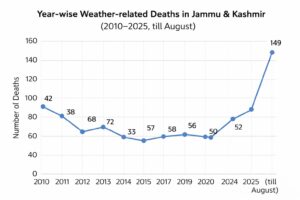
SRINAGAR, Dec 30: The year 2025 has officially emerged as the deadliest year in Jammu and Kashmir in terms of loss of human lives due to extreme weather events, with at least 149 people killed till the end of August, according to official data compiled by the Meteorological Department (MeT), Kashmir. The figures highlight an alarming escalation in the human cost of climate-induced disasters across the Union Territory.
Data accessed by Kashmir Despatch reveals that a total of 856 people have lost their lives due to extreme weather incidents in Jammu and Kashmir between 2010 and August 2025, underscoring a disturbing trend of rising fatalities linked to increasingly intense and unpredictable weather patterns in the region.
Officials and experts attribute the sharp spike in deaths in 2025 to a surge in high-intensity weather phenomena, particularly cloudbursts, flash floods, avalanches, landslides and episodes of heavy rainfall, which have struck with greater frequency and ferocity in recent years.
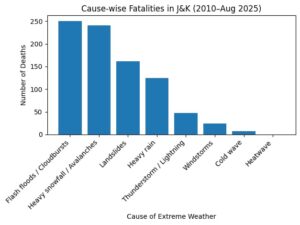
A cause-wise analysis of fatalities during the 15-year period shows that flash floods and cloudbursts have been the single deadliest hazards, accounting for 250 deaths, the highest among all categories. These were closely followed by heavy snowfall and avalanche-related incidents, which claimed 241 lives, reflecting the vulnerability of mountainous and high-altitude regions, especially during winter months.
Landslides—often triggered by intense rainfall and unstable terrain—resulted in 162 fatalities, while heavy rain-related incidents, including flooding and structural collapses, caused 125 deaths. Thunderstorms and lightning strikes claimed 47 lives, windstorms led to 24 fatalities, and cold wave conditions were responsible for seven deaths. Notably, the data shows no officially recorded deaths due to heatwaves during the period under review, unlike several other parts of the country.
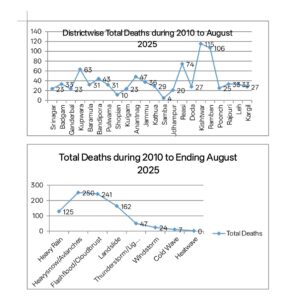
The district-wise breakdown further exposes stark regional disparities. Kishtwar district tops the list with 115 fatalities since 2010, followed closely by Ramban, which recorded 106 deaths—both districts known for their rugged terrain, frequent landslides and susceptibility to cloudbursts. Reasi reported 74 deaths, while Kupwara accounted for 63 fatalities, indicating that both Jammu and Kashmir divisions have been significantly affected.
Other districts that witnessed notable loss of life include Anantnag (47 deaths), Bandipora (43), Baramulla (31), Pulwama (31) and Jammu district (36). At the lower end of the spectrum, Samba district reported the least impact, with only four deaths recorded over the 15-year period.
The MeT data also reveals that 3,473 extreme weather events were recorded across Jammu and Kashmir between 2010 and August 2025. While the overall annual frequency of such events has remained consistently high, meteorologists point out that their increasing intensity and sudden onset have resulted in greater destruction and higher mortality.
In 2025 alone, the region witnessed 224 extreme weather events till August, a figure that has already translated into the highest death toll recorded in any single year during the period studied. Experts warn that the situation could worsen in the coming years if current trends continue.
Meteorological and climate experts caution that climate change is amplifying weather extremes in the Himalayan region, making Jammu and Kashmir increasingly prone to sudden, severe and localized disasters such as cloudbursts and flash floods. Rising temperatures, erratic precipitation patterns and rapid glacial melt are believed to be key contributing factors.
Experts have stressed the urgent need for robust early warning systems, climate-resilient infrastructure, scientific land-use planning, and community-level disaster preparedness to minimize loss of life in the future. They warn that without timely interventions and policy action, extreme weather events will continue to pose a recurring and deadly threat to lives and livelihoods across Jammu and Kashmir.