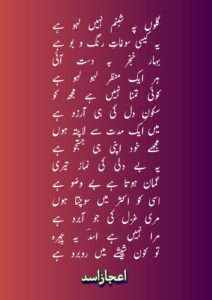
By Zulfiqar Naqvi

Mohammad Aijaz Asad, IAS (born 1986) hails from Mendhar in District Poonch, a borderland region of Jammu and Kashmir whose cultural soil has long been fertile with literary imagination and intellectual courage. This is the land that produced towering figures such as Krishan Chander and Charagh Hasan Hasrat, writers who combined social consciousness with artistic excellence and gave Urdu literature voices of empathy, resistance and moral interrogation. Emerging from this legacy, Aijaz Asad represents a continuation of that tradition bringing to it a distinctly contemporary sensibility.
Known as the youngest IAS officer from the region, Aijaz Asad embodies a rare synthesis of public responsibility and creative inwardness. His engagement with governance and administration does not distance him from the subtleties of human emotion, rather it sharpens his awareness of social contradictions, moral fragility and the everyday struggles of individuals navigating a fractured world. This lived closeness to power, policy and people lends his poetry an experiential authenticity that distinguishes it from purely academic or romantic verse.
Asad’s entry into Urdu poetry is marked by a conscious stylistic choice by rejecting the archaic diction, ornamental verbosity and self-indulgent abstraction. Instead, he opts for clarity, simplicity and directness, crafting verses that are immediately accessible yet layered with ethical and philosophical depth. His language is deliberately unpretentious but his vision remains elevated, concerned with dignity (waqar), humility (inkisari), moral courage and the metaphysical dimensions of love and suffering. This balance between simplicity of expression and seriousness of thought places him firmly among modern Urdu poets who believe that profundity need not be linguistically obscure.
His maiden collection, “Barf Zaar” (2018), stands as an evidence to this poetic philosophy. The title itself is clearly suggestive of cold terrains, stillness and endurance that symbolically mirrors the emotional and ethical landscapes explored within. The ghazals in “Barf Zaar” explore multiple thematic registers. This poetry spans romantic love that matures into metaphysical inquiry, sharp satire on social hypocrisy and moral duplicity, reflections on loneliness and alienation in modern life and an unwavering insistence on ethical integrity in times of darkness and deception.
What distinguishes Aijaz Asad most compellingly is his transformation of poetry into moral witness. His verses do not merely observe reality rather they interrogate it. He questions hollow religiosity divorced from ethics, criticises media falsehood and public pretence and repeatedly returns to the idea that true elevation lies not in dominance or sanctity but in humility, compassion and moral resolve. Even when he invokes classical symbols or historical-religious allusions, they are reactivated to speak to contemporary crises rather than serve as ornamental nostalgia.
Aijaz Asad’s poetry, hence occupies an important space in contemporary Urdu literature as it endeavors bridging tradition and modernity, administration and aesthetics, simplicity of language and height of vision. His work reminds us that poetry, even in an age of noise and speed can still function as a quiet but firm ethical compass.
The critical study of the following selected verses from “Barf Zaar” seek to explore the multiple dimensions of his poetic voice in order to situate Aijaz Asad as a poet whose simplicity is not a limitation but a deliberate and powerful artistic choice. At the core of Asad’s poetic vision lies a deep concern with dignity rather than mere display of power or hierarchy.
“Sawal, dosto azmat ka hai, saroo’n ka nahi,
Hamein waqar ka parcham sambhalna ho ga.”
(Friends, the question is of greatness and dignity—not of heads themselves, we must uphold the banner of dignity, whatever it costs.) The poet draws a stark ethical distinction between survival and moral greatness (azmat). By asserting that the question is not about heads, whether they remain upon the body or are sacrificed, he elevates dignity above life itself. The verse thus enters a tradition of moral absolutism, where certain values are non-negotiable even in the face of annihilation. The phrase “waqar ka parcham” (the banner of dignity) becomes a symbol of ethical continuity. A banner, once raised must be held aloft regardless of personal loss. In this sense, dignity is not an abstract virtue but a collective trust handed down through struggle and sacrifice. This interpretation places the couplet in dialogue with martyrdom literature, resistance poetry and ethical humanism. Without invoking explicit historical or religious references, the verse resonates with traditions where honour, conscience and moral integrity outweigh bodily existence.
“Ghazab ki payas lagi, samna saraab ka hai,
S’o reg-e-sehra se pani nikalna ho ga.”
(A terrible thirst grips us, and what lies ahead is a mirage, so we must draw water even from the desert sand.) This couplet portrays an extreme state of need where genuine solutions are absent. The mirage symbolizes false hopes, deceptive promises and hollow assurances. Thirst represents an urgent moral, emotional, or existential hunger. The desert stands for harsh realities that offer no easy relief. Extracting water from sand suggests extraordinary effort and inner resilience. The poet affirms that survival with dignity demands self-reliance when illusions fail.
“Lazmi tau nahi wali ho jaye,
Aadami, kaash aadami ho jaye.”
(It is not necessary that one becomes a saint, if only a human being could truly become human!) This couplet draws a clear line between sainthood and basic humanity. The poet questions society’s obsession with spiritual status and outward piety. Becoming a saint (wali) is rare and extraordinary. But being genuinely human should be natural and common. The verse criticizes moral decay hidden behind religious labels. It stresses compassion, honesty and empathy as essential human qualities. True worth lies in ethical conduct, not in lofty titles. Here the poet does not demand angelic traits, he just want the society to restore the human values. It is an indirect satire on the deteriorated social setup and the poet has precisely conveyed his message through these two lines. His satirical approach further highlights the dual standard of the society in the next couplet where one feels alienated even he is in a crowd of people.
“Koi apna nahi laga mujh ko,
Aashna sab hain, sab se yaari hai.”
(Everyone is familiar and I do share friendship with all but none seems to be true to me.) Here the poet expresses modern emotional alienation and makes a clear distinction between familiarity and belonging. Though surrounded by people, he feels inwardly alone. Friendship here lacks depth and emotional commitment. Social connections are shown as widespread but superficial. The poet excellently criticizes a society rich in contacts but poor in intimacy which reflects the paradox of loneliness amid crowds. The tone is quiet, resigned and deeply human.
“Duniya mein kisey aag lagani nahi aati,
Afsos magar sab ko bujhani nahi aati.”
(Who in this world does not know how to set fire? Sadly, not everyone knows how to put it out.) Here fire symbolizes conflict, hatred and chaos and the poet successfully criticizes humanity’s ease in creating destruction. In the prevalent society creating trouble is common but resolving it is rare. The verse points to moral irresponsibility in society where people provoke crises but avoid accountability. It is a satire on political, social and personal behavior. The tone is ironic but morally charged and the poet calls for responsibility, not aggression.
“Faqeer-e-ishq hun kuchh de ke talna ho ga,
Bas ik nigah ka sikka uchhalna ho ga.”
(I am a beggar of love—you must give me something to turn me away, just toss me the coin of a single glance.) Love is portrayed as sacred poverty, not possession. Here the poet humbles himself before love.
A mere glance is enough to sustain him which elevates love beyond material exchange. The verse suggests spiritual fulfillment through minimal grace. It echoes Sufi ideas of love as devotion. The imagery of begging intensifies emotional sincerity and love here is dignity through surrender, not dependence.
“Sar bulandi ata kre gi tumhein,
Ye jo fitrat mein inkisari hai.”
(It is humility in your nature, that will grant you true elevation.) The couplet overturns conventional ideas of pride and success. True greatness, the poet suggests, comes from humility. Arrogance leads to downfall, humility to honor. Through these two lines the poet portrays ethical and spiritual wisdom. This portrayal resonates with both humanist and religious traditions. The tone though a little didactic but gentle as the moral elevation is inward, not social. The couplet affirms dignity through modesty.
“Uss ka jannat se wasta hi nahi,
Husn-e-akhlaq se wo aari hai.”
(He has no connection with paradise at all, who is devoid of moral beauty.) Paradise is redefined as an ethical condition and mere belief or ritual does not guarantee salvation. Good character is presented as the true criterion for going to paradise or getting the blessings of Allah on the Day of Judgment. The verse criticizes hollow religiosity. Ethics are placed above outward faith. It is the behavior that makes us nearer to Allah. Moral conduct becomes the gateway to paradise. The tone is firm yet reflective and the couplet reinforces moral accountability.
“Andheri raat ki zulmat se takrana meri fitrat,
Charagh-e-azm ko mein raah ki mash’al banata hun.”
(To clash with the darkness of the night is my nature; I turn the lamp of resolve into a torch for the path.) This couplet presents a powerful image of inner resistance and moral resolve. The “dark night” symbolizes despair, injustice, fear and adverse circumstances that obscure truth and hope. By saying that confronting this darkness is his nature (fitrat), the poet defines resistance not as a forced act but as an inherent moral instinct. He does not wait for light to arrive but instead he lits the “lamp of resolve” that represents inner firm determination, faith and steadfast will. By turning this small personal lamp into a “torch for the path,” the poet suggests that individual courage can illuminate the way for others. Personal struggle thus acquires collective meaning. The couplet asserts that hope is not passive or inherited. It is created through action and conviction. Here, the poet presents himself as one who transforms inner strength into guiding light, confronting darkness not only for his own survival but to lead others through it as well.
“Dushmani ho gayi hai duniya se,
Teri khwahish jo kar raha hun mein.”
(The world is no dearer to me, because I long to have You only.) In this beautiful couplet, the poet declares a conscious and deliberate withdrawal from worldly attachments, yet this withdrawal is not entirely free of pain. By stating “dushmani ho gayi hai duniya se,” he acknowledges an inevitable rupture that arises when one refuses to conform to a world increasingly governed by compromise, hypocrisy and moral erosion. Although the estrangement appears self-chosen, it is also subtly conditioned by a sense of victimization at the hands of a degraded social order that no longer accommodates sincerity, empathy or ethical living. The phrase “teri khwahish” in the second line makes the poet’s response to this condition explicit. Aligning himself with the desire of the Beloved which might be understood as God, Truth, or a higher moral consciousness, he seeks refuge in a metaphysical and mystical orientation. This alignment is both an act of resistance and a form of spiritual shelter, offering protection from a society that has grown inhospitable to moral integrity. Thus, the poet’s withdrawal embodies voluntary renunciation (tark-e-duniya), a classical mystical stance wherein spiritual fidelity necessitates detachment from corrupt material and social norms. Estrangement here is not merely rejection but a protective withdrawal, a way of preserving inner coherence amid external decay. The poet suggests that when the world ceases to be ethically habitable, mysticism becomes not escape but survival; a path toward inner alignment, sincerity and higher truth.
“Agar ishq ruhoo’n ka bandhan hai payare,
Tau iss mein badan ki zarurat kahan hai.”
(If love is a bond between souls, my dear; then where is the need for the body in it?) This couplet again presents a purely metaphysical understanding of love. The poet argues that if love (ishq) is truly a bond between souls then the body has no essential role in it. Physical presence, desire and attraction are shown as secondary or even irrelevant when compared to spiritual union. By raising this question, the poet challenges modern notions of love that are largely centered on the body and sensory gratification.
The verse aligns closely with Sufi and mystical traditions where love is seen as a force that transcends flesh and reaches the realm of the spirit. Here “ishq” becomes a means of inner awakening rather than possession. The couplet thus elevates love from a physical experience to a spiritual reality emphasizing purity, depth and permanence over transient bodily attraction.
“Sabhi akhbar jhootey hain, ye sab jhootey risaaley hain,
Aji, chehru’n ko padh leeje, yahi sache hawale hain.”
(All newspapers lie, all magazines deceive; Read faces instead—these are the true references.) This couplet offers a sharp critique of mediated truth in the modern world. The poet declares newspapers and magazines to be “false,” not necessarily because every word they print is untrue but because they often distort reality through as they lack sincerity. In contrast, the poet urges us to “read faces.” Human faces carry lived experience—pain, fear, hope, exhaustion and truth that cannot easily be fabricated. Expressions, silences and eyes become more reliable references than printed words. Thus, the couplet privileges experiential and human truth over institutional narratives. It calls for moral perception and empathy reminding us that reality is found in people, not in pages.
“Nikal raha hai mere paon se lahoo tau kya?
Mujhe khabar hai ke kaantu’n pe chal raha hun mein.”
(What, though if my feet bleed; I know I am walking on thorns.) This couplet reflects conscious endurance and moral awareness of suffering. The poet acknowledges the blood flowing from his feet which is a vivid image of pain and injury but immediately dismisses self-pity with the phrase “tau kya” (so what). This indicates acceptance rather than complaint. He knows why he is bleeding—because he is walking on thorns. The thorns symbolize a difficult path marked by truth, agitation, integrity or moral struggle. What gives the couplet depth is awareness. The poet is not a victim of ignorance; he has chosen this path knowingly. Pain, therefore, becomes meaningful rather than accidental. The verse suggests that suffering is an inevitable consequence of walking a righteous or honest path, and true strength lies in continuing forward with clarity and resolve.
“Jab kat gaye baazu, ussy daantu se sambhala,
Par ham ne alam mehr-o-wafa ka nahi Chhodha.”
(When his arms were severed, he held it with his teeth, yet he did not let go of the banner of love and loyalty.) This couplet is a powerful example of “talmīḥ”—a literary allusion, referring to the supreme sacrifice of Hazrat Abbas (a.s.) at Karbala. The severed arms symbolize the loss of physical strength and worldly means. Yet, even after this unbearable injury, he holds the banner (Alam) with his teeth. The banner represents loyalty (wafā), love, faith and commitment to truth. By shifting from arms to teeth, the poet emphasizes that moral resolve survives even when the body fails. The second line carries the ethical climax that the banner of love and loyalty is never abandoned. Physical defeat does not translate into moral defeat. The couplet thus celebrates unwavering faith, absolute loyalty and the idea that principles must be upheld regardless of suffering or sacrifice. It transforms historical martyrdom into a timeless moral ideal—steadfastness in the face of annihilation.
To sum up it can be asserted that Aijaz Asad’s poetry in “Barf Zaar” emerges as a coherent moral, ethical and metaphysical vision articulated through remarkably simple yet resonant language. His verses consistently privilege dignity over power, conscience over convenience and inner truth over external validation. Whether he speaks of alienation amid crowds, the hypocrisy of society, the pain of chosen suffering or the spiritual essence of love, Asad remains anchored in a humanist ethos that seeks restoration rather than escape. His poetry does not indulge in ornamental excess or rhetorical flamboyance and instead it derives its strength from clarity, restraint and moral seriousness. What ultimately distinguishes Aijaz Asad is his ability to transform personal resolve into collective ethical guidance. His metaphors of darkness and light, thirst and mirage, thorns and bleeding feet are not merely aesthetic devices but moral signposts pointing toward endurance, responsibility and integrity. Even his use of classical allusion, particularly the reference to Hazrat Abbas (a.s.), is not nostalgic but instructive—reasserting timeless values of loyalty, sacrifice and steadfastness in a contemporary context. Thus, Aijaz Asad stands as a poet whose simplicity is neither naïveté nor limitation but a deliberate artistic and ethical choice. His poetry reaffirms that in an age of noise, spectacle and moral ambiguity, verse can still function as a quiet yet unwavering compass—guiding individuals and societies toward dignity, humility and higher vision.