KD NEWS SERVICE
KREERI-BARAMULLA, April 13: Beneath the soft spring sky of Kreeri, where memory often lingers in whispers of verse and fragments of forgotten prose, a rare and stirring literary awakening took shape within the serene environs of Degree College Kreeri. What unfolded was not merely a formal gathering, but an evocative return to Kashmir’s timeless companionship with literature—a celebration where words were not spoken alone, but felt, remembered, and revived.
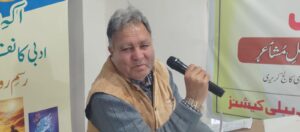
Orchestrated by the Kruhan Cultural Forum under the stewardship of its president Syed Shameem Ahmad Shameem, the event brought together an assembly of poets, writers, scholars, and lovers of literature, all bound by a shared reverence for the written word. In a Valley where literary traditions once flourished in every gathering and courtyard, the occasion felt like the rekindling of a long-dormant flame—fragile, yet luminous with possibility.
Presiding over the congregation was the eminent writer Dr. Ghulam Nabi Haleem, whose address rose beyond speech into reflection. He spoke of literature as the conscience of society, as a quiet yet enduring force that preserves identity even in times of upheaval. His words carried both concern and conviction—that the erosion of literary culture is not merely a loss of language, but a fading of collective consciousness itself. In his voice was an appeal—not loud, yet deeply urgent—for the revival of a culture that once defined the intellectual rhythm of Kashmir.
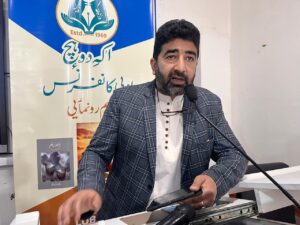
The gathering reached a deeply poignant moment with the remembrance of Manzoor Hashmi, whose legacy was honoured posthumously with the prestigious Khillat-e-Karohan Award. In that solemn tribute, grief and gratitude coexisted, as the audience reflected on a life devoted to the service of literature—one that continues to breathe through every word he left behind.
In a seamless continuation of this homage, several distinguished literary figures were conferred with the Sharaf-e-Karohan Award. Fayaz Tilgami, Syed Nazir Hussain, Shad Dardpuri, Nooruddin Hosh, Syed Saaduddin Saadi, and Tanha Nizami were each honoured for their enduring contributions. Their felicitation was not a mere formality; it was a recognition of years spent in quiet dedication—of ink that flowed not for acclaim, but for the preservation of thought, language, and identity.
If the honours evoked memory, the release of books breathed life into the present. The unveiling of Sehrai Safar by Syed Nazir Hussain opened a window into journeys that traverse both landscape and emotion, while Xchur Halam by Rafiq Tahir Kaw Chaki carried within it the subtle rhythms of lived experience. Equally significant was the edited volume on Mir Syed Hussain Wasif (RA), compiled by Syed Saaduddin Saadi—a work that stands as an act of preservation, safeguarding spiritual and intellectual heritage from the erosion of time.
As the pages were unveiled and gently turned, it became evident that this was more than a ceremonial release. Each book was a continuation of a narrative that refuses to be silenced—a reminder that literature in Kashmir has never merely existed; it has endured.
Throughout the gathering, a shared concern found expression in different voices—the gradual fading of organized literary engagement and the urgent need to revive it. The Kruhan Cultural Forum, through this initiative, emerged not just as a sponsor, but as a custodian of cultural memory, striving to create spaces where words can once again find community, and where young voices can rise to meet the echoes of the past.
The proceedings, gracefully conducted by Jahangir Bukhari, unfolded with quiet elegance, allowing each moment its rightful pause and reflection. Yet, what lingered beyond the formal conclusion was something intangible—a sense that literature, long subdued, had begun to breathe again.
As dusk descended upon Kreeri, the gathering did not dissolve into silence. Conversations lingered like unfinished verses, books were held close as if they carried more than ink, and somewhere in that quiet dispersal, new stories had already begun to take shape.
For on this day, in this modest corner of Kashmir, literature was not merely celebrated—it was remembered, reclaimed, and gently returned to the people who have always belonged to it.

