Vinod Bhat
New Delhi: Mechanisation and access to affordable finance can transform sanitation work into safer, dignified and sustainable self-employment. Timely assistance enables experienced workers to acquire modern equipment, improve service delivery and secure a more stable livelihood.
Sushil Kumar Sharma, a 32-year-old resident of Ward No. 23 near Loyalka School, Rajura, Pilani, in Jhunjhunu district of Rajasthan, has experienced this transformation through the Swachhta Udyami Yojana (SUY) under the NAMASTE initiative of the Ministry of Social Justice and Empowerment, Government of India.
A graduate with a Bachelor of Arts degree, Sushil belongs to a modest family and lives with his elderly parents. He is the principal earning member of the household. He has also fulfilled his responsibilities towards his three sisters, who are now married. His father’s poor health and the family’s difficult financial circumstances compelled Sushil to discontinue his studies and begin working to support the household. He later joined Nagar Palika Vidya Vihar, Pilani, as an outsourced sewer-cleaning worker and earned approximately ₹15,000 per month.
The work was physically demanding and offered limited financial security. Sushil faced unstable employment, occupational hardship, restricted access to capital and the social stigma associated with sanitation work. Despite these challenges, he remained committed to supporting his family and aspired to establish dignified self-employment in sanitation services.
Sushil received assistance under the Swachhta Udyami Yojana within the NAMASTE framework. The support enabled him to procure a tractor with a suction tanker for mechanised sewer and septic-tank cleaning services. The project, supported on 15 January 2026, had a total cost of ₹10.70 lakh. It was financed through a loan of ₹5.35 lakh and a capital subsidy of ₹5.35 lakh. Access to the vehicle and equipment enabled Sushil to move beyond outsourced work and establish himself as a self-employed sanitation entrepreneur.
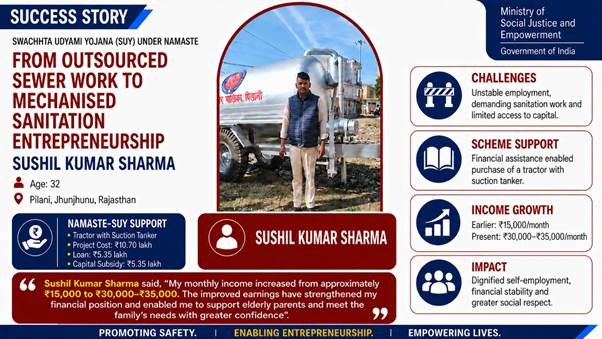
Mechanisation made sanitation operations more efficient and reduced dependence on physically strenuous cleaning practices. It also gave Sushil greater control over his work and created a more stable and dignified source of livelihood.
Expressing his contentment over help and support through NAMASTE–SUY, Sushil Kumar Sharma said, “My monthly income increased from approximately ₹15,000 to ₹30,000–₹35,000. The improved earnings have strengthened my financial position and enabled me to support elderly parents and meet the family’s needs with greater confidence”.
Today, Sushil is the owner and operator of a mechanised sanitation enterprise. His transition from an outsourced sewer-cleaning worker to an entrepreneur has brought greater income, stability, self-reliance and social respect.
Sushil Kumar Sharma’s journey demonstrates how financial assistance, capital subsidy and access to modern sanitation equipment can convert occupational experience into sustainable entrepreneurship. His success reflects the role of the NAMASTE–SUY initiative in promoting safety, dignity and economic empowerment among sanitation workers.
Through determination and timely support under NAMASTE–SUY, Sushil has progressed from uncertain outsourced employment to dignified mechanised self-employment. His story is an inspiring example of how targeted assistance can improve livelihoods while advancing safer and more professional sanitation services.

