Proposed MoU with J&K set to unlock new opportunities in AVGC-XR and digital filmmaking
VINOD BHAT
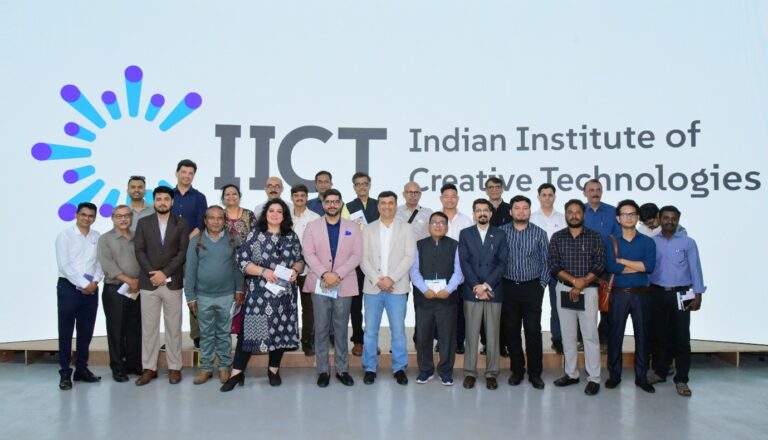
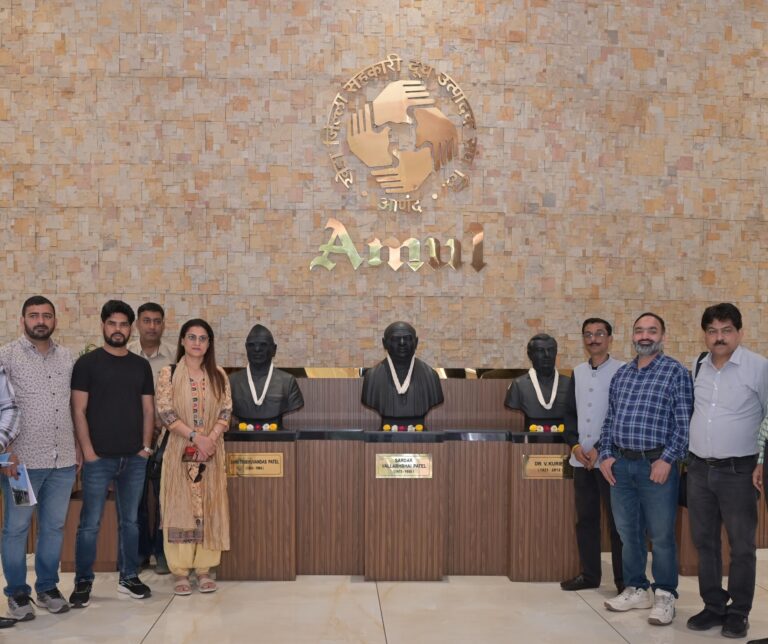
MUMBAI, Feb 27: A delegation of journalists from across the country on Thursday visited the Indian Institute of Creative Technologies (IICT) in Mumbai, in a press tour facilitated by the Press Information Bureau, Mumbai, to gain first-hand insight into India’s emerging centre of excellence for the Animation, Visual Effects, Gaming and Comics (AVGC-XR) sector.
The visit offered media representatives an immersive exposure to the institute’s academic ecosystem, state-of-the-art production infrastructure and industry-integrated training model that is positioning IICT as a key pillar in strengthening India’s “Orange Economy.”
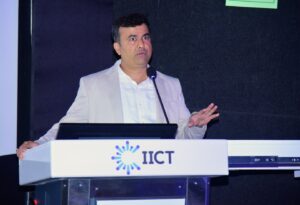
The programme began with a comprehensive presentation by Shri Ninad Raikar, Chief Operating Officer of IICT, who outlined the institute’s vision, mandate, industry collaborations and long-term roadmap. He described IICT as a transformative national initiative designed to bridge the long-standing gap between academic learning and real-time production environments.
“IICT is a visionary initiative by the Ministry of Information and Broadcasting, Government of India, designed to empower the next generation with future-ready skills,” Raikar said. “With state-of-the-art infrastructure and real-time industry exposure, the campus creates an immersive learning environment that bridges education and industry. For anyone aspiring to build a successful career in AVGC-XR, IICT is an ideal platform to upskill and unlock new opportunities.”
Dr. Vishwas Deoskar, CEO of IICT, while interacting with the delegation, elaborated on the institute’s larger mission of building a globally competitive talent pool. He emphasised that the AVGC-XR sector is no longer peripheral but central to film production, gaming, digital advertising, immersive storytelling and emerging technologies such as virtual production and digital twins.
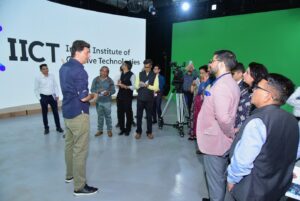
He noted that IICT’s pedagogy blends conceptual learning with hands-on studio exposure, ensuring that students graduate not just with theoretical knowledge but with production-ready portfolios aligned to international standards.
A major highlight of the visit was the screening of AI-assisted short films created by IICT students at the Rangayan Preview Theatre, a high-end screening facility built to global specifications. The films demonstrated technical finesse in animation, VFX compositing, sound design and AI-enabled cinematic workflows, while also reflecting strong storytelling instincts.
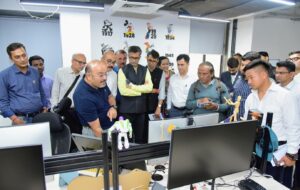
Journalists were later taken on a guided tour of animation labs, VFX suites, gaming studios, immersive technology facilities and the Photogrammetry Studio, where a live 3D scan demonstration showcased how digital avatars and virtual production assets are created. At the Anubhuti Drishya Immersive Studio Lab, applications of augmented reality (AR), virtual reality (VR) and mixed reality (MR) were demonstrated in real time, underlining the institute’s focus on experiential learning.
The delegation also interacted with faculty members drawn from leading animation, gaming and post-production industries, as well as students enrolled in specialised diploma and certification programmes. The visit concluded with a detailed Q&A session and a group interaction with the IICT leadership team.
The institute, established in September 2024 as a National Centre of Excellence for AVGC-XR with a one-time budgetary support of ₹391.15 crore, operates under a public-private partnership model with FICCI and CII as industry partners. Its first operational phase, launched in July 2025, currently runs 18 specialised programmes and has enrolled more than 100 students. A startup incubation centre on campus is already supporting eight emerging ventures in the creative technology domain.
Union Minister for Information and Broadcasting Ashwini Vaishnaw, who has spearheaded the national vision behind IICT, has described the institute as a transformative intervention in India’s creative and entertainment landscape.
“We have started an initiative which is completely novel in the world of film and entertainment,” Vaishnaw said at the launch of the institute, adding that IICT is being developed on the template of premier institutions such as the IITs and IIMs to evolve into a world-class centre of excellence for the AVGC-XR sector.
At the inauguration of the first operational campus, he underlined the long-term potential of the project. “This is a big achievement. It will open new opportunities for the youth of our country,” he said, reiterating the government’s commitment to sustained funding, global partnerships and institutional support to ensure India becomes a global content creation hub.
Significantly, IICT’s expanding national footprint is now poised to include Jammu and Kashmir.
The Jammu and Kashmir government is preparing to formalise a strategic partnership with IICT to accelerate growth in the AVGC sector and strengthen the Union Territory’s digital media, film production and post-production ecosystem. Highly placed sources indicated that a Memorandum of Understanding (MoU) is likely to be signed in the coming weeks, with a high-level IICT delegation expected to visit the Union Territory around March 20 to formalise the agreement.
The proposed collaboration follows Chief Minister Omar Abdullah’s visit to the IICT campus on January 15 at the premises of the National Film Development Corporation (NFDC) complex in Mumbai. During his visit, the Chief Minister reviewed the institute’s infrastructure, interacted with faculty and explored avenues for institutional collaboration, student exchanges and capacity building.
“The availability of such advanced screening and post-production infrastructure is crucial for nurturing serious filmmakers,” Abdullah had said during the visit. “If we want Jammu and Kashmir to become an attractive destination for filmmaking, then human talent and post-production capability must be created locally. That is where a relationship with an institution like IICT becomes important for us.”
Officials indicated that the MoU would focus on structured skill development programmes for students and selected teachers from Jammu and Kashmir, who would later serve as trained resource persons within the region. The collaboration is expected to promote startup incubation, short-term certification courses, joint screenings and the use of immersive technologies for digital heritage preservation.
With a permanent 10-acre campus under development at Film City in Goregaon and partnerships signed with global technology firms such as Google, Meta, NVIDIA, Microsoft, Apple, Adobe and WPP, IICT is positioning itself as a national hub for creative technology excellence.
If the proposed MoU materialises as expected, Jammu and Kashmir could soon integrate more deeply into India’s rapidly expanding AVGC-XR ecosystem—transforming its rich storytelling legacy into a technology-driven creative economy capable of generating sustainable, skill-based employment for its youth.