spot_imgspot_img
spot_img
Home Blog Page 14

J&K FDA Launches Special Food Safety Drive Across Employee Accommodations

0

Srinagar, May 18: The Food Safety Wing of the Jammu and Kashmir Drugs and Food Control Organization on Sunday launched a special inspection drive across hotels, canteens and government residential accommodations housing move employees in Srinagar to ensure the availability of safe and hygienic food.

The drive was conducted on the directions of the Commissioner, Food and Drugs Administration (FDA), J&K, with special teams comprising Food Safety Officers inspecting multiple establishments associated with the annual Darbar Move-related employee accommodations.

According to officials, inspection teams visited 14 establishments, including Government Residential Quarters at Sempora, Pampore, TRC Srinagar and several hotel accommodations hired by the Estates Department for lodging employees.

During the inspections, Food Business Operators (FBOs) were directed to strictly follow provisions of the Food Safety and Standards Act and Regulations, particularly hygiene and sanitation norms prescribed under Schedule 4 of the Food Safety and Standards Regulations.

Officials instructed operators to provide fresh and hygienic meals to employees and warned against the use of synthetic food colours or unsafe ingredients in cooked food. The inspection teams also sensitized food handlers about safe food handling practices, kitchen cleanliness, proper storage of raw materials and maintaining personal hygiene.

The Food Safety Department said the inspection drives would continue in the coming days across various locations to monitor compliance and enforce food safety regulations effectively.

Overall Stock Position of Fertilizers in the country is comfortable; No change in the MRP of Major Fertilizers

0

Vinod Bhat

New Delhi: Amid the evolving situation in West Asia, the Government of India continues its efforts to keep citizens informed through regular updates. In this regard, a media briefing was held today at the National Media Centre, where officers from the Ministries of Petroleum and Natural Gas, Ports, Shipping and Waterways, External Affairs provided updates on fuel availability, maritime operations, and measures being undertaken to maintain stability across key sectors. The Ministry of Chemicals and Fertilzers has also shared updates regarding the availability and stock position of fertilizers in the country.

Fertilizer stock position and availability

  • Overall Stock Position of Fertilizers in the country is comfortable.
  • For Kharif 2026, the fertiliser requirement has been assessed by DA&FW at 390.54 LMT, against this stock as on today is around 200.98 LMT (more than 51%), significantly higher than the usual level of about 33%. This reflects improved planning, advance stocking, and efficient logistics management by the Government.
  • MRP of major fertilizers – No change in the MRP of Major Fertilizers.
  • Domestic production and import of fertilizers after crisis;- (Lakh Tons)
Product Domestic production after crisis Import reached on Indian Ports after crisis
Urea 52.1 13.29
DAP 7.03 0.88
NPKs 17.33 4.09
SSP 9.76 0
MOP 0 3.49
Total 86.2 21.8


  • Domestic production of fertilizers after crisis has been 86.2 LMT against 93 LMT during the same period last year. Total of approx. 108 LMT fertilizers has been added in the availability after crisis situation.
  • India has secured approx. 13.5 LMT DAP and 7 LMT NPKs from out of SOH to be arrived at Indian ports in May and June.
  • Global Tender for TSP and Ammonium Sulphate- Indian Fertilizers companies have issued aggregated global tender for procurement of 4 LMT TSP and 3 LMT Ammonium Sulphate and now under progress. These will help to ensure adequate availability during the peak season.
  • Global Tender for Ammonia and Sulphur – Indian Fertilizers companies have issued aggregated global tender for procurement of 5.36 LMT Ammonia & 5.94 LMT Sulphur. These will help to ensure adequate availability during the peak season.
  • Availability of inputs for production of fertilizers i.e. Urea and P&K fertilizers is being regularly reviewed by the Department of Fertilizers.
  • DoF is regularly paying all the subsidy bills raised by the companies on weekly basis.
  • 9 Meeting of EGoS held till date to ensure the adequate availability of the fertilizers and most of the challenges in the availability addressed by EGoS.
  • India’s fertiliser security remains strong, stable, and well-managed, with availability consistently exceeding requirement across all major fertilisers.

Energy Supply and Fuel Availability

The Ministry of Petroleum and Natural Gas provided an update on the current fuel supply situation, outlining measures being taken to ensure uninterrupted availability of petroleum products and LPG in the context of the evolving situation in West Asia. It was noted that:

Public Advisory and Citizen Awareness

  • Citizens are advised to avoid panic purchase of petrol, diesel and LPG as the Govt is making all efforts to ensure availability of petrol, diesel and LPG.
  •  Beware of rumours and rely on official sources for correct information.
  • LPG consumers are requested to use digital booking platforms and avoid visiting distributors.
  •  Citizens are encouraged to use alternate fuels such as PNG and electric or induction cooktops.
  •  All citizens are requested to make necessary efforts to conserve energy in their daily use during the current situation.

Government Preparedness and Supply Management Measures

  • Despite the ongoing geopolitical situation, the Government has ensured that 100% supply is being made to Domestic LPG, Domestic PNG and CNG (Transport).
  • For commercial LPG, priority has been given to hospitals, educational institutions. Besides this, priority has also been given to pharma, steel, automobile, seed, agriculture, etc. In addition to this, supply of 5 Kg FTL to migrant labour is also doubled based on avg. daily supply on 2nd and 3rd March 2026.
  • The Government has already implemented several rationalisation measures on both the supply and demand side, including enhancing refinery production, increasing the booking interval from 21 to 25 days in urban areas and up to 45 days in rural areas and prioritising sectors for supply.

Coordinated Efforts with States/UTs and Institutional Mechanisms

  • State Governments are empowered under the Essential Commodities Act, 1955 and LPG Control Order, 2000 to monitor supply and act against hoarding and black marketing.
  • Govt. of States/UTs have to play a primary role in monitoring and regulating supply situation of essential commodities including Petrol, Diesel and LPG. Govt. of India has reiterated the same via multiple letters and VCs to all States/UTs.
  •  The Government of India vide letters dated 27.03.2026 and 02.04.2026 have stressed the need for proactive public communication to reassure citizens regarding adequate fuel availability. Regular review meetings are being held with States/UTs. In this context, meetings were convened on 02.04.2026 (Chaired by Secretary, MoPNG) and on 06.04.2026 (Chaired by Secretary, MoPNG along with Secretaries of I&B and Consumer Affairs), wherein the following was emphasized:

⮚    To issue daily press briefings and issue regular public advisories.

⮚    To actively monitor and counter fake news / misinformation on social media.

⮚    To intensify daily enforcement drives by District admin and to continue raids and inspections in coordination with OMCs

⮚    To promote PNG adoptions and alternate fuels.

⮚    To prioritize LPG supply, especially for domestic needs, and adopt targeted distribution of 5 kg FTL cylinders to ensure supply stability.

Enforcement and Monitoring Actions

  • Enforcement actions continue across the country to curb hoarding and black marketing of LPG. During last 4 days, more than 6950 raids were conducted across the country.
  • PSU OMCs officials have conducted surprise inspections at about 2800 RO and LPG distributorships during last 4 days across the country to ensure smooth supplies and to check any hoardings/black marketing cases.
  • PSU OMCs have strengthened and continued surprise inspections and imposed penalties on 428 LPG distributorships, and 80 LPG distributorships have been suspended till yesterday.

LPG Supply

Domestic LPG Supply Status:

  • LPG supply continues to be affected by the prevailing geopolitical situation.
  • Supply of LPG to domestic households has been prioritized.
  • No dry-outs have been reported at LPG distributorships.
  • Online LPG cylinder bookings increased to about 99% on an industry basis yesterday.
  • Delivery Authentication Code (DAC) based deliveries have increased to about 95% to prevent diversion. DAC is received on the registered mobile number of the consumer.
  • During the last 4 days, about 1.72 Crore LPG cylinders were delivered against bookings of around 1.69 Crore LPG cylinders.

Commercial LPG Supply and Allocation Measures:

  • Total commercial LPG allocation has been increased to about 70% of pre-crisis levels, including 10% reform-linked allocation.
  • During last 4 days, about 1.90 Lakh – 5 Kg FTL cylinders were sold.
  • Since 3rd April 2026, PSU OMCs have organised about 13,800 awareness camps for 5 Kg FTL Cylinders, wherein more than 2.22 Lakh – 5Kg FTL cylinders were also sold.
  • Yesterday, around 2229 – 5kg FTL cylinders were sold through about 95 camps.
  • A three-member committee of Executive Directors of IOCL, HPCL and BPCL, in consultation with State authorities and industry bodies finalises the plan for the sale of Commercial LPG in the States/UTs.
  • Since May-26, total of 1,08,753 MT of Commercial LPG has been sold.
  • During last 4 days, total of 25,204 MT of Commercial LPG has been sold.
  • During last 4 days, about 888 MT of Auto LPG has been sold by PSU OMCs.

Natural Gas Supply and PNG Expansion Initiatives

  • Consumers have been prioritised with 100% supplies to D-PNG and CNG-Transport.
  • Gas supply to other industrial and commercial sectors, including supplies through CGD networks, is enhanced up to 80%.
  • CGD entities have been advised to prioritize PNG connections for commercial establishments such as hotels, restaurants and canteens across all their GAs, to address concerns regarding the availability of commercial LPG.
  • States/UTs and Central Ministries have been requested to expedite approvals required for expansion of CGD networks.
  • The Government of India vide letter dated 18.03.2026 has offered all States/UTs additional 10% allocation of commercial LPG to States provided they can help in long term transition from LPG to PNG.
  • 22 States/UTs are receiving additional commercial LPG allocation linked to PNG expansion reforms.
  • The Government of India vide Gazette dated 24.03.2026 has notified the Natural Gas and Petroleum Products Distribution (Through Laying, Building, Operation and Expansion of Pipelines and Other Facilities) Order, 2026 under the Essential Commodities Act, 1955. The Order provides a streamlined and time-bound framework for laying and expanding pipelines across the country, addressing delays in approvals and access to land, and enabling faster development of natural gas infrastructure, including in residential areas. It is expected to accelerate PNG network growth, enhance last-mile connectivity, and support the transition to cleaner fuels, thereby strengthening energy security and advancing India’s gas-based economy.
  • PNGRB has directed CGD entities to expedite D-PNG connections. Also, the National PNG Drive 2.0 has been extended till 30.06.2026 to sustain momentum in PNG expansion.
  • To encourage a cleaner, more secure and self-reliant energy future, the Government of India has developed a model draft State CBG Policy. The model policy is intended to serve as a comprehensive flexible guiding framework to enable States to create their own investor-friendly and implementation-oriented ecosystem for CBG development. Those States which opt for this, will be prioritized for the next tranche of additional allocation of commercial LPG.
  • Since March 2026, about 7.37 Lakh PNG connections have been gasified and infrastructure has been created for additional 2.76 Lakh connections, taking the total to 10.13 lakh connections. Further, about 7.76 Lakh customers have been registered for new connections.
  • Till 17.05.2026, more than 58,100 PNG consumers have surrendered their LPG connections via MYPNGD.in website.

Crude Position and Refinery Operations

  • All refineries are operating at high capacity with adequate crude inventories, while sufficient stocks of petrol and diesel are being maintained.
  • Domestic LPG production from refineries has been increased to support domestic consumption.
  • An inter-ministerial Joint Working Group (JWG) has been set up to ensure availability of petrochemical feedstock supply for the domestic market. Subsequently, Govt. of India vide order dated 01.04.2026 has permitted Oil Refinery companies including Petrochemical Complexes to make certain minimum quantities of C3 & C4 streams available for critical sectors as determined by Centre for High Technology (CHT).
  • Based on the requests received from the Department of Pharmaceuticals, Department of Chemicals & Petro Chemicals (DCPC), Dept. for Promotion of Industry and internal trade (DPIIT), the provision for 1120 MT/day, from LPG pool, has been made for Pharma, Chemical and Paint sector companies.
  • Since 1st May 2026, more than 8730 MT of C3-C4 Molecules (comprising Propylene and Butylene) and more than 3420 MT of Butyl Acrylate has been sold by Mumbai, Kochi, Vizag, Chennai, Mathura and Gujarat refineries to Chemical, Pharma and Paint Industry.

Retail Fuel Availability and pricing Measures

  • All Retail outlets are operating normally across the country.
  • Middle East crises has resulted into abnormal increase in the crude prices. In order to protect consumers from this impact, the Government of India has decided to absorb a part of this burden through a reduction in excise duties on petrol and diesel by Rs. 10/litre.
  • Govt. of India vide Gazette notification dated 15.05.2026 has reduced the export levy on diesel from Rs. 23 per litre to Rs. 16.50 per litre and on ATF from Rs. 33 per litre to Rs. 16 per litre. Further, export duty on Petrol has been imposed to Rs. 3 per litre.
  • There are adequate stocks of petrol and diesel available at all Petrol Pumps in the country.

Maritime Safety and Shipping Operations

The Ministry of Ports, Shipping and Waterways provided an update on the prevailing maritime situation in the Persian Gulf, detailing the measures being undertaken to ensure the safety and security of Indian vessels and crew in the region. It was stated that:

  • Vessel Update: The Marshall Islands-flagged LPG carrier SYMI had safely crossed the Strait of Hormuz on 13 May 2026. The vessel, carrying 19,965 MT of LPG cargo for India with 21 foreign crew members onboard, berthed at Kandla late night on 16 May 2026 and has since completed discharge of the entire cargo.
  • The Ministry of Ports, Shipping and Waterways continues to coordinate with the Ministry of External Affairs, Indian Missions, and maritime stakeholders to ensure seafarer welfare and uninterrupted maritime operations.
  • All Indian seafarers in the region are safe, and no incident involving Indian-flagged vessels or foreign vessels with Indian crew has been reported in the past 96 hours.
  • DG Shipping Control Room has handled 9,702 calls and more than 21,312 emails since activation. In the last 96 hours, a total of 436 calls and 996 emails have been received from seafarers, their families, and maritime stakeholders.
  • The Ministry, through the Directorate General of Shipping (DG Shipping), has facilitated the safe repatriation of more than 3,217 Indian seafarers so far, including 61 in the last 96 hours from various locations across the Gulf region.
  • Port operations across India remain normal, with no congestion reported.

Safety of Indian Nationals in the Region

The Ministry of External Affairs continues to monitor developments in the Gulf and West Asia region, with focused efforts on ensuring safety, security and welfare of the Indian community in the region. It was informed that:

  • The Ministry of External Affairs is in regular contact with State Governments and Union Territories for sharing of information and better alignment of efforts.
  • The dedicated special control room in the Ministry is operational to respond to queries from Indian nationals and their families.
  • Indian embassies and consulates continue to operate round-the-clock helplines to provide timely assistance and are proactively assisting our citizens. They are also in close contact with the local Governments.
  • Advisories are being issued including information related to local government guidelines, flight and travel situations, consular services and various welfare measures being undertaken for the community.
  • Indian Missions are actively engaged with the resident Indian community. They are regularly interacting with the Indian community associations, organizations, professional groups, and Indian companies to address their concerns.
  • Government is according high priority to the welfare of Indian seafarers in the region. Indian Missions are extending all assistance to them including coordination with the local authorities and agencies, extending consular assistance, and assisting for requests to return to India.
  • The overall flight situation continues to improve with additional flights operating from the region to various destinations in India.
  • UAE airspace is open. Indian and UAE carriers are operating flights from UAE to various destinations in India.
  • Flights continue to operate from various airports in Saudi Arabia and Oman to various destinations in India.
  • Qatar airspace is partially open. Air India, Air India Express, Indigo and Qatar Airways are operating flights from Qatar to various destinations in India.
  • Kuwait airspace is open. Jazeera Airways and Kuwait Airways are operating flights from Kuwait to India.
  • Bahrain airspace is open. Air India Express, Indigo and Gulf Air are operating flights from Bahrain to various destinations in India.
  • Iraq airspace is open with limited flight operations to destinations in the region, which can be used for onward travel to India.
  • Iran airspace is partially open. Ministry has advised Indian nationals to avoid travelling to Iran and urged those already there to leave with Indian embassy’s support. So far, Indian Embassy in Tehran has facilitated movement of 2,551 Indian nationals out of Iran through land border routes.
  • Israel airspace is open and limited flight operations have resumed to destinations in the region, which can be used for onward travel to India.

Prime Minister receives the Grand Cross of the Royal Norwegian Order of Merit

0

Vinod Bhat

New Delhi: In a special ceremony hosted in Oslo, His Majesty King Herald V of Norway conferred upon Prime Minister Shri Narendra Modi the ‘Grand Cross of the Royal Norwegian Order of Merit’. The award is Norway’s highest honour bestowed on foreign Heads of Government, and is conferred in recognition of the outstanding service in the interest of Norway and humankind.

Speaking on the occasion, Prime Minister Modi expressed his deep gratitude to His Majesty King Herald V and to the people of Norway for this honour. He dedicated the award to the historic friendship between India and Norway, calling it a tribute to the enduring warmth, trust, and affection shared between the people of India and the people of Norway.

The conferment stands as a symbol of the deep bonds of goodwill that exists between India and Norway, and will guide their journey of friendship and collaboration into the future.

Food Safety Department Intensifies Inspections Across Srinagar Markets

0

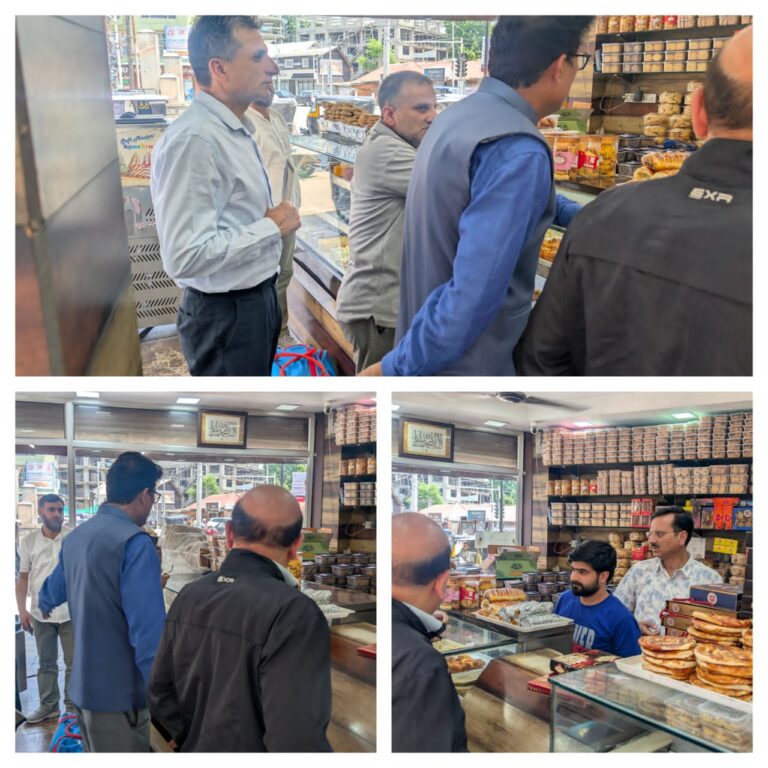
Srinagar, May 18: A team of the Food Safety Department Srinagar, along with Assistant Commissioner Food Safety Srinagar yameen ul nabi, today carried out an intensive inspection drive in the areas of Karanagar, kanikadal, Fathi kadal,Gojwara and Hawal areas today to ensure compliance with the provisions of the Food Safety and Standards Act and Rules.

During the inspection, three bakery units were found violating the provisions of Schedule-4 of the Food Safety and Standards Act pertaining to hygiene and sanitary requirements. Consequently, prosecution under the relevant provisions of the Food Safety and Standards Rules and Regulations shall be initiated and the cases will be submitted before the competent court of law.

The inspection team also observed that several retail shopkeepers and small wholesalers were exposing food items directly to sunlight and were not adhering to the prescribed storage conditions mentioned on product labels. Such practices may adversely affect the quality and safety of food products.

In this regard, all Food Business Operators (FBOs) are strictly directed not to expose food items to excessive sunlight and to ensure that all food products are stored in cool, dry places or strictly as per the storage instructions mentioned on the label declaration of each product.

All Food Business Operators are further directed to follow Good Storage Practices and maintain proper hygienic conditions as mandated under the Food Safety and Standards Act and Regulations. Any violation or non-compliance shall invite strict legal action against the defaulters under the relevant provisions of the Food Safety and Standards Act.

NSE Opens India’s Digital Gold Era with Nationwide EGR Trading Launch

0

Trading Commences Across Six Cities in the country

KD NEWS SERVICE

MUMBAI, May 18: In a landmark development poised to redefine India’s bullion ecosystem, the National Stock Exchange of India (NSE) on Monday formally commenced live trading in Electronic Gold Receipts (EGRs), ushering in what market participants are calling one of the most transformative moments in the country’s commodity markets since the advent of electronic equity trading.

The launch marks the beginning of a nationwide digital framework for gold ownership and trading — a structural shift that could fundamentally alter how Indians buy, hold, transfer and monetize the precious metal that has for centuries occupied a central place in the nation’s cultural and financial identity.

Announcing the commencement of trading, NSE said the rollout follows a successful mock trading exercise conducted on May 16, during which the exchange reported zero system errors or operational exceptions. The seamless transition from testing to live operations signals a high degree of technological preparedness for a platform expected to eventually serve millions of investors and market participants across the country.

The launch represents far more than the addition of another trading product. It is the creation of a regulated digital marketplace for gold, backed by vault infrastructure, exchange-based price discovery, and nationwide settlement systems — effectively integrating India’s fragmented physical gold trade into the country’s modern financial architecture.

Industry experts say the move has the potential to bring unprecedented transparency, efficiency and liquidity to one of the world’s largest gold-consuming markets.

India has long been among the globe’s biggest buyers of gold, with households, traders and institutions collectively holding thousands of tonnes of the metal. Yet despite the scale of demand, much of the market has historically operated through decentralized physical channels, often marked by pricing inefficiencies, purity concerns and logistical barriers. Electronic Gold Receipts aim to bridge that gap by converting physical gold into tradable electronic instruments held in demat form, similar to shares and bonds.

Under the new framework, investors can deposit gold at accredited vaulting centres and receive EGRs that can be traded electronically on the exchange platform. Each receipt represents ownership of standardized gold stored securely in regulated vaults, enabling investors to participate in the bullion market without the complexities of physical handling.
The NSE said the initial phase of operations has already generated an “overwhelming response” from market participants and ecosystem partners, reflecting strong institutional and retail interest in the product.

At present, vaulting and collection centres are operational in Ahmedabad and Mumbai, while four additional centres — Delhi, Kolkata, Chennai and Bangalore — are being activated immediately as part of the first expansion phase. The exchange plans to significantly widen the network over time, targeting as many as 120 centres across India in a phased rollout.

The scale of the planned infrastructure expansion underscores the exchange’s ambition to create a truly national bullion marketplace, connecting investors, refiners, jewellers, traders and financial institutions through a unified electronic ecosystem.
Market observers believe the initiative could also help deepen financialization of household gold savings in India. Traditionally, a large portion of privately held gold has remained outside formal financial systems, locked away in vaults, lockers and family reserves. By digitizing ownership and enabling exchange-based trading, EGRs could unlock new avenues for liquidity, collateralization and investment participation.

Analysts say the product may particularly appeal to younger investors who seek exposure to gold but prefer the convenience, transparency and security of digital assets over physical bullion purchases.

The development also carries strategic significance for India’s broader financial modernization agenda. Regulators and policymakers have for years advocated greater transparency and formalization in commodity markets, especially in sectors as economically important as bullion. Electronic Gold Receipts provide a regulated structure that could improve traceability, standardization and investor confidence while strengthening market oversight.

For the NSE, the launch further reinforces its position as a pioneer in technological innovation within India’s capital markets. The exchange, which revolutionized Indian trading in the 1990s by introducing electronic screen-based trading, is once again positioning itself at the forefront of market transformation.
Founded in 1994, NSE has evolved into one of the world’s largest exchanges by trading volume, particularly in derivatives. Over the decades, it has played a central role in reshaping India’s financial landscape through technology-led reforms, high-speed trading systems, robust clearing mechanisms and broad retail participation.

The successful rollout of EGR trading is expected to strengthen India’s aspirations of emerging as a major global hub for bullion trading and price discovery — a position historically dominated by international financial centres such as London, Zurich and Shanghai.
Industry leaders believe the initiative could eventually pave the way for sophisticated gold-market products, including lending, collateral financing, structured bullion investments and integration with global commodity markets.
The timing of the launch is also significant. Amid persistent global economic uncertainty, volatile currency movements and geopolitical tensions, gold continues to retain its appeal as a safe-haven asset for investors worldwide. By introducing a modern, exchange-traded framework for gold ownership, NSE is seeking to align India’s deep-rooted affinity for the metal with the efficiency and credibility of regulated financial markets.

As trading screens lit up with the first Electronic Gold Receipts on Monday morning, the launch carried symbolic weight beyond the commodity itself. For many observers, it represented the convergence of tradition and technology — a centuries-old store of value entering the digital age through the infrastructure of one of the world’s most advanced exchanges.

With nationwide expansion plans already underway and market enthusiasm running high, the beginning of EGR trading may ultimately be remembered not merely as a product launch, but as the opening chapter of a new era for India’s gold economy.

LG Manoj Sinha Completes Self-Enumeration for Census 2027, Urges Public Participation

0

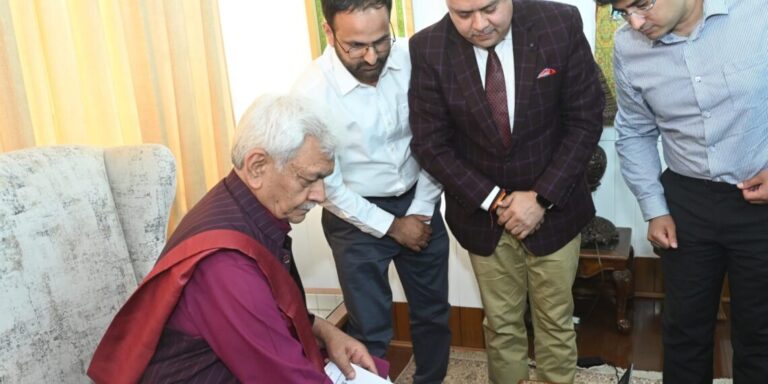
Srinagar, May 17: The Jammu and Kashmir Lieutenant Governor Manoj Sinha on Sunday said he has completed his self-enumeration for Census 2027 and urged every household in Jammu and Kashmir to actively participate in the ongoing Census process.

In a post on X, the Lieutenant Governor, said that the current phase covers house listing and housing operations and appealed to people to personally provide their details through the self-enumeration mechanism.

“Completed my self-enumeration. This phase covers house listing and housing operations. I urge every household in J&K to personally provide their details and take part in the Census,” LG Sinha wrote.

He further stated that Census 2027 holds historic significance as it will be India’s first fully digital and paperless Census exercise integrating advanced digital technologies, mobile-based data collection systems and self-enumeration facilities.

LG Sinha said the initiative reflects the country’s transition towards modern digital governance and citizen-centric service delivery mechanisms.

Prof. Sheikh Ajaz Bashir Assumes Charge as Dean Academic Affairs at IUST

0

Senior Academician Brings Over Three Decades of Experience in Higher Education Reforms, Digital Governance and Institutional Development

Awantipora, May 17: Senior academician and Director Colleges J&K, Prof. Sheikh Ajaz Bashir, has assumed charge as Dean Academic Affairs at the Islamic University of Science and Technology after being recently deputed to the university as Professor in Electronics and Communication Engineering.

Prof. Ajaz Bashir is a distinguished academician with more than three-and-a-half decades of service in the Higher Education Department and is widely recognised for his contribution to academic administration, policy formulation and institutional development across Jammu and Kashmir.

He has held several important academic and administrative positions in the Union Territory and has been part of multiple high-level committees, including the Higher Education Council, focusing on faculty development, digital reforms, institutional growth and implementation of national educational initiatives.

Serving as Director Colleges since 2023, Prof. Ajaz has played a significant role in strengthening digital governance in higher education through initiatives such as the data-driven policy planning and development system SIGMA, SCALE, and automated credit-based contractual faculty engagement systems.

Throughout his career, he has remained associated with various reforms aimed at improving academic standards, strengthening institutional frameworks and promoting innovation and excellence within the higher education sector.

A PhD in Electronics, Prof. Ajaz served as faculty member and Head of the Department of Electronics at several institutions including Government S.P. College Srinagar, Government Degree College Bemina and Government Degree College Baramulla before being appointed Principal in 2016.

He later served as Principal of multiple Government Degree Colleges and headed the prestigious Islamia College of Science and Commerce from 2019 to 2023.

During his tenure at Islamia College, several academic excellence initiatives were launched, including introduction of various undergraduate, integrated and postgraduate programmes in Nano Sciences, Zoology, Botany and Chemistry under Academic Leap 2020.

He also introduced the Learning Management System (LMS) and examination reforms with continuous assessment mechanisms. Under his leadership, Islamia College became the first institution in Jammu and Kashmir to implement the National Education Policy (NEP).

Later, while serving as Principal of Amar Singh College along with additional charge as Nodal Principal for Kashmir Division Colleges, he initiated major infrastructural reforms at the institution.

At present, besides assuming charge at IUST, Prof. Ajaz Bashir continues to hold the charge of Director Colleges and is spearheading a centralised admission process at the Directorate level aimed at making admissions more student-friendly and increasing enrolment across degree colleges in Jammu and Kashmir.

J&K Bets Big on a Cleaner Future with ₹433 Crore Urban Sanitation Push

0

Mega projects for Srinagar, Baramulla and Rajouri promise cleaner cities

KD NEWS SERVICE

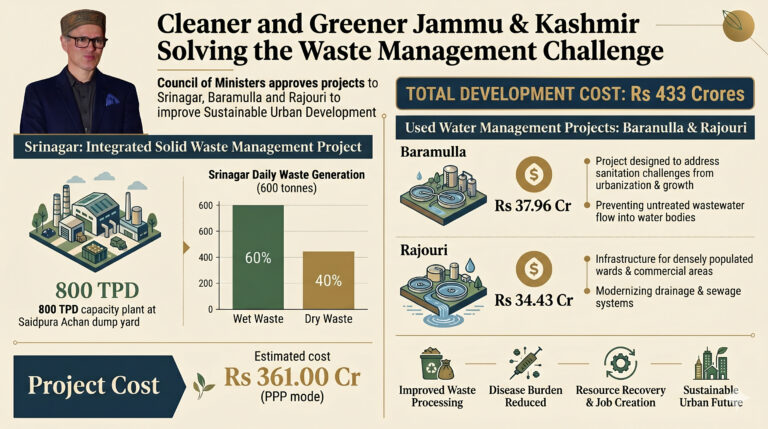
SRINAGAR, May 16:  In one of the most significant urban infrastructure decisions in recent years, the Omar Abdullah-led government in Jammu and Kashmir has approved a sweeping ₹433 crore sanitation and waste-management package aimed at transforming the urban landscape of the Union Territory. The ambitious initiative, cleared by the Council of Ministers, seeks to tackle mounting challenges of solid waste, sewage treatment and urban sanitation in Srinagar, Baramulla and Rajouri — three rapidly expanding urban centres grappling with the pressures of population growth and inadequate civic infrastructure.

The projects are being viewed not merely as infrastructure interventions, but as a long-term environmental and public-health mission designed to reshape the future of urban living in Jammu and Kashmir.

At the heart of the package is the establishment of a state-of-the-art 800 Tonnes Per Day (TPD) Integrated Solid Waste Management (ISWM) facility in Srinagar, to be developed at the Saidapora Achan dump yard under the Public-Private Partnership (PPP) model. Estimated at a cost of ₹361 crore, the project is expected to become the largest and most technologically advanced waste-management initiative ever undertaken in the Kashmir Valley.

Officials say the Srinagar project has been conceived in response to the alarming rise in municipal waste generation in the city, which currently produces nearly 600 tonnes of garbage daily. With Srinagar witnessing rapid urban expansion, growing commercial activity and increasing population density, existing waste-disposal systems have struggled to keep pace. Though door-to-door collection and source segregation mechanisms are already in place, authorities acknowledge that scientific processing and environmentally sound disposal systems remain inadequate.

The proposed facility aims to change that equation entirely.

Designed with future urban expansion in mind, the plant’s 800 TPD capacity will not only address present-day requirements but also prepare the city for the environmental demands of the coming decades. Experts believe the project could significantly reduce open dumping, foul odours, pest infestations, drainage blockages and contamination caused by unscientific waste disposal — persistent issues that have long plagued parts of Srinagar.

Beyond aesthetics, the project carries profound public-health implications. By improving waste segregation, recycling, treatment and disposal, the initiative is expected to lower the risk of disease outbreaks, improve air quality and prevent groundwater contamination. Officials also anticipate increased resource recovery and employment generation through modern waste-processing systems.

The government has simultaneously approved two major Used Water Management Projects for the municipal councils of Baramulla and Rajouri, at estimated costs of ₹37.96 crore and ₹34.43 crore, respectively.

While smaller in scale than Srinagar’s ISWM project, these initiatives are expected to play a transformative role in improving sanitation and wastewater treatment in two towns that have witnessed substantial urban growth over the last decade.
In Baramulla, rapid urbanisation, institutional expansion and rising trade activity have intensified pressure on the town’s civic infrastructure, particularly sewerage and sanitation systems. Untreated wastewater flowing into drains and nearby water bodies has increasingly emerged as a major environmental concern.

The approved project seeks to address these vulnerabilities through a comprehensive system involving interception and diversion of wastewater, sewage pumping stations, sewage-treatment infrastructure and septage-management facilities using advanced treatment technologies.
Rajouri faces a similar urban challenge.

Driven by its growing educational institutions, expanding commercial sectors and administrative importance, the town has experienced accelerated population growth and infrastructure stress. Officials say existing drainage and sanitation networks have become insufficient for the town’s growing needs, particularly in densely populated wards and commercial zones.

The newly sanctioned used-water management project in Rajouri is expected to establish a modern sewage-treatment framework capable of reducing water pollution, protecting public health and preventing untreated wastewater from entering rivers, drains and local water channels.

Urban planners and environmental observers have welcomed the projects as a decisive shift toward sustainable governance in Jammu and Kashmir, especially at a time when climate resilience and ecological preservation are becoming central to policy planning worldwide.

The combined impact of these initiatives, experts say, could extend far beyond sanitation.
Cleaner cities, reduced environmental degradation, better disease control, enhanced water quality and improved urban planning are among the anticipated long-term outcomes. The projects are also expected to generate employment opportunities during both construction and operational phases while encouraging scientific waste handling and resource recovery practices.

For residents, however, the significance is more immediate and deeply personal.
In many neighbourhoods across Srinagar, Baramulla and Rajouri, overflowing waste sites, clogged drains and deteriorating sanitation have increasingly become symbols of urban distress. The government’s new push is being seen as an attempt to restore not only civic order but also public confidence in responsive governance.
Officials described the projects as part of a broader vision to build cleaner, healthier and more liveable cities across Jammu and Kashmir — a vision aligned with sustainable urban development goals and citizen-centric governance.

If implemented efficiently and within timelines, the ₹433 crore sanitation package could emerge as a defining milestone in Jammu and Kashmir’s urban transformation journey — one that reimagines waste not as a burden, but as a challenge that can be managed through planning, technology and political will.

For a region celebrated globally for its natural beauty, the message behind the initiative is unmistakable: the future of Jammu and Kashmir will not only be judged by its landscapes, but also by how sustainably it protects them.

Census-2027: Self-Enumeration Exercise kicks off in Anantnag: DC appeals to public for wider participation

0

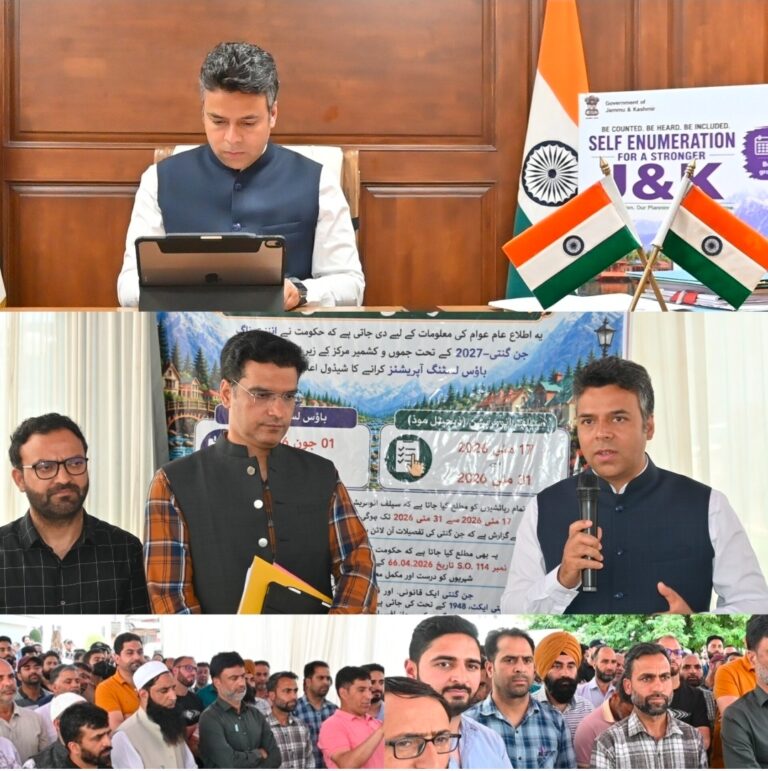
ANANTNAG, MAY 17: As part of Census-2027, the Self-Enumeration (Digital Mode) Exercise, scheduled from May 17 to 31, 2026 and preceding the House Listing Operations (June 01 to 30, 2026), kicked off today in Anantnag.

The Deputy Commissioner (DC) who is also the Principal Census Officer, Dr. Bilal Mohiuddin Bhat, formally inaugurated the self-enumeration facilitation counter/camp at the DC office.
Setting an example, the DC completed his self-enumeration activity in the presence of other concerned district officials. A detailed presentation and live demonstration of the self-enumeration process were also delivered on the occasion.

Addressing the camp, the Deputy Commissioner said that self-enumeration is India’s maiden attempt to capture household data, allowing individuals to use digital platforms to submit their census information online before enumerators visit their households. He described the process as a secure, web-based facility that enables respondents to enter their census data directly.

Dr. Bilal appealed to the general public to actively participate in the self-enumeration process through the digital mode on se.census.gov.in as well as in the overall Census 2027 operations, noting that planning, development models, and the allocation of resources are guided by census data. He informed that provisions for self-enumeration, consisting of 33 questions, have been incorporated into the portal to facilitate citizens and make the process more transparent and convenient. He further stressed the importance of public participation in ensuring the successful conduct of the census operations.

The function was attended by ADC (DCO) Vikas Ahlawat, ACR (NOC) Tariq Ahmad Malik, district and sectoral officers, census coordinators, master trainers, field trainers, supervisors, enumerators, and other staff.

Principal Census Officer (Urban) briefs Media on launch of Self-Enumeration for Census 2027

0

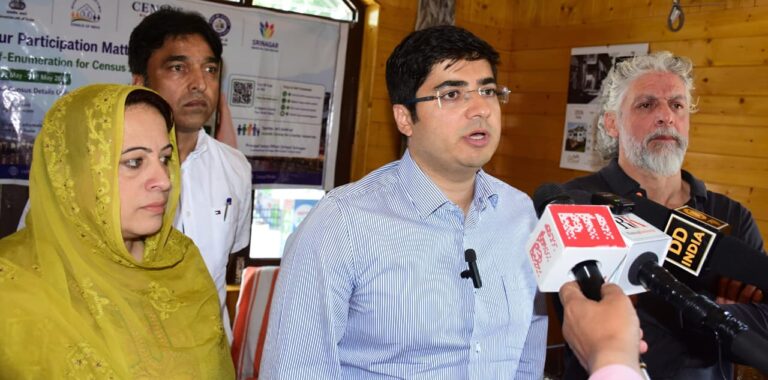
SRINAGAR, MAY 17: Principal Census Officer (Urban)/Commissioner, Srinagar Municipal Corporation (SMC), Faz Lul Haseeb, today briefed the media regarding the commencement of the Self-Enumeration phase of Census 2027, which begins today and will continue until May 31, 2026.

While addressing the media, He said that the Self-Enumeration initiative enables citizens to voluntarily submit their household and demographic details through a simple and convenient digital platform. He emphasized that the initiative is aimed at facilitating greater public participation and ensuring accuracy in the Census process.

He further highlighted that Self-Enumeration is a significant citizen-centric initiative introduced for the first time in the history of the Indian Census, allowing residents to provide their information from the comfort of their homes. The initiative has been designed to promote ease, transparency, and efficiency in the Census exercise while strengthening public outreach and supporting welfare-oriented planning.

Appealing to the general public, Haseeb urged all residents to actively participate in the Self-Enumeration process within the stipulated time frame and extend full cooperation to the administration for the successful conduct of Census 2027.

He also called upon citizens to ensure that accurate and complete information is provided so that the Census exercise reflects a true and reliable demographic profile, which will contribute to effective planning and development.