spot_imgspot_img
spot_img
Home Blog Page 152

Lok Bhavan Marks Statehood Day of Tripura, Manipur & Meghalaya

0

KD NEWS SERVICE

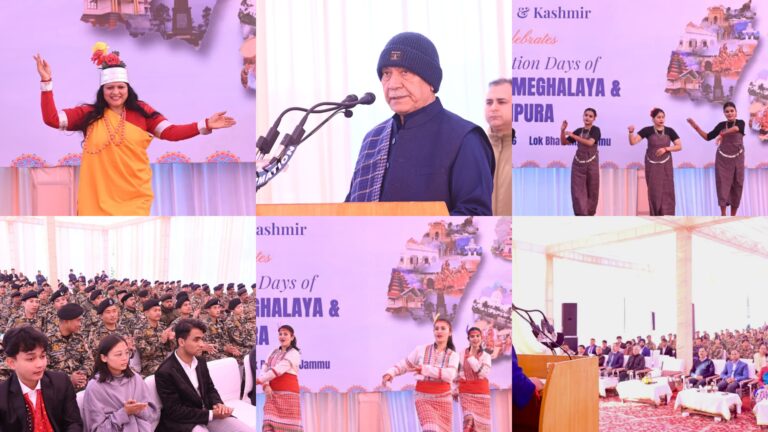
JAMMU, Jan 21: Jammu and Kashmir Lok Bhavan on Tuesday celebrated the Statehood Day of Tripura, Manipur and Meghalaya with great enthusiasm and cultural fervour in Jammu, highlighting the rich traditions, diversity and shared national spirit of the three northeastern states.

The vibrant cultural evening, organised in the true spirit of ‘Ek Bharat Shreshtha Bharat’, brought together students, security personnel and residents hailing from Tripura, Manipur and Meghalaya who are currently living and serving in the Union Territory of Jammu and Kashmir. The event served as a platform to strengthen emotional bonds between regions and to showcase India’s unity in diversity.

Lieutenant Governor Shri Manoj Sinha, who was the chief guest on the occasion, extended his heartfelt greetings to the people of Tripura, Manipur and Meghalaya on their Statehood Day. He paid rich tributes to the iconic leaders, reformers and cultural ambassadors of the three states, recalling their invaluable contributions to the freedom struggle, nation-building and preservation of India’s civilisational ethos.

Addressing the gathering, the Lieutenant Governor said that the cultural diversity and rich heritage of Tripura, Manipur and Meghalaya are not merely symbols of tradition but have emerged as powerful engines of growth. He noted that these cultural strengths are fostering innovation, enhancing economic vitality and building social resilience across the region.

Shri Manoj Sinha underlined that under the visionary leadership of Hon’ble Prime Minister Shri Narendra Modi, the northeastern region has witnessed historic and transformative development. “This development is not only accelerating economic growth and ensuring lasting peace, but is also safeguarding and celebrating the unique cultural identities of these states,” he said, adding that such progress has significantly boosted tourism and strengthened the hospitality sector.

The Lieutenant Governor observed that the local economies of Tripura, Manipur and Meghalaya are flourishing due to focused efforts on heritage preservation, infrastructure development and improved connectivity. He highlighted that the establishment of new premier educational institutions and enhanced access to opportunities are instilling pride among the youth, motivating them to innovate while staying rooted in their traditions.

He further said that renewed emphasis on reviving traditional art forms, crafts and indigenous skills is creating sustainable livelihoods and ensuring that cultural legacies are passed on to future generations.

Concluding his address, Shri Manoj Sinha expressed hope that Tripura, Manipur and Meghalaya would continue to scale new heights of progress, prosperity and harmony in the years to come, while contributing meaningfully to the nation’s collective growth and unity.

India Stakes Its Claim in the Global AI Race at Davos

0


From scale to service, India redefines AI leadership: Ashwini Vaishnaw


VINOD BHAT

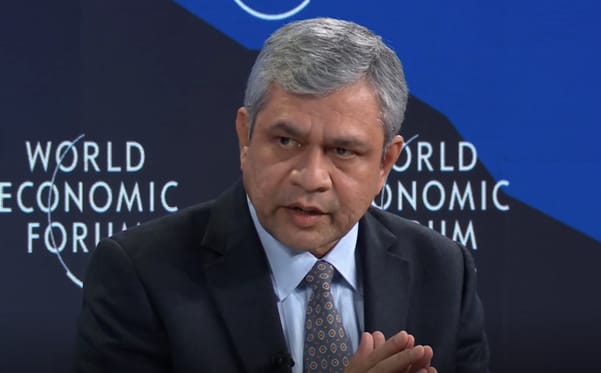
NEW DELHI, Jan 21: India made a confident and impactful entry into the global Artificial Intelligence (AI) discourse at the World Economic Forum in Davos, firmly positioning itself among the world’s leading AI-ready nations. Union Minister for Electronics and Information Technology, Shri Ashwini Vaishnaw, articulated India’s vision, strategy and achievements during a high-level panel discussion titled “AI Power Play”, which examined the geopolitics of AI, its economic implications, governance challenges and pathways for inclusive global adoption.

The panel brought together some of the most influential voices shaping the global AI ecosystem. Moderated by Mr. Ian Bremmer, President of the Eurasia Group, the discussion featured Ms. Kristalina Georgieva, Managing Director of the International Monetary Fund (IMF); Mr. Brad Smith, President and Vice Chair of Microsoft; Mr. Khalid Al-Falih, Saudi Arabia’s Minister of Investment; and Shri Ashwini Vaishnaw, representing India’s rapidly expanding digital and technological footprint.

Addressing the global audience, Shri Vaishnaw asserted that India belongs to the “first group” of nations prepared for the AI-driven future, having made systematic progress across all five critical layers of AI architecture—applications, models, chips, infrastructure and energy. He underlined that unlike approaches focused solely on building the largest and most expensive AI models, India’s strategy prioritises real-world deployment, economic sustainability and measurable return on investment (ROI).

“Return on investment does not come from creating the biggest models,” Shri Vaishnaw said, pointing out that nearly 95 per cent of real-world AI use cases can be effectively addressed using mid-sized models in the 20–50 billion parameter range. He highlighted that India has already developed a bouquet of such efficient and cost-effective AI models, which are being actively deployed across sectors to improve productivity, service delivery and technological efficiency. This pragmatic approach, he explained, enables India to offer maximum impact at a significantly lower cost, a critical advantage in the era of the Fifth Industrial Revolution.

Backing his remarks with global benchmarks, the Minister noted that Stanford University ranks India third worldwide in AI penetration and preparedness, and second globally in AI talent, underscoring the country’s strong human capital base and growing innovation ecosystem.

A major focus of India’s AI strategy, Shri Vaishnaw said, is large-scale diffusion and democratisation of AI. To overcome the global shortage and high cost of advanced computing infrastructure, particularly GPUs, the Government of India has adopted a public-private partnership (PPP) model. Under this initiative, 38,000 GPUs have been empanelled as a shared national compute facility, subsidised by the government and made available to students, researchers and startups at nearly one-third of prevailing global costs. This move, he said, ensures that access to advanced AI tools is not restricted to a few large corporations but is widely available across the innovation ecosystem.

Complementing infrastructure support, Shri Vaishnaw highlighted India’s ambitious nationwide AI skilling programme, which aims to train 10 million people. The initiative is designed to ensure that India’s vast IT workforce and startup ecosystem are fully equipped to leverage AI for both domestic applications and global service delivery, further strengthening India’s position as a trusted digital partner to the world.

On the critical issue of regulation, the Minister outlined India’s distinctive techno-legal approach to AI governance. He stressed that legal frameworks alone are insufficient to address the complex challenges posed by AI technologies. “We must build technical solutions to detect bias, authenticate deepfakes with court-admissible accuracy, and ensure safe deployment through mechanisms such as unlearning,” he said, adding that India is actively developing indigenous technological safeguards to enhance trust, accountability and safety in AI systems.

Other panelists and global stakeholders acknowledged India’s rising influence in the AI domain. Moderator Ian Bremmer observed that India has emerged over the past decade as a significant geopolitical and technological force, while leaders from global institutions and industry praised India’s emphasis on accessibility, diffusion and sovereign AI capability as a replicable model for emerging economies.

As discussions at Davos continue to shape the future of global technology governance, India’s message was clear and compelling: AI must be inclusive, affordable, trusted and rooted in real-world impact—and India is ready to lead that transformation.


Cabinet approves equity support to Small Industries Development Bank of India

0

New Delhi: The Union Cabinet, chaired by the Prime Minister Shri Narendra Modi has approved the equity support of Rs.5,000 crore to Small Industries Development Bank of India (SIDBI).

The equity capital of Rs.5000 crore shall be infused into SIDBI by the Department of Financial Services (DFS) in three tranches of Rs.3,000 crore in Financial year 2025-26 at the book value of Rs.568.65/- as on 31.03.2025 and Rs.1,000 crore each in Financial Year 2026-27 and Financial year 2027-28 at the book value as on 31st March of the respective previous financial year.

Impact:

Post equity capital infusion of Rs.5000 crore, number of MSMEs to be provided financial assistance is expected to increase from 76.26 lakh at the end of Financial Year 2025 to 102 lakhs (approximately 25.74 lakh new MSME beneficiaries will be added) by the end of Financial Year 2028. As per latest data (as on 30.09.2025) available from official website of M/o MSME, 30.16 crore employment is generated by 6.90 crore MSMEs (i.e. employment generation of 4.37 persons per MSME). Considering this average, employment generation is estimated to be 1.12 crore with the expected addition of 25.74 lakh new MSME beneficiaries by the end of Financial Year 2027-28.

Background:

With a focus on directed credit and anticipated growth in that portfolio over the next five years, the risk-weighted assets on SIDBI’s balance sheet are expected to rise significantly. This increase will necessitate higher capital to sustain the same level of Capital to Risk-weighted Assets Ratio (CRAR). The digital and digitally-enabled collateral-free credit products being developed by SIDBI, aimed at boosting credit flow, along with the venture debt being offered to start-ups, will further escalate the risk-weighted assets, requiring even more capital to meet healthy CRAR.

A healthy CRAR, well above the mandated level, is a key to protect credit rating. SIDBI will benefit from an infusion of additional share capital by maintaining a healthy CRAR. This infusion of additional capital would enable SIDBI to generate resources at fair interest rates, thereby increasing the flow of credit to Micro, Small & Medium Enterprises (MSMEs) at competitive cost. The proposed equity infusion in staggered or phased manner will enable SIDBI to maintain CRAR above 10.50% under high stress scenario and above 14.50% under Pillar 1 and Pillar 2 over next three years.

Cabinet approves continuation of Atal Pension Yojana (APY) and extension of funding support for promotional and developmental activities and gap funding till 2030-31

0

New Delhi: The Union Cabinet chaired by the Prime Minister, Shri Narendra Modi, today approved the continuation of Atal Pension Yojana (APY) up to FY 2030-31 along with extension of funding support for promotional and developmental activities and gap funding.

Implementation Strategy:

The scheme will continue up to 2030-31 with Government support for:

Promotional and Developmental activities to expand outreach among unorganised workers including awareness, capacity building.
Gap funding to meet viability requirements and ensure sustainability of the scheme.
Major Impact:

Ensures old-age income security for millions of low-income and unorganised sector workers.
Enhances financial inclusion and supports India’s transition to a pensioned society.
Strengthens the vision of Viksit Bharat @2047 by providing sustainable social security.
Background:

Launch: APY was launched on 9th May, 2015 with the objective of providing old-age income security to workers in the unorganised sector.
Scheme Features: APY offers a guaranteed minimum pension of Rs.1,000 to Rs.5,000 per month starting at age 60, based on contributions.
Progress: As of 19th January, 2026, over 8.66 crore subscribers have been enrolled, making APY a cornerstone of India’s inclusive social security framework.
Need for Extension: Sustained government support is essential for continued awareness, capacity building, and bridging of viability gaps to ensure the scheme’s sustainability.

Battling Infernos Bare-Handed : J&K Forest Guards Cry for Safety and Justice

0

TAUSEEF AHMAD
SRINAGAR, Jan 21: As Jammu and Kashmir witnesses an unusually dry winter marked by scant snowfall and prolonged dry spells, the region’s frontline forest guards—tasked with safeguarding its vast and fragile forest cover—say they are being pushed into life-threatening situations on an almost daily basis, without adequate protection, fair wages or institutional support.
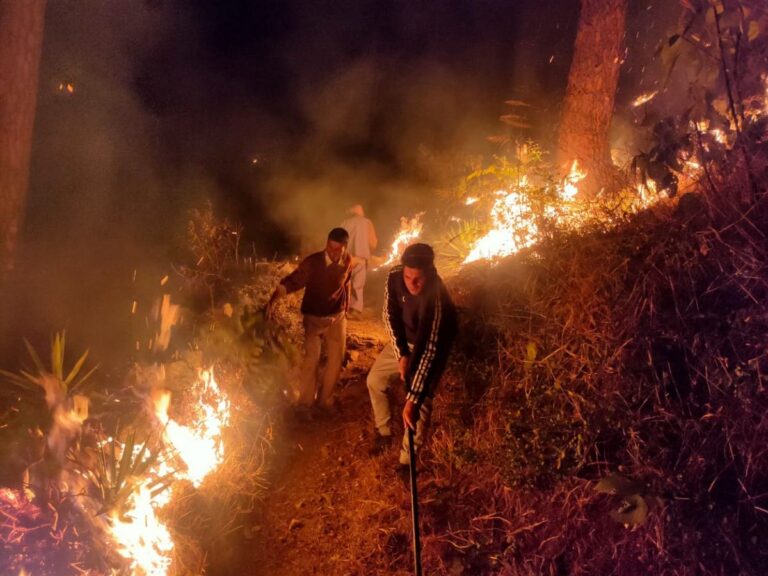
Forest guards, who are often the first and only responders to forest fires in remote areas, say the number of fire incidents has surged this season, forcing them to venture deep into hazardous terrain armed with little more than wooden sticks and basic tools. They allege that despite the extreme risks involved, they are neither provided modern firefighting gear nor granted any risk allowance or insurance cover commensurate with the dangers they face.
“We are entering fire zones every day. Many of us go with nothing more than sticks. There is no modern fire gear, no risk allowance and no proper insurance cover,” said a forest guard posted in north Kashmir, speaking to Kashmir Despatch. He said that while most people are asleep at night, forest guards trek across steep mountains and dense forests to locate fires and prevent them from spreading, often without protective clothing, breathing equipment or communication tools.
The guard said that every night patrol carries the fear of sudden stone-slides, unpredictable wind shifts, wildlife attacks or getting trapped by flames. “One mistake, one misstep, and it can cost a life,” he said, adding that the risks have multiplied with changing climate patterns and prolonged dry conditions.
Adding to their sense of neglect is the issue of stagnant pay. Forest guards and foresters point out that while employees of other departments have benefited from successive 6th and 7th Pay Commission revisions, their own salaries have remained virtually unchanged for nearly a decade. “We are still drawing the same salaries we were paid years ago, even though our responsibilities and risks have increased manifold,” said a staff representative.
According to the guards, their demands for pay revision and safety measures have been raised repeatedly over the years, but without any concrete outcome. “When a forest guard dies in the line of duty, the family is left on its own. There is no structured relief, no long-term support, and no sense of dignity,” the representative said, appealing to Lieutenant Governor Manoj Sinha and Forest Minister Javed Rana to take urgent notice of their plight.
The risks faced by forest guards are not hypothetical. Official records and departmental data reveal that nearly 130 forest guards have lost their lives on duty in Jammu and Kashmir over the years, while many others have suffered serious injuries due to forest fires, stone-slides, wildlife attacks and violent encounters with timber smugglers.
Recent incidents have further exposed the vulnerability of frontline forest staff. In December 2025, forest guard Gull Mohammad Shah lost his life while battling a forest fire in Anantnag. In May the same year, 44-year-old Shameem Ahmad Mir drowned in Nallah Sindh during official duty in Ganderbal. Another guard, Mohd Iqbal Zargar, was killed in a stone-slide near Gaadi Nallah in Doda on December 29, 2025.
Forest guards say that despite these recurring tragedies, their working conditions remain unchanged. They perform round-the-clock duties in some of the most inaccessible parts of the Union Territory, often without weekly offs. Their responsibilities range from firefighting and night patrolling to preventing illicit timber smuggling, initiating legal action under forest laws, carrying out plantation work, managing eco-tourism activities and maintaining constant interaction with local communities.
“Our duty begins where the road ends,” said one guard. “We patrol forests at night, fight fires on steep slopes, confront smugglers and face wild animals so that forests can survive.”
Despite the nature and scale of their work, forest guards in Jammu and Kashmir continue to remain in Pay Level-2, while several other grassroots cadres with comparable duties have been upgraded. The growing gap, they say, reflects institutional apathy toward those tasked with protecting the region’s “green gold.”
The severity of the forest fire situation was acknowledged earlier by Forest Minister Javed Rana, who informed the Legislative Assembly that around 1,243 forest fire incidents were reported during the 2024–25 financial year. In 2025 alone, nearly 350 forest fires were recorded, affecting approximately 880 hectares of forest land across Jammu and Kashmir.
For the guards on the ground, these numbers translate into sleepless nights, constant danger and the looming fear of death without security for their families. “We go out every day knowing we may not return,” said another forest guard. “Yet our families have no insurance, no assurance and no dignity if we die. If the government truly values forests, it must value the people who stand between flames and irreversible destruction.”

Beyond Quadrification: Reimagining J&K’s Unity

0

Learning from Ladakh, honouring Gulab Singh through reorganisation—not splitting

By Latief U Zaman Deva

The spectacular contribution of Mahraja Gulab Singh lay in creation and consolidation of the erstwhile State of J&K notwithstanding its replete & deep diversities which, after the termination of the British rule in 1947,initially checkmated successfully the vision of Sheikh Mohammed Abdullah for the position of the State in the Union of India akin to one once enjoyed by Ukraine & Belorussia in Soviet Union before its disintegration in 1990. One can arrive at a prudent conclusion in this behalf on acquainting oneself with the parleys between him and union Govtt about application of laws to the State . He didn’t even consent to the application and extension of a few laws on entries falling in union list and corresponding with subjects covered in the Instrument of Accession. This legacy continues to haunt & blunt the political aspirations of the centrifugal conglomerate sweeping over an absolute majority of people cutting across regional, ethnic & linguistic diversities & therefore a framework operable to the advantage of the centripetal political and the Central Executive formations under the subterfuge of Constitution, democracy & the rule of law. Under these circumstances the “Apple cart” suits national interests.
Quadrification
Confront the Votaries of “Division “ for logic in support of their chauvinistic orchestration their stalk arguments move around “ nothingness in common with Koshur & Kashmir “ but a swift retort about the application of their logic to “ Chenab Valley and Peer Panchal” regions infuriates them to the extent of denying intra-divisional stark diversities springing from the factual & ground positions. In Ladakh barring majority of Buddhists none from other communities had ever harboured the idea of seceding from the J&K till social & commercial boycott launched against them by the Buddhist Association from 1989 to 1995. This got manifested immediately after August 5, 2019 when an endless wave of protests gripped Kargil Distt & disappointment writ large on the faces of common people other than Buddhists in Leh Distt. Disregarding public sentiments by forcing misconceived decisions breads contempt & propels urges in disillusioned people for alternatives unless democratic options such as conduct of referendum are adopted. Buddhists were themselves demanding UT status only but in order to carry along others with them as well who represent 52% of the population of the region against 48% of the Buddhists ; the Leh Apex Body has now included in their Charter of demands Statehood also & thus unifying all sections of the Society. Chenab Valley & Peer Panchal have distinct identities & have subjugated their yearnings, for territory based Institutional framework, due to being constituent units of the erstwhile state of Jammu & Kashmir. A referendum may be the best option for ascertaining the public perspective & in the event of its holding the majority of people in these two regions may prefer the existing position or in alternate an empowered UT status with Assemblies triggering vivisection of the J&K reducing Dugger Elaka to a narrow loop between Lakhanpur & Patnitop Hill range. A gigantic disservice to the legacy of Gulab Singh. No dispensation regardless of its ideology can foster uncertainty and dissatisfaction in inhabitants of the border areas which lesson Modi Govtt also learned when relentless agitation by the farmers from Punjab and adjacent regions forced PM to scrap farm laws. Ladakh & Peer Panchal scenario present a similar dilemma. Chenab Valley also for reasons of high & mighty mountaineous ranges coupled with indigenous political aspirations of the majority of people contrary to one espoused by a parochial section of the society.
Regional identities
UT of J&K consists of four natural regions which are detailed below:-
1) Sub- mountain & semi- mountainous loop comprising of Kathua, Samba, Jammu & Udhampur Distts measuring 8385 Sq kms + Reasi sub Division,
2) Chenab valley ( outer Hills) with Doda, Kishtwar & Ramban Distts falling in it & spread over 11885 Sq Kms +Mahore & Dharmadi sub-Divisions of Reasi Distt,
3) Peer Panchal ( Jhelum basin ) having within it the Distts of Rajouri & Poonch covering 4034 Sq kms + tiny contiguous areas of Reasi Distt &
4) Kashmir Valley ( Jehlum Valley) formed on 15948 Sq kms, as a homogenous entity in general with recorded history of 5000 years and anthropologic traces/ presence of 7000 years.
In region ist including Sub Divisions of Dharmadi & Mahore the Dogras constitute 79.38% , Gujjar 6.51% , Koshur 5.79% ,Punjabi 5.11% & Pahari 2.55% . The entire loop falls in sub- tropical Zone except Lohi Malhar areas in Kathua bordering Bhaderwah Distt Doda & sub-Divisions of Mahore & Dharmadi otherwise falling in Outer Hills region. The 2nd region is temperate with 65.74 % Koshur population, 11.24% Gujjar, 5.56% Dogra 4.45% Pahari. The 3rd region of Peer Panchal formed by the two Distts of Rajouri & Poonch has 56.10% Paharis,, 38.46% Gujjar, 3.78 Koshur & 1. 07% Dogra population. This region is partly temperate & partly sub-tropical.
Total diversity galore in all aspects including Geography, Geology, Linguistics, ethnicity , political aspirations, culture and civilizational moorings & places of origin, before migration and Settlement at present habitats. There is need for promoting the ethnic cum linguistic identify of the four regions by acknowledging Jammu as Elaka Dugger, adoption of Chenab as identity for the three Distts & two sub Divisions of Reasi Distt, locally already nomenclature of Chenab valley in use & the Peer Panchal range the best description for the twin border Distts where identify crisis of the two largest ethnic communities calls for affirmative action moreso in face of the envious political positions occupied by the two major communities trans Jhelum in Pakistan Administered Kashmir (PAK) . The present exclusive Competing discourse confined to Koshur & Dogras ignites resentment against non availability of space in the dialogue for the inhabitants of two border Distts on line of Actual control and hapless residents sandwiched between middle Himalayas & lower Shiwaliks (Chenab Valley) .

Reorganisation of the Divisions
Recognition and acknowledgement of the regional identities should be accompanied by reorganisation of Divisional set up which would transform identities into territorial bastions based on ethnicity & languages. The reorganisation of States on linguistic basis in 1956 may have led to creation of Punjab State per se Punjabi Sikhs & Telugu State ( Andhra Pradesh) by amalgamation with Hyderabad of the adjacent non Tamil areas from Madras Presidency & exclusion of non- Telugu regions from Hyderabad in Mysore,now Karnataka. Actually Punjabi people particularly Sikhs haven’t reconciled with the two Divisions of Punjab, ist in 1947 & 2nd in 1956. The quest for unity in diversity instead of trifurcation post independence could have addressed the concerns of Punjabi in the background of pristine image of Sikh empire & inevitability of remaining on board with Haryanaites & Himachali.
. After partition there used to be two Governors for a population of 32 Lakhs( 1941 Census) ,one each for Kashmir and Jammu. The nomenclature of the Divisional head was rechristened to Commissioner in 1950s & in 1963 as Divisional Commissioner. Based on the census 2011 the population of J&K was 12.27 Million & the State Decadal Growth Spurt ( 2001-2011) @ 23.64%. Accordingly the projected population ending 2025 in the UT of J&K is 16.5 Million & job profile of the Divisional commissioner has increased manifold from just Revenue and the Law & Order duties. Himachal Pradesh resembles J&K in many respects but has three Divisions for population of over 6 Million (2011) spread over 55673 Sq kms. In PAK there are three Divisions (Mirpur,Poonch & Muzaffarabad) and ten Distts for population of 40.5 lakhs (2017) covering 13297 Sq Kms and in Gilgit Baltistan three Divisions ( Gilgit, Baltistan, Diamir) comprising fourteen Distts covering an area of 72971 Sq kms for population of 15 Lakhs (2017). The new Divisions apart from four natural regions may have to reckon with Maraz ( South kashmir) & Kamraz ( north Kashmir) for the reasons of population & historical context of Kashmir valley at one stage was an embodiment of Kamraz, Yamraz & Maraz entities. The region of Elaka Dugger on the basis of population, massive industrialisation post Indra-Abdullah Accord 1975 , undeclared capital for central Deptts & other Organizations should have two Divisions, Jammu & Udhampur. The break up could be as follows:-

S. No Division Distts Population
(2011) Area
(Sq kms)
1 Maraz( Anantnag) Anantnag, Kulgam, Shopian & Pulwama 2329830 5382
2 Kamraz( Baramulla) Baramulla, Bandipura & Kupwara 2270625 6967
3 Srinagar Srinagar, Budgam & Ganderbal 2288020 3599
4 Chenab Valley ( Doda) Doda, Kishtwar & Ramban 924345 11885
5 Udhampur Udhampur & Reasi 869652 4356
6 Jammu Jammu, Samba & Kathua 2465291 5748
7 Peer Panchal ( Rajouri) Poonch & Rajouri 1119250 4304
8 Total 20 Distts 12267013+ 42241
+ Projected population by 2025 is 16.5 Million
The union territory of Ladakh extends over 59146 Sq Kms with population of 2.74 Lakhs ( 2011) and has 2+5=7 Distts with 01 Division. Initially on the eve of the creation of a Division for Ladakh in the erstwhile State the locations of Divisional offices were apportioned between Leh & Kargil. After split of the State into two union territories by down grading the State of J&K there is every justification for a full Divisional status for Kargil comprising of Distts of Kargil, Drass & Zanaskar.
There is no need for constituting a Commission and instead the Council of Ministers under CM could take decision on the basis of Election Manifest of the ruling party for rationalization & creation of new Divisions. The momentous decision need be followed by constituting a committee of senior officers under chairmanship of the Financial Commissioner Revenue for a) determining the composition and size of the offices of Divisional heads in contrast to the existing compositions due to considerable reduction in the size & territorial jurisdictions b) identification of sites for office complexes & other infrastructure and logistics c) interim office arrangements , d) identification of surplus staff for redeployment & redesignation of posts with objective of minimising fresh creations & inter alia to take a call on utilisation of twenty posts of ADDCs whose existing job assignments could be entrusted with two Distt Offices of the Planning and Development Deptt , the Appellate & Revisional powers of the Divisional Commissioners to be substantially shared with the Regional Directors Survey & Land Records & Combination of Regional Directorates under principal Deptts like Health, Agriculture and Horticulture, Industries, Handicrafts & Handloom, Tourism,Floricultured & Hospitality and Protocol etc e) working out one time financial requirement & its phasing for construction of five modern office complexes in the local ambience laden architecture and earth quack resistant structural designs & f) examining suggestions / pleas for inclusion and exclusion of contiguous areas while determining the territorial boundaries of the Divisions.
Under J&K Reorganisation Act 2019 the power to create new administration Units fall within the jurisdiction of the Lf Governor. The Interregnum period,between declaration of the Govtt forward move & the notifying of the new Divisions formally, may last for more than one year which is sufficient duration for raising public opinion without any acrimony in favour of an epoch making development whose spin off shall go beyond public services but simultaneously may prove to be a stepping stone for broader unity in J&K. Hence a real tribute to Mahraja Gulab Singh by J&K NC.
Policy interventions / Decisions
1) IThe bogey of inter Divisional development disparities & creation of infrastructure is by now imaginary only. After identification of the sectors falling in the category of disparities between the two Divisions by the Skiri Commission in its report during 1980; the mechanism put in place by the Govtt brought it down completely to the extent permissible & by 2000 Jammu had overtaken Srinagar as disclosed in the Report of the Committee headed by Madh Godbolay, former Home Secretary GOI. The impact factor of largesse extended by the Centre to the State/UT or used by itself directly depicts on the basis of financial and physical indices that the dice is heavily loaded in favour of Jammu due to geographical factors. Need based approach should be mantra for development of the UT cutting across Villages, Panchayats, Blocks, Municipal Bodies in urban areas, Distts & its sustenance through statutory safeguards ;
II) In the report of the maiden State Finance Commission headed by Mehmood U Rehman IAS (Retd) ,while adopting Distt as unit of planning and development on the basis of three tyre model in the rest of the Country ,Distts facing disparities have been identified. To rectify them within a time frame for balanced development and growth the Govtt should come out with a sustainable financial package for execution through a separate window in the Planning and Development Deptt. J&K should also have a UT level Balanced Development Board( BDB) consisting of upto twenty members who could be drawn from local reputed Economists, Specialists in urban & rural Development, Environmentalists, Legislators and those adept & fully conversant about the status and degree of transformation undergone by marginalised sections of the Society. BDB shall advise the Deptts on strategy and other policy initiatives for balanced development of all twenty Distts and two Capital Cities and also to supervise & monitor the actual execution for corrective measures through interventions wherever warranted.
iii) Lt Governor must be credited for introducing fully three tyre Panchayat Raj in J&K but the legal framework under J&K Panchayat Raj Act suffers from two major shortcomings which should be addressed before setting in motion the process for elections for Panchayat Raj Institutions and Municipal bodies. The uniformity in the number of members for DDCs irrespective of the population is antithetical to electoral system and presently Distts with 2 to 3 lakh population have number of councillors equivalent to Distts having population above one million. Population slabs need be laid down fixing thereunder the minimum & maximum number of members the DDCs could have by reference to the population & within the applicable slab & entitlement to the number of members the electoral constituencies carved out in each Distt. The statutory DDCs could replace the Distt Development Boards provided representation is provided to the 27% urban population in these Councils by earmarking constituencies on the principles applicable to rural constituencies with requisite modifications as may be specified in each delimitation process of DDC constituencies. The existing ex-officio dispensation about membership of Mayors, Presidents and Chairpersons of the urban Institutions in the DDCs isn’t representation to the people but to specified individuals which ought to be reversed & made democratic by electing members directly or through electoral college comprising of the councillors of the Urban Institutions;
iv) Enactment of Private Universities Law is long overdue & pending consideration for long before the UT Govtt. Thousands of students from JK move out for studies in rest of the Country due to availability of scholarships under PMs Special Scheme , availability of varied discipline choices , residential character of the universities & vibrant campuses and this entails Crores of ₹ which can be retained & invested in JK provided new Universities are opened both in private & public sectors subject to stringent measures put in place for ensuring compliance with UGC & UT Higher Education laid down conditions. In Govtt sector and in accordance with Election Manifesto of the NC two campuses of each of the University of Jammu and University of Kashmir to be upgraded into full-fledged & independent universities on self financing mode with periodic liberal assistance from the UT Govtt during initial years till full fruition of the vision. Islamic University of Science and Technology Awantipur Distt Pulwama & BG Shah Padshah Islamic University Rajouri are two successful examples
The South & North campuses of Kashmir University & Bhaderwah & Udhampur Or Kathua campuses of Jammu university merit upgradation. The focus should be on employability of the programmes to be added based on assessment of job markets around the world. Govtt should accord priority for Technology led & skill based universities in the private Sector and established outside the two capital cities /concerned Distts;
v) With a view to promoting the mother tongues prevalent in J&K the setting up of separate Academies for Koshur, Dogri, Gujri, Pahari & Punjabi is called for & percentage of each of five language speakers within the UT a reckonable factor in budgetary allocations. In accordance with the mother tongues Census 2011 Koshur speakers are 56 %,Dogri 21%,Gujri & Pahari 10% each & Punjabi 1.87%. Koshur Academy in Srinagar & its camp offices in Doda & Jammu, Dogri Academy in Jammu,Gujjri in Poonch ,Pahari in Rajouri & Punjabi in Jammu. The J&K Academy for Art, Culture, and Languages should be charged with for Art and culture and State official languages i-e Urdu, Hindi & English;
vi) The J&KAS has become unwieldy & high time to decadre such services as should be manned by specialists like Information, Industries, Handicrafts & Handlooms, Project Officers under ICDS, Tourism and Hospitality & Protocol, Stationery & Printing etc etc. Out of remaining core services to Constitute JKAS & others as allied services. This shall also pave the way for equal opportunities as under the existing system the specialists don’t generally participate in the recruitment processes &
vii) Socio- economic caste Survey undertaken for identifying castes/ groups in sub- tropical & temperate regions from STs & SCs who have partaken benefits of reservations far below to the otherwise share commensurate to their populations due to extreme educational and economic backwardness qualifying for sub categories within the category concerned. Towards alignment of reservations in J&K with national level position Castes found backwards on the basis of Eleven point criterion adopted by the Mandal commission, subject to modifications & additions respectively about housing and adverse impact of militancy on non- combatants in JK context, shall be notified subsuming all under one category of “Backward classes” ending RBA & LOC/ IB categories.

The author is IAS (Retd) & former Chairman of J&K Public services Commission & can be reached on [email protected]

Disclaimer: The views and opinions expressed in this article are solely those of the author and do not necessarily reflect the editorial policy or official position of Kashmir Despatch.

Gold prices jump over 4 pc to hit record high

0

New Delhi, Jan 21: Gold futures on the MCX surged over Rs 4,100 or 4 per cent on Wednesday to a fresh record high, as investors jumped to buy safe‑haven assets amid fears of a widening US‑EU trade conflict and a softer dollar.

MCX gold February futures rose 4.25 per cent to Rs 1,56,970 per 10 grams. Meanwhile, MCX silver March futures rose 2.71 per cent to Rs 3,32,451 per kg.

International markets also saw new peaks as US gold futures jumped to $4,849 per troy ounce on COMEX. COMEX silver consolidated in the $92.5–$95.7 range.

The rally followed reports that the United States plans tariffs on eight European countries from February 1 and could raise duties to 25 per cent in June. European countries are reportedly considering anti-coercive measures, using trade defence mechanisms designed to counter economic pressure from foreign governments.

The medium-to-long-term outlook of silver remains exceptionally bullish, with scope toward $110–$120 in 2026 under sustained supply constraints and industrial demand, according to analysts.

In MCX silver futures, immediate upside targets are placed at Rs 3,30,000–Rs 3,32,000, with scope to extend toward Rs 3,35,000–Rs 3,50,000 over the coming months, they said.

“Global equity markets crashed amid the escalation of the trade war, driven by the US President’s ambition to annex Greenland. Panic selling in riskier assets is supporting safe-haven buying for both precious metals,” said Manoj Kumar Jain of Prithvifinmart Commodity Research

The US 10-year bond yields hit four-month highs due to panic selling in the Japanese bond, and supported both precious metals. Weakness in the rupee is also supporting gold and silver prices, Jain said.

Structural demand from solar, EVs, AI infrastructure, and electronics remains exceptionally strong, adding to safe-haven and inflation-hedge flows, they said.

Safe-haven flows, central bank accumulation, geopolitical risks, and expectations of accommodative monetary conditions continue to provide a powerful structural tailwind.

MoPNG Organises High-Level Upstream Engagements on Financing, Regulatory Reforms and Promotion of New Exploration Bid Rounds

0

VINOD BHAT
Delhi, Jan 21:
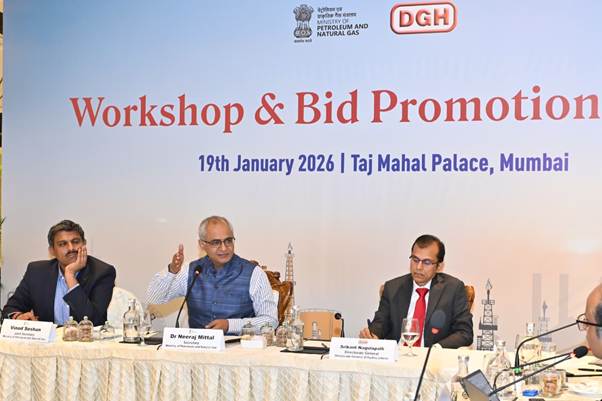
The Ministry of Petroleum and Natural Gas (MoPNG) organised a series of upstream-focused engagements in Mumbai on 19 January 2026.

The day-long programme witnessed strong and diverse participation from domestic and international upstream operators, E&P service providers, global consulting firms, leading public and private sector financial institutions, insurers, academia and industry experts, reflecting the growing interest across the ecosystem in India’s upstream reform agenda and investment opportunities.

In his virtual address, the Minister for Petroleum and Natural Gas, Shri Hardeep Singh Puri highlighted that the recent legislative, regulatory and policy reforms mark a landmark and progressive transformation of India’s upstream sector. He underscored that these reforms, coupled with data-led exploration initiatives, have unlocked extensive investment opportunities, particularly in India’s offshore and frontier areas, and reaffirmed the Government’s commitment to providing a stable, transparent and globally competitive framework to attract sustained domestic and international investment.

Key Components of the Programme

The engagements comprised:

A Workshop on Financing India’s E&P Growth
A Session on the amended Oilfields (Regulation and Development) Act, revised Petroleum and Natural Gas Rules and the Model Revenue Sharing Contract (MRSC)
A Bid Promotion Event for Upcoming Upstream Bid Rounds
Senior officials from MoPNG and the Directorate General of Hydrocarbons (DGH) interacted extensively with participants across sessions.

Financing India’s E&P Growth
The workshop on “Financing India’s E&P Growth” examined the readiness of India’s financing ecosystem to support the scale, depth and continuity of upstream investment envisaged under the Government’s expanded exploration and production programme, including initiatives such as Samudra Manthan.

The session saw active participation from global consulting firms including S&P Global, Deloitte, A.T. Kearney and EY, who shared international perspectives on upstream financing models, risk allocation and capital mobilisation.

Perspectives were also shared by financial institutions and insurers including the State Bank of India, New India Assurance and Bajaj Allianz, covering risk assessment frameworks, exposure considerations, bank guarantee structures and emerging risk-mitigation instruments such as insurance-backed surety bonds.

It was highlighted that as exploration and development activities scale up, capital requirements are expected to rise sharply and become increasingly front-loaded, necessitating financing structures aligned with upstream risk profiles and investment cycles.

Discussions covered:

Existing financing practices in upstream projects
Constraints arising from balance-sheet-based lending
The impact of bank guarantee requirements on capital efficiency
Emerging risk-mitigation and financing instruments, including insurance-backed surety bonds, enabled by recent policy measures
Financial institutions and lenders, including banks and insurers, shared perspectives on risk assessment frameworks, exposure norms and institutional considerations, while emphasising the importance of risk-sharing mechanisms and policy clarity to facilitate deeper capital participation.

In his directional remarks, Sh. Neeraj Mittal (Secretary, MoPNG), underscored that timely and adequate availability of capital will be a critical determinant of upstream execution, and called for sustained engagement between policymakers, operators and financiers to strengthen financing frameworks in line with India’s upstream ambitions.

Amended ORD Act, PNG Rules and Model Revenue Sharing Contract
A dedicated session was held to familiarise operators with the amended Oilfields (Regulation and Development) Act, the revised Petroleum and Natural Gas Rules, and the updated Model Revenue Sharing Contract (MRSC).

MoPNG highlighted that the recent reforms complete a decade-long effort to establish a stable, predictable and investor-aligned upstream regulatory framework, aimed at reducing interpretational ambiguities and supporting long-term planning as exploration activity expands.

DGH explained how the updated MRSC operationalises changes introduced through legislative and regulatory reforms, ensuring coherence between policy intent and contractual implementation.

The Secretary, MoPNG noted the constructive and encouraging response from industry participants, and emphasised that the focus going forward would be on effective and consistent implementation at scale, so that policy certainty translates into tangible outcomes.

New Upstream Bid Rounds – Translating Reform into Opportunity
The bid promotion event showcased the investment opportunities emerging from recent reforms and data-driven exploration initiatives, and aimed at encouraging wider domestic and global participation in India’s upstream sector.

The session highlighted how:

Regulatory evolution
Improved data availability
Government-led exploration initiatives
Strengthening domestic capabilities
are together reshaping India’s upstream investment landscape.

Sh. Srikant Nagulapalli (DG, Directorate General of Hydrocarbons) presented the details of forthcoming bid rounds:

OALP Bid Round X: 25 exploration blocks covering 182,589 sq. km, with 91% offshore
DSF Bid Round IV: 9 contract areas comprising 55 discoveries, with approximately 200 MMTOE of 2P reserves
CBM Bid Rounds 2025–26: 16 blocks, with 74 BCM of prognosticated gas in 2025 and 200 BCM in 2026
The University of Houston presented insights on the hydrocarbon prospectivity of India’s East Coast basins, drawing upon global analogues and basin evaluation methodologies.

Schlumberger presented on basin-scale investment opportunities enabled through digital solutions, demonstrating how advanced subsurface imaging, data analytics and integrated digital workflows can enhance prospectivity understanding, particularly in frontier and underexplored basins.

The session outlined the strategic investment case for India’s hydrocarbon sector, including:

Significant yet-to-find resource potential of 3.9 billion tonnes of oil equivalent
A large and growing domestic market with full marketing and pricing freedom
A relatively low regulatory burden under revenue-sharing contracts
Access to high-quality E&P data through the National Data Repository
A strong policy focus on enhancing domestic production and energy security
Digital India Boost: SAMPANN-DigiLocker Link Offers Secure, Paperless Pension Documents for all pensioners

0

VINOD BHAT
Delhi, JAN 21:
The Office of the Principal Controller of Communication Accounts (Pr CCA) Delhi has notified all pensioners under the Department of Telecommunications about the successful integration of the SAMPANN pension portal with the DigiLocker platform, in line with the Government of India’s Digital India programme.

This integration allows pensioners to effortlessly fetch key documents from SAMPANN—including Pension Payment Orders (e-PPOs), Gratuity Sanction Orders, Communication Sanctions, and Form-16—directly through their DigiLocker accounts. Accessible anytime and anywhere via smartphone or desktop, the facility ensures secure, paperless access, boosting transparency, convenience, and ease for essential services like banking or medical reimbursements.

Shri Ashish Joshi, Pr. Controller of Communication Accounts, Delhi emphasized that this initiative eliminates the need for physical copies, saving time and resources for pensioners across Delhi-NCR and beyond. He also added that this initiative empowers our pensioners with digital self-reliance, aligning with government’s vision for a paperless digital governance.

Pensioners can activate the service by logging into https://digilocker.gov.in with Aadhaar, linking their PPO number, and downloading documents instantly. For support, dedicated helplines and SAMPANN portals remain available. FAQs about the portal are provided at the end of this article.

About SAMPANN:
SAMPANN (System for Accounting and Management of Pension) is a flagship digital platform of the Department, developed, owned, and operated by the Office of the Controller General of Communication Accounts for pension administration and allied financial management functions. Dedicated to the nation by the Hon’ble Prime Minister on 29th December 2018, it marks a shift from system-centric administration to pensioner-centric governance, freeing retirees and their families from visiting offices to claim their rightful benefits.

SAMPANN has digitized the entire pension lifecycle—from initiation and processing of cases to issuance of e-Pension Payment Orders, disbursement, accounting, reconciliation, financial reporting, audit facilitation, and grievance redressal. Pensioners now receive payments directly into their bank accounts, eliminating the need to visit banks or government offices; they can check payment status, submit life certificates, generate e-PPOs, request changes like mobile numbers or addresses, and register complaints from home. The Department also operates toll-free helplines to further assist our esteemed senior citizens.

FAQ- DigiLocker for accessing SAMPANN Services

1. What is DigiLocker?

DigiLocker is India’s government-backed, secure cloud platform for citizens to store, access, and share authentic digital documents like licenses, vehicle registrations, and educational certificates, acting as a digital wallet that makes physical paperwork redundant and facilitates easy verification for services like banking, employment, and education, all under the Digital India initiative and available on Android, iOS, and the web.

2. How to Access DigiLocker?

a. Via Web Portal

1. Go to the official portal: https://digilocker.gov.in/

2. Click Login / Register at the top.

b. Via Mobile App

1. Download the DigiLocker app from Google Play Store (Android) or Apple Store (iOS).

2. Open the app and choose a language of your choice.

3. Allow required permissions (for a better user experience).

3. How to Register & Log In?

Register

1. Open the app/portal and tap Register.

2. Enter your mobile number/Aadhaar number.

3. You’ll receive an OTP (One-Time Password) — enter it to verify your number,

Set MPIN

1. After verifying OTP, you will be prompted to create an MPIN (mobile PIN) — this secures your login.

2. Save your MPIN for future logins.

Log In

You can login using:

✔MPIN

✔OTP

4. How to explore Services on DigiLocker?

Find & Use Services

1. After login, you’ll see the DigiLocker dashboard.

2. Users can use the Search Documents option to find services.

3. SAMPANN service can be explored on DigiLocker portal with keywords viz. SAMPANN, Controller, Communication, DoT, Pension, Gratuity, Commutation, etc.

5. How to use SAMPANN Services on UMANG?

Presently, the following Four service documents of SAMPANN are hosted on DigiLocker:

a) e-PPO

b) Gratuity Payment order

c) Commutation Payment order

d) Form-16

SAMPANN users can enter their PPO number in each category of service and Click on Get Document. The system will generate the Pension Certificate/Gratuity Payment order/Commutation Payment order/Form-16 (As requested by the SAMPANN user) associated with the entered details.

Twin Western Disturbances to Lash J&K from Jan 22, Heavy Snowfall Warning Issued

0

Weather advisory flags highway disruption, avalanche risk till Jan 28

FIRDOUS AHMAD
SRINAGAR, Jan 21: Jammu and Kashmir is bracing for a prolonged spell of inclement weather as two Western Disturbances (WDs) are set to affect the Union Territory in quick succession between January 22 and January 28, triggering widespread rainfall and snowfall, with intense activity expected on January 23 and January 27, according to a weather advisory in possession of Kashmir Despatch.
The advisory, issued by the India Meteorological Department (IMD), Srinagar, and circulated by the Department of Disaster Management, Relief, Rehabilitation and Reconstruction (DMRR&R), cautions that the back-to-back systems could significantly impact daily life, transport, agriculture and safety, particularly in middle and higher reaches of the region.
Two weather systems, prolonged impact
As per the advisory, the first Western Disturbance will remain active from January 22 to January 24, with peak intensity on January 23, while the second system is expected to affect the region from the night of January 26 to the forenoon of January 28, peaking on January 27. The close succession of the two systems is expected to prolong wet and snowy conditions across large parts of Jammu and Kashmir.
Under the influence of these systems, widespread light to moderate rainfall and snowfall is expected across the Union Territory, while moderate to heavy snowfall at isolated places has been forecast, particularly over the Pir Panjal range, the Chenab Valley of Jammu division, and the middle and higher reaches of South Kashmir.
Areas likely to receive heavy snowfall
According to the advisory accessed by Kashmir Despatch, the first Western Disturbance is most likely to cause heavy rainfall and snowfall over several vulnerable locations, including Anantnag, Pahalgam, Kulgam, Shopian, Pir Ki Gali, Gulmarg, the Sonamarg–Zojila axis, Bandipora–Razdan Pass, Kupwara–Sadhna Pass, and the districts of Doda, Udhampur, Reasi, Kishtwar and Ramban.
During the second Western Disturbance, similar weather conditions are expected to prevail, with moderate to heavy rain and snowfall again likely over the Pir Panjal range, encompassing the Chenab Valley of Jammu division and middle and higher reaches of South Kashmir, raising concerns over cumulative snowfall and saturation of slopes.
Highways, air traffic may face disruption
The advisory warns that the prevailing weather may lead to disruption of surface and air transport, including the strategically vital Jammu–Srinagar National Highway and other major roads connecting middle and higher reaches of Jammu and Kashmir. Snow accumulation and reduced visibility may lead to temporary closures of mountain passes and snow-bound roads, particularly during peak snowfall days.
Travellers, tourists and transporters have been advised to plan their movement strictly in accordance with official advisories issued by the Traffic Police and district administrations, and avoid unnecessary travel during adverse weather.
Avalanche, landslide threat flagged
The advisory has also flagged a heightened risk of avalanches in snow-bound areas, urging people to avoid venturing into sloppy and avalanche-prone zones. In addition, there is a possibility of landslides, mudslides and gusty winds ranging between 40 and 60 kmph at vulnerable locations, especially along hilly and mountainous terrain.
Farmers asked to suspend activities
Farmers across the region have been advised to temporarily suspend irrigation, fertilizer application and chemical spray activities during the affected period, as precipitation and low temperatures may adversely impact agricultural operations.
Precautionary measures and public advisory
The Disaster Management Department has urged residents to remain alert and follow official weather advisories in letter and spirit. People have been advised to avoid unnecessary travel to higher reaches, keep essential supplies and medicines readily available, and ensure the safety of elderly persons, children and other vulnerable groups.
The advisory further cautions people not to ignore official warnings and to avoid movement on snow-bound or slippery roads.
Emergency services on standby
To ensure public safety, emergency services have been placed on alert. Citizens can seek assistance through the Unified Emergency Helpline (112) or contact the UT Emergency Operations Centre (UTEOC), J&K, which is operational round the clock.
The advisory has been forwarded to all concerned departments with instructions to give it wide publicity through print, electronic and social media, enabling timely preparedness ahead of the approaching spell of severe winter weather across Jammu and Kashmir.