spot_imgspot_img
spot_img
Home Blog Page 36

Cabinet approves “Mission for Cotton Productivity” with Rs.5659.22 crore Outlay for Self-Sufficiency in Cotton and Competitiveness in Global Textile Markets by 2030-31

0

Vinod Bhat

New Delhi: The Union Cabinet chaired by the Prime Minister Shri Narendra Modi has approved Rs.5659.22 crore for Mission for Cotton Productivity (2026–27 to 2030–31) to address bottlenecks, declining growth, and quality concerns in India’s cotton sector.

The mission aligns with the 5F vision (Farm to Fibre to Factory to Fashion to Foreign) of Government of India. The Mission focuses on enhancing cotton productivity through development of High yielding variety (HYV) seeds resistant to disease and pests, scaling up of existing and latest crop production technologies through states governments, Krishi Vigyan Kendras, and State Agricultural Universities (SAUs) through large-scale promotion and adoption of latest crop production technologies, ensures least contaminant cotton supply to industry, and promote high-quality cotton exports with focus on the following major aspects:

  • Development of High-yielding, climate resilient, pest-resistant seeds, and other production/protection technologies
  • Upscaling improved cotton production technologies like High Density Planting System (HDPS), Closer Spacing (CS), Integrated Cotton Management, and promotion of Extra Long Staple (ELS) Cotton
  • Augmenting quality of cotton through capacity building and promoting modernization of ginning and processing factories, including adoption of best processing practices.
  • Strengthening cotton testing infrastructure across the country with modern, standardized, and accredited facilities to ensure reliable quality assessment and global benchmarking.
  • Robust branding and traceability initiatives under Kasturi Cotton Bharat to position Indian cotton as a premium, sustainable, and globally trusted product.
  • Empowering farmers through digital integration of market yards (mandis), enabling transparent price discovery, direct market access, and improved realization through e-platforms
  • Promotion of cotton waste recycling and circular economy practices to enhance resource efficiency, reduce environmental footprint, and generate additional value streams for the industry
  • Diversification of India’s fibre base by including natural fibres like flax, ramie, sisal, milkweed, bamboo and banana and advancement of environmentally sustainable textile production and innovations. Its strategic integration and promotion to complement cotton and align India’s textile sector with evolving global demand patterns.

The Mission will be implemented by the Ministry of Agriculture and Farmers Welfare and Ministry of Textiles, involving 10 institutes of Indian Council of Agricultural Research (ICAR), one institute of Council for Scientific and Industrial Research (CSIR), and 10 centres of All India Coordinated Research Project (AICRPs) on Cotton operating in different State Agricultural Universities (SAUs) of major cotton growing states.  Initially, 140 districts will be focussed in 14 States through State Department of Agriculture and ICAR for upscaling the technologies and 2000 ginning/ processing factories. Development of high-yielding climate resistant and pest-resistant seeds, deploy modern farming technologies, farmer training, quality improvement, traceability, and strengthening infrastructure by promoting sustainable fibres and innovation across the cotton value chain.

The Mission envisages to accomplish the production of 498 lakh bales (170 kg lint each) of cotton by enhancing lint productivity from 440 kg/ha to 755 kg/ha by 2031. Approximately 32 lakh farmers will be benefitted leading to self-reliance. Promotion of Kasturi Cotton Bharat for traceability and certification, targeting trash reduction <2% and promotion of natural fibres like flax, ramie, sisal, milkweed, bamboo and banana. This is a milestone in making the country self-reliant in Cotton Sector.

Cabinet approves Fair and Remunerative Price of Rs.365/qtl for Sugarcane Farmers for season 2026-27

0

Vinod Bhat

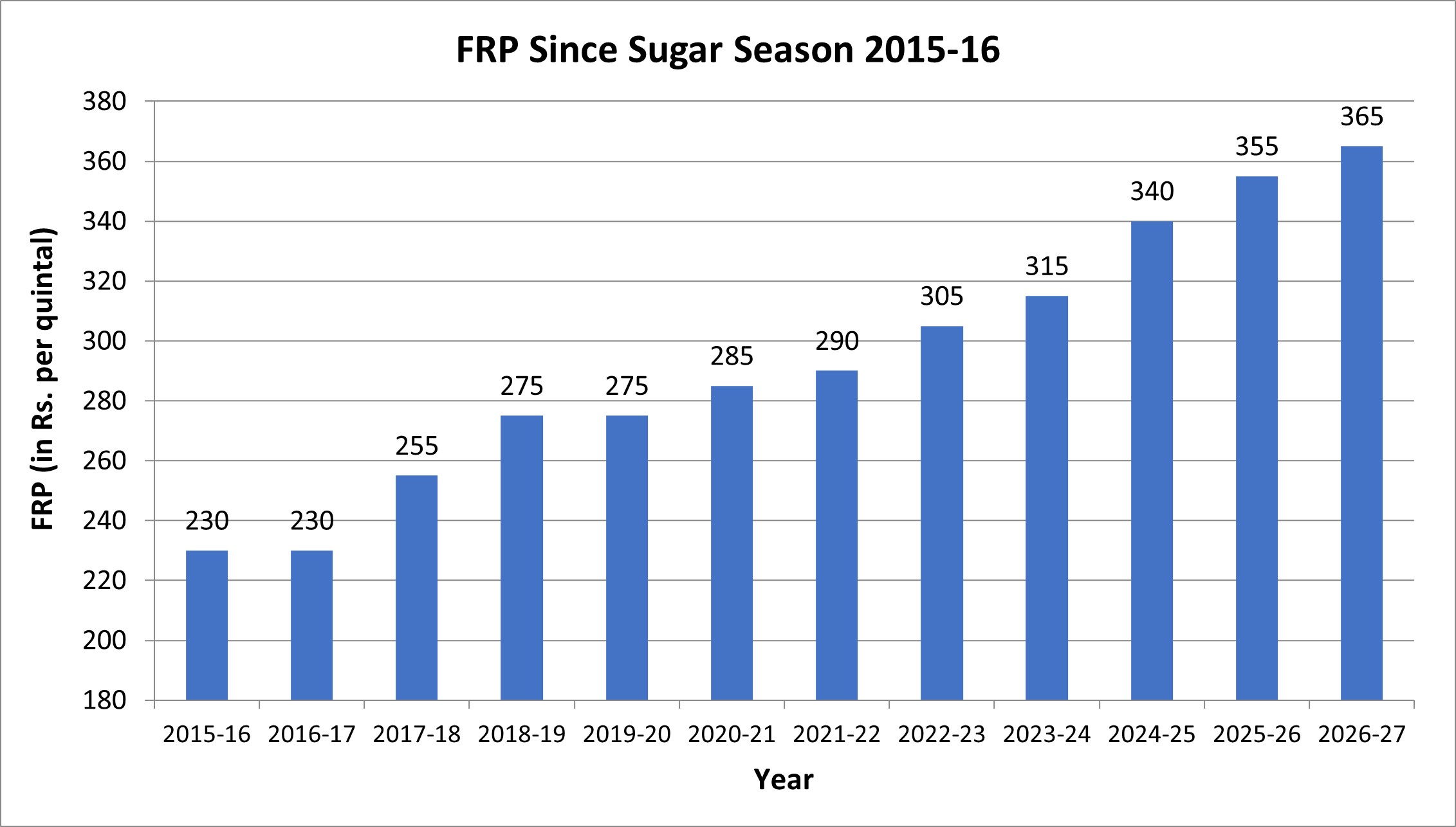
New Delhi: Keeping in view interest of sugarcane farmers (Ganna Kisan), the Cabinet Committee on Economic Affairs chaired by the Prime Minister Shri Narendra Modi has approved Fair and Remunerative Price (FRP) of sugarcane for Sugar Season 2026-27 (October – September) at Rs.365/qtl for a basic recovery rate of 10.25%, providing a premium of Rs.3.56/qtl for each 0.1% increase in recovery over and above 10.25%, & reduction in FRP by Rs.3.56/qtl for each 0.1% decrease in recovery.

The Government with a view to protect interest of sugarcane farmers has also decided that there shall not be any deduction in case of sugar mills where recovery is below 9.5%. Such farmers will get Rs.338.3/qtl for sugarcane in ensuing sugar season 2026-27.

The cost of production (A2 +FL) of sugarcane for the Sugar Season 2026-27 is Rs.182/qtl. This FRP of Rs.365/qtl at a recovery rate of 10.25% is higher by 100.5% over production cost. The FRP for Sugar Season 2026-27 is 2.81% higher than current Sugar Season 2025-26.

The FRP approved shall be applicable for purchase of sugarcane from the farmers in the Sugar Season 2026-27 (starting w.e.f. 1st October, 2026) by sugar mills. The sugar sector is an important agro-based sector that impacts the livelihood of about 5 crore sugarcane farmers and their dependents and around 5 lakh workers directly employed in sugar mills, apart from those employed in various ancillary activities including farm labour and transportation.

Background:

The FRP has been determined on the basis of recommendations of Commission for Agricultural Costs and Prices (CACP) and after consultation with State Governments and other stake-holders.

In the previous Sugar Season 2024-25, out of cane dues payable of Rs.1,02,687 crore about Rs.1,02,209 crore cane dues have been paid to farmers, as on 20.04.2026; thus, about 99.5% cane dues have been cleared. In the current Sugar Season 2025-26, out of cane dues payable of Rs.1,12,740 crore about Rs.99,961 crore cane dues have been paid to farmers, as on 20.04.2026; thus, about 88.6% cane dues have been cleared.

Cabinet approves Emergency Credit Line Guarantee Scheme 5.0

0

Vinod Bhat

New Delhi: The Union Cabinet chaired by the Prime Minister Shri Narendra Modi has approved Emergency Credit Line Guarantee Scheme (ECLGS) 5.0. The scheme aims to provide credit guarantee coverage of 100% for MSMEs and 90% for non-MSMEs as well as airline sector, to Member Lending Institutions (MLIs) by National Credit Guarantee Trustee Company Limited (NCGTC) for the amount in default under the additional credit facility extended to the eligible borrowers to tide over any short-term liquidity mismatches in view of West Asia Crisis.

Salient features of the scheme:

  • Eligible borrowers: MSMEs and non-MSMEs with existing working capital limits and scheduled passenger airlines having outstanding credit facilities, as of March 31, 2026, provided their accounts are standard.
  • Guarantee coverage: 100% for MSMEs and 90% for non-MSMEs as well as airline sector.
  • Guarantee Fee: Nil.
  • Quantum of Support: Additional credit up to 20% of peak working capital utilised during Q4 FY 26 (capped at Rs.100 crore). For airlines up to 100% (capped at Rs.1,500 crore per borrower, subject to satisfying certain specific conditions).
  • Tenor of Loan:
  • For MSMEs/Non MSMEs (except Airline sector): 5 years from the date of first disbursement including moratorium of 1 year.
  • For airline sector: 7 years from the date of first disbursement including moratorium of 2 years.
  • Tenure of Guarantee Cover: Maximum period of guarantee cover shall be co-terminus with the tenor of the loan.
  • Duration of the Scheme: The Scheme would be applicable to all loans sanctioned during the period from the date of issue of these guidelines by NCGTC upto 31.03.2027

Impact:

The scheme aims to enable businesses to tide over the challenges arising from the West Asia conflict. Additionally, this is expected to help businesses maintain their operations, protect jobs, and sustain supply chains. The proposed credit guarantee scheme is a major step to help businesses, particularly MSMEs and airline sector, to ensure their additional working capital needs, are catered by the Banks & FIs. By providing timely liquidity, the scheme will sustain the businesses and prevent job losses. It will also promote uninterrupted domestic production and maintain the resilience of the ecosystem.

Nagbal–Beehama Road in Shambles, Ganderbal Residents Seek Immediate Repairs

0

Touseef Wani

Ganderbal, May 5:Residents of Ganderbal have voiced strong concern over the worsening condition of the Nagbal–Beehama road, which has become a major source of inconvenience for daily commuters.

The road, riddled with potholes across several stretches, has made vehicular movement increasingly difficult and unsafe. Commuters report that the damaged surface has slowed traffic considerably and raised the risk of accidents.

Drivers, in particular, are facing daily hardships navigating the broken patches, leading to frequent delays and higher maintenance costs due to wear and tear of vehicles.

Locals have urged the administration to take immediate steps to repair and restore the road to a proper motorable condition. They also called for expediting the long-pending proposal to upgrade the stretch into a four-lane road to cater to rising traffic and improve connectivity in the area.

“The situation has become unbearable. Authorities must act on priority and ensure a lasting solution,” said a local resident.

Residents are now looking towards the concerned departments for swift intervention to address the issue and prevent further inconvenience.

IUST Hosts Key Workshop Engaging Diverse Stakeholders for Community-Led Action and Ethical Accountability to Combat Drug Menace

0

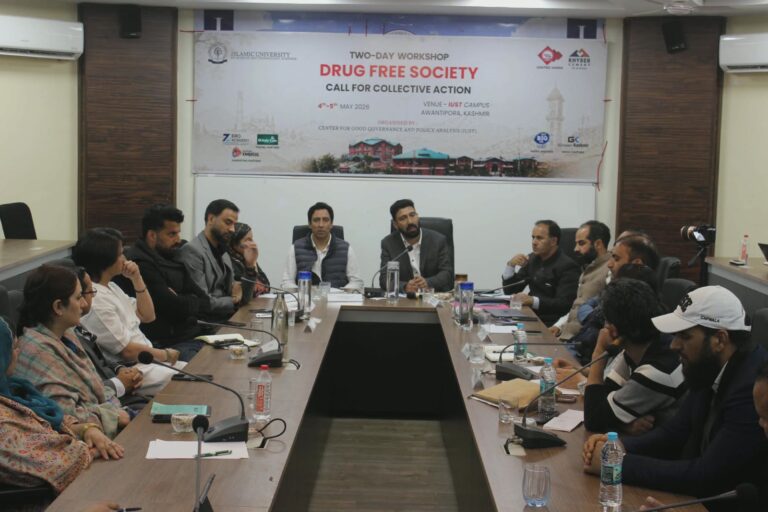
Awantipora, May 05: The Islamic University of Science and Technology (IUST) reaffirmed its commitment to addressing pressing social challenges by hosting the second day of a two-day workshop on “Drug-Free Society: Call for Collective Action.” The programme, through its multiple sessions, brought together a wide spectrum of stakeholders including representatives from the administration, religious leaders, NGOs, academia, and civil society, coordinating a comprehensive and inclusive dialogue on tackling substance abuse.

During a dedicated session with religious leaders, the Grand Mufti of Jammu & Kashmir called for a strong, community-driven response to curb the growing menace of substance abuse. Highlighting the alarming scale of the issue, he noted while thousands of cases have been registered, and significant arrests made the challenge of tackling the issue of drugs is staggering and needs collective efforts. He described substance abuse as a “Shaitaani act”.

Emphasizing the institutional role of IUST in promoting awareness and social responsibility, the Grand Mufti appreciated the university’s proactive efforts in creating platforms for dialogue and action on critical societal issues. He stressed that lack of parental supervision is among the primary causes of substance abuse.

The programme was coordinated by Prof. G. N. Itoo, Director, Centre for Good Governance and Policy Analysis, who asserted that the fight against drug abuse must begin at the family level, with parents playing a central role in guiding and monitoring their children. He also called upon religious leaders to contribute meaningfully towards spreading awareness about this menace and also participate in preventive initiatives.

A Quarter of Power and Promise: NSE Delivers Strong Q4 with 22% Income Growth to ₹5,360 Crore

0
KD NEWS SERVICE
MUMBAI, May 5: The National Stock Exchange of India (NSE) today unveiled a set of numbers that, at first glance, spoke of growth—but beneath them lay a deeper story about the transformation of India’s financial landscape and the millions of people now shaping it.
Over the final quarter of the financial year, the exchange recorded a total income of ₹5,360 crore, a sharp rise from the previous quarter’s ₹4,395 crore. Its profit climbed to ₹2,871 crore, up from ₹2,409 crore, reflecting a powerful surge in activity across the markets. These gains were not abstract—they were driven by a visible shift in how Indians are engaging with investing.
Across the country, more individuals are entering the markets, and those already participating are trading more actively.
This surge in participation translated into a major jump in transaction-based income, which reached ₹4,077 crore in the quarter, marking a 34% increase. The growth was broad-based, cutting across traditional share trading as well as the increasingly popular derivatives segment.
The scale of this activity becomes clearer when seen through daily trading numbers. In the cash market, the average daily trading value rose to ₹1,19,617 crore, while futures trading averaged ₹1,77,891 crore per day.
Options trading, which has become a major driver of volumes, surged to ₹76,375 crore daily, reflecting a sharp rise in both hedging and speculative activity. Together, these figures point to a market that is not only expanding but becoming more sophisticated.
Beyond trading, NSE’s technology-driven services continued to play a crucial role. The systems that connect brokers and investors generated ₹269 crore through connectivity services, while ₹128 crore came from data feeds and terminal services.
Even the exchange’s investments contributed meaningfully, adding ₹198 crore during the quarter. These streams highlight how NSE has evolved into a technology-led ecosystem rather than just a trading platform.
With growth came higher spending. Total expenses for the quarter rose to ₹1,486 crore, compared to ₹1,234 crore earlier. A significant portion of this increase was due to a year-end allocation of ₹223 crore toward social responsibility initiatives, reflecting the institution’s broader role beyond business.
At the same time, the exchange set aside ₹84 crore to address ongoing regulatory settlement matters, while pursuing a larger settlement of ₹1,491.21 crore, which remains under consideration.
Even after these commitments, NSE’s operational strength remained clear. Its operating profit reached ₹3,633 crore, and its underlying profit before tax—adjusted for one-time factors—stood at ₹3,990 crore, showing steady growth at its core.
Looking at the full year, the exchange reported total income of ₹18,713 crore and a profit of ₹10,302 crore, maintaining strong profitability despite slight moderation in income compared to the previous year.
On its core operations alone, the final quarter saw income rise to ₹4,811 crore, with profits of ₹2,503 crore and a profit margin of about 52%, reflecting efficiency and scale.
But the true story of NSE lies not just in earnings, but in its reach and impact.
By the end of the year, 2,979 companies were listed on the exchange, making it a central platform for businesses seeking capital. During the year, companies raised vast sums, including about ₹1.8 trillion through initial public offerings, while total fund mobilisation across instruments reached approximately ₹20.3 trillion.
Its reach now extends to nearly every corner of India, covering 99.9% of postal codes and serving around 13 crore unique investors, supported by roughly 25.7 crore registered accounts. What was once a market dominated by institutions and large cities has now become accessible to millions across towns and smaller regions.
At the same time, the exchange has invested heavily in building awareness and trust. During the year, it conducted 17,902 investor education programs, reaching around 9.4 lakh participants. It also maintains strong safeguards, including an investor protection fund of ₹2,872 crore and a settlement guarantee fund of about ₹13,079 crore, ensuring stability even during periods of market stress.
NSE’s influence is also expanding into newer areas. Its debt market platforms have seen growing activity, while in commodities, innovations such as electricity futures and smaller gold contracts have driven volumes higher, with total turnover reaching ₹11,098 crore during the year. Its mutual fund platform has also grown rapidly, with the number of transactions rising to 12.1 crore, reflecting changing investment habits.
On the global stage, the exchange continues to stand tall. It is now the largest derivatives exchange in the world by trading volume and ranks among the leading exchanges globally in terms of equity trading activity.
These achievements highlight not just size, but the reliability and speed of its systems.
Perhaps the most striking reflection of its importance is its contribution to the country’s finances. During the year, NSE contributed ₹59,186 crore to the exchequer, including ₹48,345 crore in transaction taxes, ₹4,480 crore in income tax, ₹3,411 crore in stamp duty, ₹1,942 crore in GST, and ₹1,008 crore in regulatory fees. Every trade executed on its platform feeds into this larger economic cycle.
For shareholders, the year ended with a strong reward. The board recommended a dividend of ₹35 per share, including a special one-time payout of ₹10, signaling confidence in the exchange’s financial strength and future outlook.
What emerges from all these numbers is not just the story of a successful quarter or even a profitable year. It is the story of an institution that has become deeply woven into India’s economic fabric—connecting millions of investors, enabling businesses to grow, supporting government revenues, and shaping the future of financial markets.
From pioneering electronic trading in 1994 to becoming a global powerhouse today, NSE’s journey mirrors India’s own rise. And as participation deepens and markets evolve, it continues to stand at the center—quietly driving a financial transformation that is still unfolding.

LG Sinha Orders Transfer of 3 IAS Officers

0

Srinagar, May 5: The Jammu and Kashmir Lieutenant Governor Manoj Sinha on Tuesday ordered transfers and postings of three IAS officers with immediate effect in the interest of administration.

According to Government Order No. 869-JK(GAD) of 2026 dated May 5, as per news agency JKNS, Pranjal J Hazarika, IAS (AGMUT: 2021), awaiting orders of posting in the General Administration Department, has been posted as Additional Secretary to the Government in the Labour and Employment Department.

Vivek Agarwal, IAS (AGMUT: 2021), also awaiting orders of posting in the General Administration Department, has been appointed as Additional District Development Commissioner, Budgam.

Meanwhile, Vikas Ahlawat, IAS (AGMUT: 2022), has been posted as Additional Deputy Commissioner, Anantnag.

GOC White Knight Corps Reviews Operational Readiness in Basantgarh

0

Senior Army officers assess security dynamics, stress vigilance and multi-agency coordination

Srinagar, May 5: The White Knight Corps on Tuesday said that its General Officer Commanding (GOC), accompanied by GOC CIF (D), visited the general area of Basantgarh to review the prevailing security situation and operational preparedness.

The Corps in a post on X stated that the visiting officers were briefed on the existing security layout, force deployment, surveillance mechanisms, and contingency response systems in place.

The post further stated that detailed discussions were held on optimising the operational framework and enhancing coordination among various agencies to ensure stability in the hinterland.

The Corps emphasised that sustained vigilance and integrated efforts remain crucial for maintaining a secure environment. “We serve, we protect,” it added.

Young Life Lost Too Soon: Grief Sweeps J&K Accounts Fraternity After Aaman Wani’s Sudden Demise

0

KD NEWS SERVICE

SRINAGAR, May 5: A profound sense of grief and sorrow has engulfed the Jammu and Kashmir Accounts fraternity following the untimely demise of Mohammad Aaman, son of Zahoor Ahmad Wani, Director Finance in the Power Development Department (PDD). The tragic news has sent shockwaves across official circles and the local community alike, marking a heartbreaking loss of a young life full of promise.

According to details, Mohammad Aaman suffered a massive heart attack while on an evening walk in Delhi on May 3, 2026. Despite immediate attention, he could not be revived, leaving his family, friends, and well-wishers devastated. His sudden passing at such a young age has been widely described as both tragic and incomprehensible.

The mortal remains of the deceased were brought back to Kashmir early this morning. The funeral prayers were offered at 7:45 AM in his native locality of Akad, situated approximately 12 kilometers from Anantnag along the K.P. Road. A large number of mourners gathered to pay their last respects, reflecting the deep bond the family shares with the community.

Senior officials and members of the J&K Accounts Services turned out in large numbers to express solidarity with the bereaved family during this difficult time. Among those present were high-ranking dignitaries including the Director General Accounts & Treasuries (DGA&T), Director General Resources/Funds, Director General Budget, Director Accounts & Treasuries Kashmir (DATK), Principal of the Accounts Training Institute (ATI), Srinagar, along with numerous officers and officials from the Accounts fraternity.

In a statement issued here, the J&K Accounts Employees Association expressed deep anguish over the loss. The association extended heartfelt condolences to the grieving family and prayed for eternal peace for the departed soul. “May Allah grant him the highest place in Jannah and bestow strength and patience upon the bereaved family to endure this irreparable loss,” the statement read.

The gathering at the funeral and subsequent condolence visits underscored the respect and empathy shared within the administrative community, highlighting the close-knit nature of the fraternity in times of sorrow.

The Rasm-e-Chahrum (fourth-day ritual prayers) of the deceased will be observed on Friday, May 8, where family, friends, and colleagues are expected to assemble once again to pray for the departed soul.
Mohammad Aaman’s sudden departure leaves behind a void that words can scarcely fill. His memory will continue to live on in the hearts of those who knew him, as the region mourns yet another untimely loss.

Shehlat Foundation, in Collaboration with Mool Mouj Foundation, Organizes Major Awareness Programme on Drug Abuse and Social Evils

0

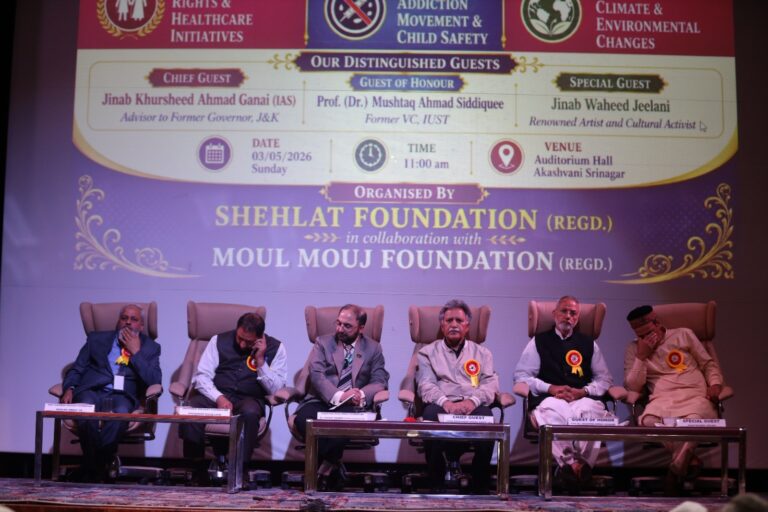
Srinagar: Shehlat Foundation, in collaboration with Mool Mouj Foundation, organized a comprehensive awareness programme focused on drug abuse prevention, rehabilitation, child safety, and social reform, bringing together eminent speakers, social activists, artists, educators, and concerned citizens to deliberate on one of society’s most pressing challenges.

The event commenced with the recitation of the Holy Quran by Adnan Ashraf, a Class 6 student of PM Shri Government Secondary School Laharwalpora, Bandipora, followed by a Naat presented by Abid Salam. Renowned broadcaster Syed Mubashir Rufai skillfully conducted the proceedings.

Delivering the welcome address, Ghulam Abbas (IIS), former Director CBC, emphasized the urgent need for collective social responsibility.

Chief Guest, Mr. Khursheed Ahmad Ganie (IAS), Chairman, Group of Concerned Citizens, described drug abuse as a grave social crisis. He highlighted the critical roles of mothers, sisters, political leadership, NGOs, and grassroots institutions, and stressed the need to strengthen village-level systems with proper resources and clear roadmaps to combat the menace.

Guest of Honour, former Vice Chancellor of IUST, Prof. Dr. Mushtaq Ahmed Siddiqui, identified key factors behind the rise in drug abuse, including weakening family structures, erosion of moral leadership, and unchecked materialism. He emphasized addressing root causes, advocating for stronger joint family systems and the vital role of grandparents in child upbringing.

Special Guest, Waheed Jeelani, underscored the importance of art in social reform, stating that artists, media, and cultural organizations must actively contribute to societal betterment.

Chairman Mool Mouj Foundation, Dr. Zubair Saleem, highlighted that drug abuse is a disease that is preventable and fully curable. He stressed the need for strong government alignment, public awareness, prevention strategies, and rehabilitation efforts, urging active participation in the government’s “Nasha Mukt J&K” mission.

Noted poets Zareef Ahmad Zareef, Zahoor Hygami, and G. M. Dilshad, through their poetic recitations, powerfully conveyed the message against drug abuse and reflected on the deteriorating condition of families affected by substance abuse. They emphasized the role of parents, teachers, and moral education in safeguarding future generations, while expressing concern over declining societal values.
Javid Jawad introduced the vision and mission of Shehlat Foundation, reaffirming its commitment to social welfare.

Dr. Irtiqa emphasized child safety, noting that lack of awareness among parents and elders often leads to irreversible consequences, including death and disability. She strongly advocated prevention as the most effective strategy.

A powerful skit by Firdous Dramatic Club effectively portrayed the societal dangers of drug abuse and highlighted the crucial role of parents in curbing the menace.
Chairman Shehlat Foundation, Mohammad Rafiq Lone, appreciated all participants and reaffirmed that the Foundation will continue to serve as a vital bridge between the government, NGOs, and the public in the fight against social evils.

The programme successfully reinforced the urgent need for coordinated social, cultural, educational, and governmental efforts to build a healthier, drug-free society. Acting Chairman, J&K Yateem Foundation, Mohammad Iqbal Beigh, presented mementos on behalf of Shehlat Foundation to the distinguished guests.