spot_imgspot_img
spot_img
Home Blog Page 87

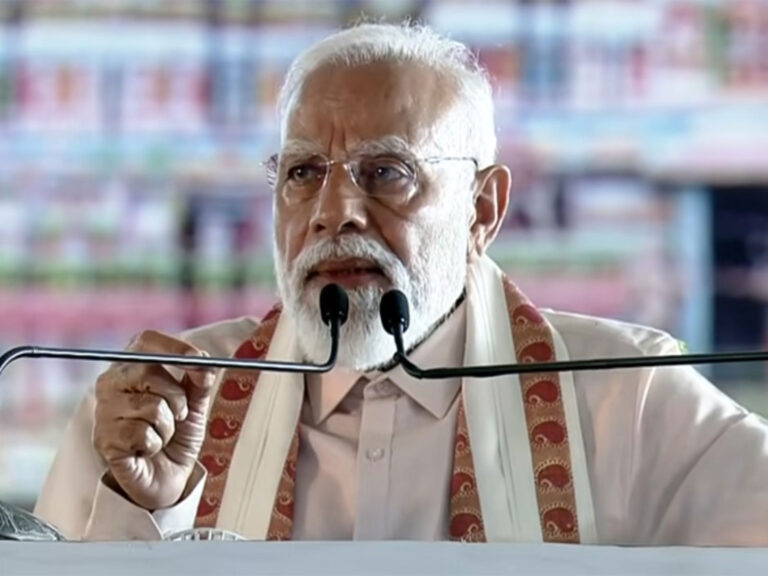
PM Modi inaugurates and lays foundation stones for various development projects worth ₹23,550 crore in Silchar, Assam

0
Vinod Bhat

New Delhi: The Prime Minister, Shri Narendra Modi, laid the foundation stone and inaugurated multiple development projects in Silchar, Assam, today. Addressing the gathering,  PM Modi stated that visiting the Barak Valley, a land defined by its culture and vibrancy, is always a deeply special experience for him. The Prime Minister remarked that Silchar serves as the gateway to this valley, where history and language have merged to create a unique regional identity. Shri Modi noted that the region’s strength lies in its diversity, where Bengali, Assamese, and tribal traditions flourish together in harmony. “The diversity of the Barak Valley is its greatest asset, fostering a spirit of brotherhood among its citizens” affirmed Shri Modi.

The Prime Minister observed that the fertile plains and tea gardens of the region have long been the backbone of its local economy and trade routes. PM Modi stated that today’s inauguration of projects worth thousands of crores will further empower the Barak Valley as a logistics hub for the entire North East. Shri Modi noted that these initiatives in rail, road, and education are designed to create vast employment opportunities for the local youth. The Prime Minister pointed out that the region is now being positioned to connect not just the state, but the neighboring regions of West Bengal and the North East. “Barak Valley is going to become a major logistics and trade hub for the North East,” remarked Shri Modi.

The Prime Minister remarked that the current government is making the region the centerpiece of India’s Act East Policy. PM Modi noted that the current administration is working to restore its industrial glory. The Prime Minister observed that a historic milestone was reached today with the ground-breaking ceremony for the ₹24,000 crore Shillong-Silchar High-Speed Corridor. He stated that this Access Controlled Corridor is the first of its kind in the North East and ends a decades-old wait for the people. Shri Modi noted that this corridor will link Silchar to Mizoram, Manipur, and Tripura, and eventually to the vast markets of South-East Asia. The Prime Minister pointed out that this connectivity will provide an immense boost to local industry, agriculture, and tourism. “Barak Valley is going to be connected to a very bright future,” affirmed Shri Modi.

The Prime Minister stated that the new Silchar flyover will provide much-needed relief from the traffic congestion that has long troubled the city’s residents , this infrastructure is a major boon for students at Silchar Medical College, NIT, and Assam University, saving their precious time. Noting that the electrification of over 2,500 kilometers of Assam’s rail network will ensure faster travel, Shri Modi observed. “High-speed, clean rail transport will significantly benefit the pristine environment of the Barak Valley”.

The Prime Minister said that the tea garden workers and farmers of the valley have contributed immensely in  Assam’s development. He said that so far more than ₹20,000 crore under the PM-Kisan Samman Nidhi has been transferred to the farmers of Assam. Shri Modi further noted that just yesterday, thousands of farmers in the Barak Valley also received money in their bank accounts. The Prime Minister added that this assistance is helping farmers meet their small but important needs related to agriculture. Shri Modi noted that the establishment of the region’s first Agriculture College at Patharkandi will transform the valley into a hub for agricultural research. The Prime Minister pointed out that this institution will provide the necessary support for local youth to launch successful agri-startups. “Barak Valley will now be known for agricultural studies and research,” stated Shri Modi.

Shri Modi stated that the current government follows the mantra of prioritizing those who have been left behind in the race for development. The Prime Minister remarked that while border villages were once considered the “last” villages, his government views them as the “first” villages of the nation. He noted that the Vibrant Village Program, expanded from Cachar district, is already bringing visible improvements to border habitations. The Prime Minister pointed out that the historical neglect of these areas is now being replaced by proactive development and strategic focus. “We consider the border villages as the first villages of the country,” affirmed the Prime Minister.

The Prime Minister observed that the Assam government has performed a historical duty by granting land rights to thousands of tea garden families.Stating that providing these land titles is a major step toward changing the future of generations who served for two centuries, Shri Modi noted that this legal security ensures a life of dignity “These land rights will now allow families to access central schemes like permanent housing, electricity, and water”.

The Prime Minister stated that the government has also focused on providing schools, scholarships, and job opportunities specifically for the youth of the tea gardens. PM Modi remarked that these efforts are opening doors to a golden future for the children of workers who were previously neglected. He said that education, skill development, and health have become the primary pillars of the current government’s regional strategy. The Prime Minister pointed out that Assam is rapidly emerging as a health hub, with AIIMS and cancer hospitals now forming a strong network. “The doors of a golden future are opening for the youth of the tea gardens,” noted Shri Modi.

The Prime Minister observed that while the youth of Assam now have an open sky of opportunities in the semiconductor and tech sectors, the current era of peace and progress has been achieved through immense sacrifices and must be protected from regressive forces. The Prime Minister pointed out that a befitting reply must be given to any force trying to push the state back into its troubled past. “Assam is now becoming an important part of India’s semiconductor sector. The ecosystem and talent related to next-generation technology are getting ready here,” affirmed Shri Modi.

The Prime Minister observed that during global crises and wars, the current government is working with full strength to minimize the impact on Indian citizens. Shri Modi noted that the region’s journey on the path of progress is now unstoppable, supported by its rich language and culture. PM Modi remarked that the development projects inaugurated today are just the beginning of a new era for the valley. The Prime Minister observed that the collective resolve of the people will ensure a bright and prosperous future for the entire state. “The day is not far when Barak Valley will be recognized as a new center of development,” concluded Shri Modi.
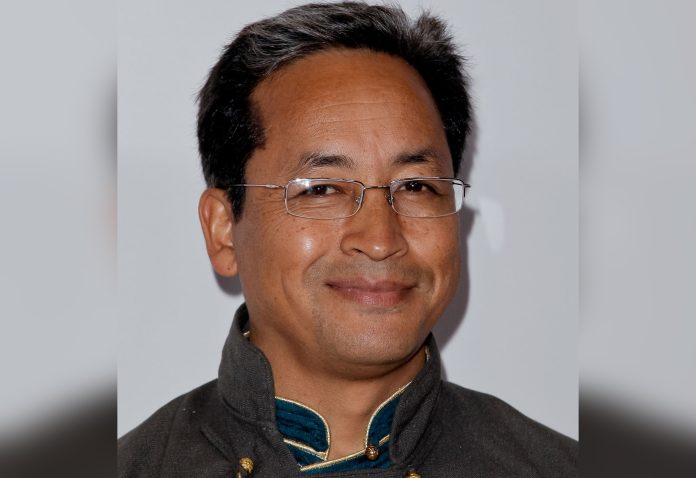
Centre Revokes Detention of Sonam Wangchuk Under NSA

0

Decision Taken to Promote Peace, Stability and Dialogue in Ladakh; Government Reaffirms Commitment to Safeguards for Ladakh; Move Aimed at Creating Environment for Constructive Engagement with Stakeholders; Detention Revoked After Nearly Half of NSA Period Completed

New Delhi, Mar 14: The Ministry of Home Affairs (MHA) has revoked the detention of activist Sonam Wangchuk under the National Security Act with immediate effect, stating that the decision has been taken to foster peace, stability and meaningful dialogue in Ladakh.

MHA in an official Statement issued as per news agency Kashmir News Corner — KNC reads, In the backdrop of the serious law and order situation that arose in the peace-loving town of Leh on 24 September 2025, Shri Sonam Wangchuk was detained on 26 September 2025 under the provisions of the National Security Act (NSA) pursuant to an order issued by the District Magistrate, Leh, with a view to maintaining public order. Shri Sonam Wangchuk has already undergone nearly half of the period of detention under the said Act, it reads,

MHA Statement further reads that, The Government has been actively engaging with various stakeholders and community leaders in Ladakh with a view to addressing the aspirations and concerns of the people of the region. However, the prevailing atmosphere of bandhs and protests has been detrimental to the peace-loving character of the society and has adversely affected various sections of the community, including students, job aspirants, businesses, tour operators and tourists and overall economy.

The Government remains committed to fostering an environment of peace, stability, and mutual trust in Ladakh so as to facilitate constructive and meaningful dialogue with all stakeholders. In furtherance of this objective, and after due consideration, the Government has decided to revoke the detention of Shri Sonam Wangchuk with immediate effect by exercising the powers available under the National Security Act, it reads.

Statement reads that, The Government reiterates its commitment to providing all necessary safeguards for Ladakh. It remains hopeful that the issues concerning the region will be resolved through constructive engagement and dialogue, including through the mechanism of the High-Powered Committee as well as other appropriate platforms.

Powering Resilience: India’s Long-Term Energy Strategy

0

Vinod Bhat

New Delhi: Operation Epic Fury has had an impact of epic proportions on world energy prices, sending crude oil prices skyrocketing to $120 per barrel just a few days ago. Since then, prices have remained volatile, keeping the entire energy market on edge. At the centre of global concern lies the Strait of Hormuz, the world’s most critical chokepoint, through which nearly one-fifth of global crude oil passes. The Strait of Hormuz matters significantly for India’s energy supplies, but things currently look manageable. Over the last 11 years, India has actively diversified the sources of its energy imports. India has also worked to change the mix of its energy sources, strongly pushing domestically generated renewable energy.

Imagine if this crisis had hit India a decade ago. With almost all our oil and gas coming from the same volatile region and no real alternatives in place, the impact would have been devastating. Petrol and diesel prices would have shot up overnight crippling transport and pushing inflation through the roof. India has relative remain insulated to the churn caused by the crisis.  In comparison, other countries are struggling significantly. Japan, already burdened by record-high public debt, has become one of the most vulnerable economies. The gas-reliant UK has seen immediate price spikes leading to renewed inflation. Nations like Egypt and Turkey are confronting fresh inflationary pressures. Singapore is dealing with sharp increases in electricity and petrol costs, while South Korea has resorted to imposing a fuel price cap for the first time in nearly three decades to stabilize its economy amid the oil surge.

The current crisis therefore offers an important reminder; India’s relative resilience today is not accidental. It is the result of deliberate policy choices made over the past decade under Prime Minister Narendra Modi to diversify energy sources and strengthen domestic capacity.

In today’s interconnected world, no country can be fully self-sufficient in energy. Even advanced economies rely on global supply chains for fuel, technology and critical minerals. The real challenge is not eliminating dependence altogether, but ensuring that a single disruption does not cripple the entire system.

Over the past decade, India has steadily moved in that direction. Through a strategy of multi-alignment diplomacy, the country has expanded its crude sourcing network from 27 countries to over 40,[1] reducing reliance on any single supplier or region. In the event of supply disruptions in one part of the world, this broader network provides India with greater flexibility to adjust. Thus not putting all eggs in same basket has helped us sail through.

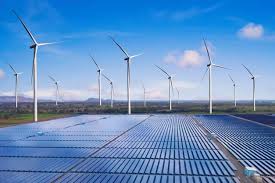
At the same time, India has accelerated the expansion of its domestic energy capacity. The country’s total installed electricity capacity has more than doubled in past 11 years and now crossed 520 GW, with more than half coming from non-fossil fuel sources including renewable energy, hydro and nuclear power.[2] Without this rapid expansion of clean energy, India would today be far more dependent on imported fuels to meet rising electricity demand.

One of the other most visible examples of this shift is the PM Surya Ghar Muft Bijli Yojana, which aims to install rooftop solar panels in one crore households. This has enabling families to generate their own electricity, promoted decentralised energy production and reduces pressure on conventional power sources.[3]

Beyond lowering household electricity bills, the programme carries significant long-term economic and environmental benefits. The initiative is expected to save the government nearly ₹75,000 crore annually in electricity costs,[4] highlighting how clean energy expansion can simultaneously strengthen fiscal efficiency and sustainability.

Without such decentralised solar expansion, rising electricity demand would have placed greater pressure on fossil-fuel-based power generation, increasing fuel imports and making India far more vulnerable to global energy disruptions like those unfolding today.

Such initiatives have also begun to influence household energy behaviour. As rooftop solar expands and electricity becomes cheaper, families may increasingly rely on electric appliances for cooking and other daily needs. Over time, this shift could reduce India’s dependence on imported LPG as well.

Alongside renewable electricity generation, India is also transforming its mobility sector through EV. This shift is strategically important because the transport sector accounts for a significant share of India’s oil consumption, meaning that electrifying mobility can gradually reduce long-term crude oil demand. Reflecting this transition, India’s EV sector has expanded rapidly from just 2,600 electric vehicles in 2014 to 16.71 lakh EV sales in 2025, signalling the growing adoption of clean mobility.[5]

Government policies have played a crucial role in this transition. The FAME-I scheme (2015) supported around 2.78 lakh EVs, saving nearly 50 million litres of fuel.[6]

As EV adoption grows, its impact goes beyond cleaner transport. Over time, greater electric mobility will reduce India’s dependence on imported oil, making the country less vulnerable to global disruptions like those currently unfolding in the Middle East. If the rapid expansion of electric vehicles had not taken place over the past decade, India would have been at tight spot. India would be even more dependent on petrol and diesel for transportation, exposing the economy to sharper fuel price spikes and a much larger import bill at a time when global energy markets are already under severe stress.

The integration of renewable energy with electric mobility creates a powerful multiplier effect. Electric vehicles already have significantly lower operating costs than petrol or diesel vehicles. When EVs are charged using solar power generated at home, transportation becomes not only cleaner but also significantly cheaper. The broader impact is both economic and strategic. Lower fuel imports not only improve air quality and mobility but also shield the economy from external oil shocks like those currently unfolding in global energy markets.

India has also strengthened its Strategic Petroleum Reserve (SPR) capacity over the past decade to prepare for supply disruptions during geopolitical crises. Under PM Modi, India expanded its emergency oil storage infrastructure with strategic reserves at Visakhapatnam, Mangaluru, and Padur, while initiating additional facilities at Chandikhol and Padur Phase-II. As a result, India today has oil reserves that can sustain the country for around 74 days when strategic reserves are combined with commercial inventories.[7] A decade ago, however, India’s emergency crude reserves could cover barely 13 days of demand,[8] leaving the economy far more exposed to sudden import shocks. The expansion of strategic reserves has therefore placed India in a significantly stronger position to manage supply disruptions and price volatility during crises like the one currently unfolding in global energy markets.

In a world where geopolitical tensions can disrupt global energy supply chains overnight, true resilience is not something built during a crisis. It must be forged years in advance through foresight, strategic planning, and decisive action. India’s decade-long push for energy diversification under PM Modi, including diversifying import sources and routes, building strong long-term global partnerships, making massive investments in domestic infrastructure, and accelerating the shift to renewables, is now clearly proving its value. As the Hormuz crisis reveals vulnerabilities across the globe, India’s preparations have significantly softened the impact compared to many other nations. This moment underscores why proactive self-reliance in energy is more critical than ever. In an unpredictable world, such forward-thinking strategies remain the strongest defence against sudden economic shocks.

Ex-J&K DGP R.R. Swain Named Chairman of Odisha Uniformed Services Staff Selection Commission

0

VINOD BHAT

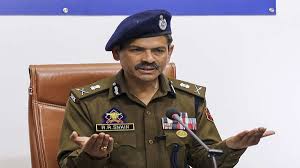
NEW DELHI, Mar 13: Former Director General of Police (DGP) of Jammu and Kashmir, Rashmi Ranjan Swain, has been appointed as the Chairman of the Odisha Uniformed Services Staff Selection Commission (OUSSSC), marking a new chapter in the veteran police officer’s long and distinguished career in public service.

A 1991-batch officer of the Indian Police Service from the Odisha cadre, Swain retired as the police chief of Jammu and Kashmir in 2024 after decades of service in some of the most challenging policing environments in the country. With his appointment, he will become the first Chairman of the newly constituted commission tasked with overseeing recruitment and selection processes for various uniformed services in the state.

The Odisha Uniformed Services Staff Selection Commission has been established to streamline and strengthen recruitment procedures for police and other uniformed services in the state. As Chairman, Swain will be responsible for guiding the commission’s functioning, ensuring transparency in recruitment, and implementing robust selection mechanisms to enhance the efficiency and professionalism of the state’s uniformed forces.

Born in Rourkela in Odisha, Swain has had an illustrious career spanning over three decades in policing and security administration. During his tenure in Jammu and Kashmir, he held several crucial field and administrative assignments, gaining extensive experience in law enforcement, counter-insurgency operations, and intelligence coordination.

Over the years, Swain served as Senior Superintendent of Police (SSP) in several key districts of Jammu and Kashmir, including Jammu, Srinagar, Leh, Poonch, and Ramban. His field postings in these strategically important regions exposed him to diverse law-and-order challenges ranging from urban policing to border security and counter-insurgency management.

Apart from field assignments, Swain also played an important role in strengthening institutional mechanisms within the police system. He served in the Jammu and Kashmir Anti-Corruption Bureau (formerly Vigilance Organisation), where he was involved in investigating corruption-related cases and promoting accountability within public institutions.

Later in his career, Swain held the post of Special Director General in the Criminal Investigation Department, where he supervised critical intelligence operations and investigations related to security threats and organized crime.

Widely regarded as a firm and professional officer, Swain was known for his strong stance against militancy and his emphasis on dismantling terror networks operating in the region. During his service in Jammu and Kashmir, he played a key role in counter-terror operations and efforts aimed at identifying and disrupting terror-financing channels that sustained
militant activities in the region.

His leadership and experience in intelligence-led policing and counter-terror strategy earned him recognition within security circles, particularly during the challenging security environment in Jammu and Kashmir.

With his appointment as Chairman of the Odisha Uniformed Services Staff Selection Commission, Swain is expected to bring his vast administrative and policing experience to the institution, contributing to the creation of a transparent, efficient, and merit-based recruitment system for uniformed services in Odisha.

Kishtwar Kings, Jammu Panthers Register Wins in YSS-JKSC Cricket Premier League; Doda Lions Edge Jammu Swords

0

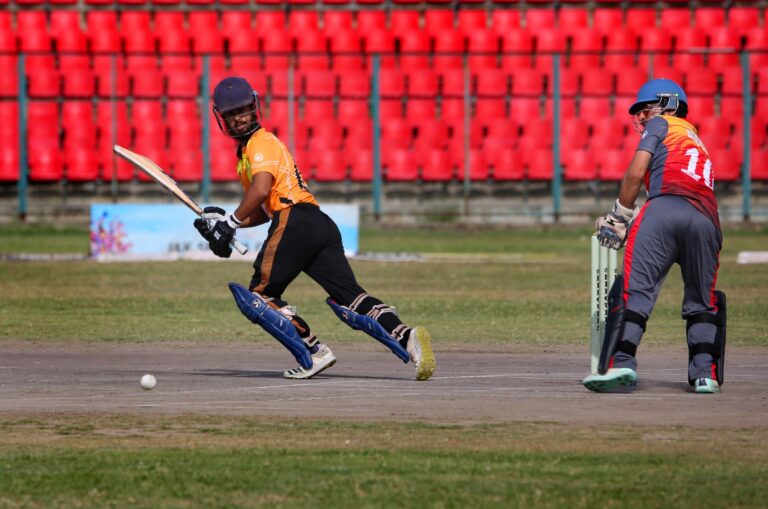
Jammu, Mar 13: Kishtwar Kings defeated Banihal Kites by 32 runs, Jammu Panthers defeated Doda Lions by 18 runs, and Doda Lions edged past Jammu Swords by 7 runs in the YSS-JKSC Cricket Premier League matches played at M A Stadium in Jammu on Friday.

In the first match of the day, Kishtwar Kings, after winning the toss, elected to bat first and posted a competitive 155/7 in 19 overs. The innings was anchored by Faraaz Butt, who smashed an explosive 51 off 25 balls, striking seven fours and three sixes at a strike rate above 200.

He was well supported by Akmal Afzal, who made 33 from 26 balls, while Damil Amin added a useful 27 off 23 deliveries to help push the total past the 150 mark. Late contributions from Waseem Bhat (14 not out) and Sameer Sheikh (6 not out off 2 balls) provided a final flourish.

For Banihal Kites, Khan Ussama was the pick of the bowlers, claiming 3 wickets for 23 runs in 4 overs, while Amir Lefty chipped in with two wickets.

Chasing 156, Banihal Kites struggled to build partnerships and were bowled out for 123 in 17.3 overs. Furqaan Khan top-scored with 35 off 25 balls, while Haris Mir contributed 20 and Basit Wani added 19, but the chase never gathered momentum.

Kishtwar Kings’ bowlers maintained tight control throughout the innings. Saqib Majeed delivered the standout spell, taking 3 wickets for just 12 runs in 4 overs, while Burhan Qazi, Shahbaz Malik, and captain Mehmood Ur Rehman claimed two wickets each to seal the victory.

With this convincing win, Kishtwar Kings strengthened their position in the league, thanks to an explosive half-century from Faraaz Butt and a disciplined bowling display led by Saqib Majeed.

In the second match of the day, batting first after winning the toss, Jammu Panthers posted a competitive 199/8 in 20 overs, powered by aggressive middle-order contributions.
Wicketkeeper-batsman Atul set the early momentum with a quick 42 off 25 balls, striking nine boundaries. He was well supported by Vishaavjeet Singh, who added 34 from 23 deliveries with seven fours. The innings gathered further pace in the latter stages as Ahmed Farooq smashed 44 off 24 balls, including four fours and two sixes, while Sami Ullah hammered 44 from just 22 balls with three sixes to push the total close to the 200 mark.
For Doda Lions, Adil Wani and Yawar Khan were the pick of the bowlers, claiming three wickets each, but the Panthers’ batting depth ensured a challenging target.

In reply, Doda Lions fought hard but ultimately fell short, finishing at 181/8 in their 20 overs. Opener Farhab Shapoo played a brilliant knock of 54 off 36 balls, striking nine fours and a six to anchor the chase. Muteeb Mehraj contributed 32 off 27 balls, while Mehran Ganai chipped in with 19, but regular wickets halted the Lions’ momentum during the middle overs.

The turning point came through an outstanding spell from Deep, who delivered a match-winning performance with the ball. The pacer returned figures of 4 for 19 in his four overs, removing key batsmen and tightening the chase.

Despite a late push from the lower order, Doda Lions could not close the gap, allowing

Jammu Panthers to secure a hard-fought 18-run victory.
In the third match of the day, Doda Lions held their nerve to secure a narrow 7-run victory over Jammu Swords.

After winning the toss, Doda Lions opted to bat first and posted a competitive 185/5 in 20 overs, thanks largely to a brilliant innings from captain Aamir Ashraf, who anchored the batting with 86 runs off 56 balls, striking 14 boundaries at an impressive strike rate of 153.57.

Ashraf received useful support from Yawar Khan (21) and Mehran Ganai, who remained unbeaten on 32 off 23 balls. In the final overs, Adil Wani provided a quick boost with a fiery 22 from just 7 balls, including three sixes, helping the Lions finish strongly.

For Jammu Swords, Pranav Gupta and captain Rahul Khatri picked up two wickets each, but the bowlers struggled to contain the Lions’ aggressive batting in the death overs.
Chasing 186 for victory, Jammu Swords lost early wickets, slipping to 21/2 inside three overs. However, Vimarsh Kaw steadied the innings with a classy 76 off 52 balls, hitting eight fours and a six to keep his side in the hunt.

Later, Pranav Gupta produced a late assault with an unbeaten 51 off just 21 deliveries, smashing seven fours and two sixes to bring the Swords close to the target. Despite the late charge, Jammu Swords finished on 178/6 in their 20 overs, falling just short
Among the bowlers for Doda Lions, Adil Wani (2/33) and Amir Wani (2/35) played crucial roles, while Arif Rather delivered an economical spell of 1/14 in four overs, putting pressure on the opposition during the powerplay.

With this hard-fought win, Doda Lions emerged victorious in one of the most exciting matches of the league so far.

J-K Cabinet Clears 18% Fare Hike for Passenger Vehicles, Okays MLA Allowance Upgrade

0

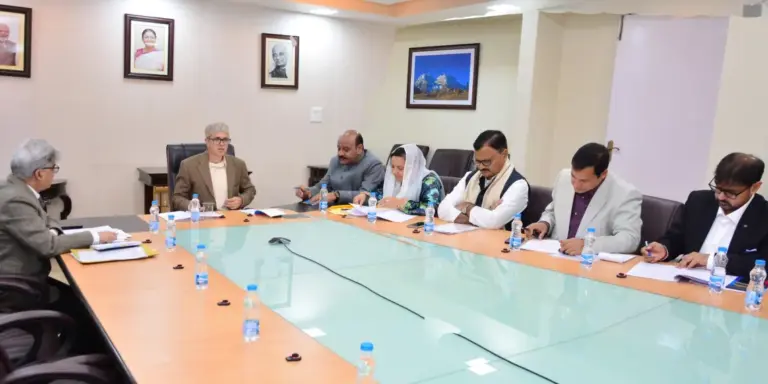
JAMMU, Mar 13: The Jammu and Kashmir government on Friday announced a significant hike in passenger vehicle fares and approved enhanced allowances for ministers and legislators, following a cabinet meeting chaired by Chief Minister Omar Abdullah.

Sources told that, an 18 per cent increase in fares for all categories of passenger vehicles was cleared by the cabinet. The government also fixed the fare for e-rickshaws at Rs 15 per kilometre, while e-autos will now charge Rs 25 for the first kilometre and Rs 20 for subsequent kilometres.

The proposals approved by the cabinet will be sent to Lieutenant Governor Manoj Sinha for final ratification, sources added.

Sources said the cabinet gave its nod to amend rules to enhance travel, medical, housing, and car loan allowances for ministers, MLAs, the Speaker, and the Leader of the Opposition.

On the healthcare front, the administration also approved the creation of 136 faculty positions to strengthen the Government Medical Colleges in Jammu and Srinagar. The new posts comprise 27 professors and 109 associate professors.

Notably, the cabinet also consented to allow the neighbouring Union Territory of Ladakh to utilise the Jammu & Kashmir Real Estate Appellate Tribunal as a joint forum for resolving property-related disputes. (KNS)

Cabinet Condemns Attack on Farooq Abdullah, Hikes Allowances; Assures Adequate LPG Stock

0

Srinagar, Mar 13: The Jammu and Kashmir cabinet on Tuesday unanimously condemned the attack on Farooq Abdullah, president of the Jammu and Kashmir National Conference, demanding deep investigation into this attack.

According to an official spokesperson, the cabinet has also approved an 18 percent hike in passenger vehicle fares, a demand that transporters had been raising for the past five years. Transporters had sought a 50 percent increase, but the government approved an 18 percent hike.

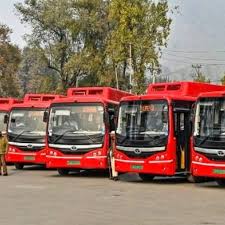
The spokesperson said the government is also pressing 200 more buses onto the roads.

The cabinet further approved the enhancement of TA DA and medical allowances for ministers, MLAs, the Speaker and the Leader of Opposition (LoP), he said.

On the ongoing LPG crisis, the spokesperson said there is enough stock of LPG in Jammu and Kashmir and appealed to people not to panic.

He urged the public to cooperate with authorities, adding that teams have been formed to check any possible black marketing.

BDO Among Three Arrested as Police Bust Fake Currency Racket in South Kashmir

0

Shopian, Mar 13: Acting on a complaint from a local shopkeeper, J&K Police have busted a fake currency circulation racket in Shopian and recovered counterfeit notes worth ₹79,000, leading to the arrest of three accused persons, police officials said on Friday.

According to the officials, the accused have been identified as Mohd Syed Wani S/O Gh. Mohiuddin Wani R/O Batpora Shopian; Mohd Maqbool Naikoo S/O Habibullah Naikoo R/O Bungam Shopian; and Peerzada Altaf S/O Peerzada Gh Mohd R/O Tukroo Babnad (BDO Zainapora).

They said that a case FIR No. 33/2026 under relevant sections of law has been registered at Police Station Shopian and investigation has been taken up.

In a statement, a police spokesperson said that a complainant reported that an individual had used fake currency notes while purchasing goods from his shop. Acting promptly on the complaint, the police initiated an investigation into the matter.

“During the course of investigation, police recovered suspected fake currency notes amounting to ₹79,000 from the possession of the accused persons and their associate, ” he said.

The recovered currency notes are suspected to be counterfeit and will be sent to the Forensic Science Laboratory (FSL) for expert examination to determine their genuineness, the statement said.

The spokesperson further said that all the accused persons have been formally arrested, and further investigation is underway to trace the source of the fake currency and identify other persons involved in the circulation network.

Shopian Police urge the general public to remain vigilant while dealing with currency transactions and report any suspicious activity to the nearest police station.

Woman Feared to Have Jumped into Jhelum from Chandanwari Uri Rope Bridge; Search Operation Underway

0

Srinagar, Mar 13: A woman is feared to have jumped into the River Jhelum from the Chandanwari rope bridge in Uri, officials said on Friday.

They told that the incident came to light after some belongings suspected to belong to the woman were found on the bridge. “A mobile phone and a shoe were recovered from the spot, raising suspicion that the woman may have jumped into the river.”

“After receiving information, a police team rushed to the spot and found a mobile phone and a shoe lying on the bridge,” officials said adding “it is suspected that the woman may have jumped into the River Jhelum.”

Soon after the incident, teams of the police and the State Disaster Response Force (SDRF) launched a search operation in the river to trace the woman.

Officials said rescue teams are conducting searches in the area, but no trace of the woman had been found till the filing of this report. (GNS)

Shri Vinai Kumar Saxena takes oath as 4th L-G of UT Ladakh

0

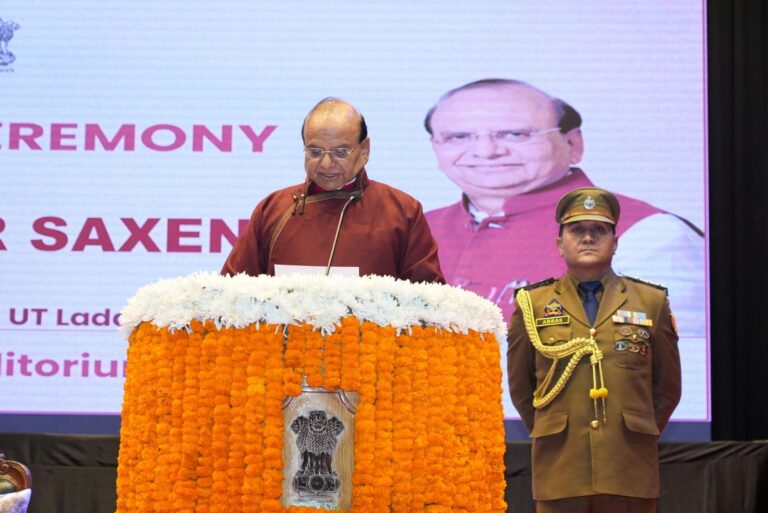
Leh, March 13: Shri Vinai Kumar Saxena today took oath as the 4th Lieutenant Governor of the Union Territory of Ladakh at a ceremony held at the Arya Nagarjuna Auditorium of the Central Institute of Buddhist Studies (CIBS) in Choglamsar.

The oath of office and secrecy was administered by the Hon’ble Chief Justice of the High Court of Jammu and Kashmir and Ladakh, Justice Arun Palli. Earlier, Chief Secretary Ashish Kundra read out the warrant of appointment issued by the President of India, following which Shri Vinai Kumar Saxena signed the charge certificate.

Shri Saxena succeeds Kavinder Gupta as the Lieutenant Governor of the Union Territory of Ladakh.

Following the swearing-in ceremony, Shri Vinai Kumar Saxena was accorded a ceremonial guard of honour by the Ladakh Police.

Interacting with the media after the ceremony, the Lieutenant Governor expressed his gratitude to Hon’ble Prime Minister Shri Narendra Modi and the Union Home Minister Shri Amit Shah for entrusting him with the responsibility of serving the people of Ladakh. Describing Ladakh as the “crown of India”, he assured that he would work wholeheartedly in accordance with the aspirations and requirements of the people.

Highlighting his development approach, Shri Saxena stated that he intends to visit villages and remote areas across Ladakh to understand the problems faced by people on the ground and identify practical and sustainable solutions. He noted that Ladakh possesses tremendous tourism potential and emphasised that one of his key priorities would be to make Ladakh one of the most beautiful and sought-after tourism destinations in the country and the world.

The Lieutenant Governor also stressed the importance of sustainable and environmentally responsible development, noting that Ladakh’s fragile ecosystem requires careful planning.

He spoke about the need to increase greenery through plantation drives, afforestation initiatives and the development of water bodies. He also highlighted the importance of improving urban infrastructure, including cleanliness and the expansion of sewage treatment facilities.

Reiterating the commitment of the administration towards the welfare of the people, Shri Saxena said that, as entrusted to him by Prime Minister Narendra Modi, he would ensure that the people of Ladakh are never disappointed. He added that he would work in close coordination with the people and seek their cooperation in transforming Ladakh into a developed and progressive Union Territory. He further stated that he would make every effort to meet people from different sections of society and address their concerns.

On the occasion, the Lieutenant Governor also interacted with people from diverse backgrounds who had gathered to greet him and convey their best wishes on assuming charge as the Lieutenant Governor of Ladakh. The ceremony also featured a cultural performance in his honour, showcasing Ladakh’s rich cultural heritage.

Shri Vinai Kumar Saxena brings with him over three decades of extensive experience in the corporate and social sectors. Prior to this appointment, he served as the Lieutenant Governor of Delhi, where he initiated several measures aimed at strengthening urban governance, environmental conservation and public infrastructure. During his tenure in Delhi, he was credited with restoring urban forests such as Sanjay Van, developing green public spaces along the Yamuna riverfront, initiating land management reforms, strengthening citizen-centric civic amenities and overseeing city beautification initiatives.

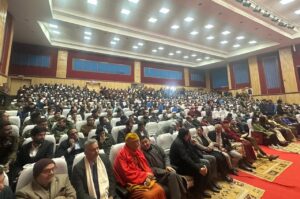
Among those present at the swearing-in ceremony were Chief Executive Councillor, LAHDC Kargil, Dr Mohd Jaffer Akhoon; Member of Parliament from Ladakh, Shri Mohmad Haneefa Jan; His Eminence Drukpa Thuksey Rinpoche; DGP Ladakh, Shri Mukesh Singh; GOC 14 Corps Lt Gen Hitesh Bhalla; Founder of Mahabodhi International Meditation Centre, Bhikkhu Sanghasena; former Member of Parliament from Ladakh, Shri Jamyang Tsering Namgyal; Principal District and Sessions Judge Leh, Smt Spalzes Angmo; Executive Councillors from LAHDC Kargil, Administrative Secretaries, Deputy Commissioner Leh, Shri Romil Singh Donk; Deputy Commissioner, Kargil, Shri Rakesh Kumar; SSP Leh Shree Raam; Directors and Heads of Departments, representatives from various political, religious and civil society organisations, state awardees, prominent citizens, senior government officials, law officials and officers from the Indian Army, ITBP and Ladakh Police.