spot_imgspot_img
spot_img
Home Blog Page 94

Indian Railways Approves Over ₹765 Crore for Traction Upgrades and Digital Communication Overhaul Across Key Corridors

0
Vinod Bhat

New Delhi: Indian Railways has sanctioned a series of key infrastructure and technology upgradation works totalling over ₹765 crore to strengthen operations, expand line capacity, and modernise communication systems across critical sections of the network.

The sanctioned projects cover upgradation of electric traction systems on two high-density freight and passenger corridors, and a major expansion of the optical fibre communication backbone across Vadodara and Mumbai Central Divisions of Western Railway.

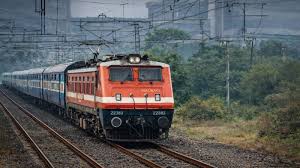
Upgradation of Electric Traction System in Duvvada–Visakhapatnam–Vizianagaram Section

Indian Railways has also sanctioned ₹318.07 crore for upgrading the electric traction system on the 106-km Duvvada–Visakhapatnam–Vizianagaram section of East Coast Railway.

The section will be upgraded from the existing 1×25 kV system to a more advanced 2×25 kV system, enabling higher freight loading, improved speed potential, and enhanced reliability on this high-density corridor.

Located on the busy Howrah–Chennai route, this section plays a crucial role in transporting minerals and industrial goods from Odisha and Chhattisgarh to Visakhapatnam Port. The upgrade will strengthen power supply capacity, ensuring smoother freight movement and more efficient passenger train operations.

The project is part of a nationwide programme included in the 2024–25 Railway Budget aimed at modernising electric traction systems across Indian Railways.

Upgradation of Electric Traction System in Raichur–Guntakal Section

Indian Railways has sanctioned ₹259.39 crore for upgrading the electric traction system on the 126-km Raichur–Guntakal section spanning Karnataka and Andhra Pradesh under Guntakal Division of South Central Railway.

The section will be upgraded from the existing 1×25 kV system to a more advanced 2×25 kV system, enabling higher train loads, improved speed potential, and greater operational reliability on this high-density corridor.

Located on the busy Mumbai–Chennai route, the upgrade will strengthen power supply capacity, facilitating smoother freight movement and faster passenger services, including Vande Bharat trains. The project will contribute to Indian Railways’ mission of achieving 3,000 MT freight loading while enhancing overall network efficiency.

The work forms part of a nationwide programme included in the 2024–25 Railway Budget aimed at modernising electric traction systems across Indian Railways.

Provision of OFC Communication Backbone in Vadodara and Mumbai Divisions

Indian Railways has sanctioned ₹187.88 crore for strengthening the communication backbone in Vadodara and Mumbai Central Divisions of Western Railway.

The project provides for installation of a 4×48 core Optical Fibre Cable (OFC) backbone architecture, ensuring enhanced bandwidth, network redundancy, and reliable support for LTE-based Kavach and other critical railway communication systems. This upgrade will strengthen the digital infrastructure required for the implementation of Kavach, the indigenous train collision avoidance system.

Under this work, optical fibre cables will be laid over 1,000 route kilometres, including 692 km in Vadodara Division and 308 km in Mumbai Division.

The project is part of a larger nationwide programme included in the 2024–25 Railway Budget aimed at expanding Kavach and modernising railway communication systems across the network.

Strengthening Rail Infrastructure and Capacity

These sanctioned works will enhance the efficiency and reliability of railway operations by improving traction power systems, strengthening communication backbone infrastructure, and enabling higher freight loading capacity along major railway corridors.

The initiatives will also support the operation of modern trains, strengthen digital communication networks, and improve the overall performance of Indian Railways across key freight and passenger routes.
PM Modi to visit Kerala and Tamil Nadu on 11th March

0
Vinod Bhat

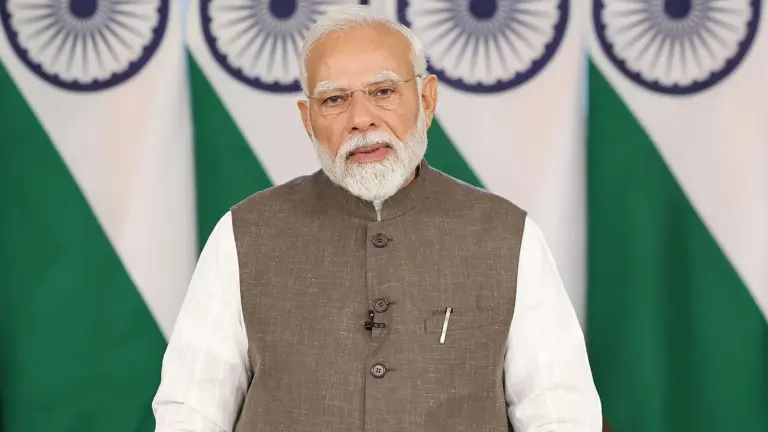
New Delhi: Prime Minister Shri Narendra Modi to visit Kerala and Tamil Nadu on 11th March 2026. At around 1:30 PM, Prime Minister will inaugurate, dedicate to the nation, lay the foundation stone and flag off multiple developmental projects worth around ₹10,800 crore in Ernakulum, Kerala. Prime Minister will also address the gathering during the programme. Thereafter at around 5:45 PM, Prime Minister will inaugurate, dedicate to the nation and lay the foundation stone for multiple development projects worth about ₹5,650 crore in Tiruchirappalli, Tamil Nadu. Prime Minister will also address the gathering on the occasion.

PM in Ernakulum

PM will lay the foundation stone for Polypropylene Unit at the Kochi Refinery of Bharat Petroleum Corporation Limited (BPCL). The investment on this project is over ₹5,500 crore The capacity of this Polypropylene Unit is 400 Kilo Tons Per Annum. Polypropylene is an essential material used in packaging, automotive components, medical devices, textiles, and household products. The facility will strengthen India’s domestic polymer manufacturing capability, reduce import dependency, promote industrial growth and will generate employment opportunities in the region.

In the road infrastructure sector, Prime Minister will inaugurate two major highway projects. The first is the six-laning of Thalapady-Chengala section of NH-66, built at a cost of over ₹2,650 crore. This section forms part of the Mumbai-Kanyakumari Economic Corridor and will strengthen connectivity between Kasaragod and Kannur districts and neighbouring regions including Mangalore and Muzhapilangad. The project will improve connectivity to key towns such as Kasaragod, Bekal, Payyannur and Kannur, enhance linkage to Azhikkal Port and support tourism and trade.

The second project is the six-laning of Kozhikode Bypass from Vengalam to Ramanattukara, constructed at a cost of around ₹2,140 crore. The project upgrades the existing undivided two-lane road into a six-lane highway with service roads on both sides. It will significantly reduce congestion, improve traffic capacity and enhance road safety. The travel time along this stretch is expected to reduce from over one hour to about 15–20 minutes. The project will also improve connectivity to important destinations such as Kozhikode Beach, Beypore Port and Kappad Beach, boosting tourism and trade in the region.

Prime Minister will also inaugurate 23 rural roads constructed under the Pradhan Mantri Gram Sadak Yojana (PMGSY) in Kerala. These roads will improve connectivity in rural and remote areas and help ensure better access to markets, education, healthcare and employment opportunities, thereby strengthening rural livelihoods.

Prime Minister will inaugurate three redeveloped railway stations under the Amrit Bharat Station Scheme – Shoranur Junction, Kuttippuram, and Changanassery. These stations have been modernised with improved passenger amenities and enhanced accessibility. The redevelopment integrates local architectural elements while creating modern, safe and convenient travel spaces for passengers.

Prime Minister will dedicate to the nation the Shoranur-Nilambur Road Railway Line Electrification Project. The electrification of this important rail section will enable faster, more efficient and sustainable train operations by eliminating the need for locomotive changes at Shoranur. Prime Minister will also flag off a new train service between Palakkad and Pollachi, strengthening rail connectivity between Kerala and Tamil Nadu. The service will benefit daily commuters, pilgrims, traders and tourists travelling between the two states.

Prime Minister will also lay the foundation stone of 50 MW Floating Solar Project at West Kallada, Kollam district, Kerala. This project will contribute to India’s clean energy goals and reinforce the country’s commitment towards a sustainable and low-carbon energy future.

PM in Tiruchirappalli

Prime Minister will inaugurate, dedicate to the nation, lay the foundation stone and flag off multiple development projects worth around ₹5,650 crore in Tiruchirappalli. The projects cover key sectors including petroleum and natural gas infrastructure, lubricants manufacturing, rural connectivity, highway development and railway services.

In the petroleum sector, the Prime Minister will lay the foundation stone for Bharat Petroleum Corporation Limited’s City Gas Distribution Network in The Nilgiris and Erode districts at an investment of more than ₹3,680 crore. The project will provide PNG connections to over 8.8 lakh households, supply gas to more than 200 commercial establishments and establish over 201 CNG stations

Prime Minister will also dedicate to the nation the 672 Thousand Metric Tonnes Per Annum Lube Blending Plant of Indian Oil Corporation at Manali in Chennai. Developed at an investment of about ₹1,490 crore, the plant will strengthen India’s lubricants manufacturing capacity.

Under the Pradhan Mantri Gram Sadak Yojana, the Prime Minister will also inaugurate 89 rural roads spanning 370 km in Tamil Nadu, which will significantly improve connectivity to markets, schools and healthcare facilities in rural areas. Prime Minister will lay the foundation stone for greenfield bypass near Gangaikonda Cholapuram on NH-81.

Prime Minister will also flag off two Amrit Bharat Express trains, two express trains and a passenger train service, strengthening rail connectivity between Tamil Nadu and other regions including Telangana, Karnataka, Kerala and eastern India, thereby benefiting passengers and supporting regional economic growth.

Asia’s largest tulip garden in Srinagar to open on March 16

0

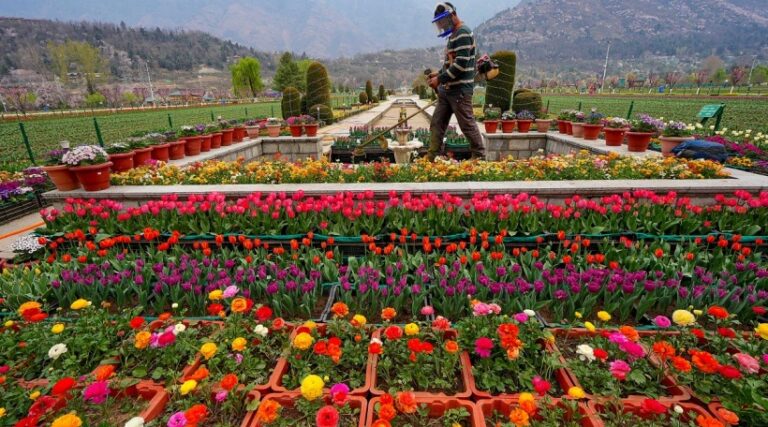
Srinagar, Mar 10 ; The Indira Gandhi Memorial Tulip Garden in Srinagar, recognised as the largest such garden in Asia, will be formally opened to the public for the 2026 season on March 16, officials said on Tuesday.

Director of Floriculture, Kashmir, Mathoora Masoom said that the garden, situated on the foothills of the Zabarwan Range with a view of the Dal Lake, is fully prepared to receive visitors. The annual blooming of the garden traditionally marks the commencement of the tourist season in the Valley.

“With the tulips now in full bloom, the department has decided to commence the visiting schedule for the season from March 16,” Director Masoom said.

Officials said approximately 1.8 million tulip bulbs, comprising between 70 and 75 different varieties, have been planted this season. The density of flower-beds has been enhanced this year to present a more vibrant and striking floral spectacle for visitors.

Originally named Siraj Bagh, the garden was rechristened as the Indira Gandhi Memorial Tulip Garden in 2008. It has since emerged as a major attraction for domestic and international tourists visiting the Kashmir Valley during the spring season.

In a related development heralding the arrival of spring, the almond trees at Srinagar’s historic Badamwari garden have burst into bloom. The garden, located in the old city area on the foothills of Koh-e-Maraan, is now covered in shades of pink and white. For the people of the Valley, the blooming of the almond trees is an annual celebration that signals the end of the prolonged winter chill. (KNS)

J&K Govt disengages 3 Jal Shakti Department workers over alleged terror links

0

Srinagar, Mar 10 : The Jammu and Kashmir Jal Shakti Department has ordered the immediate disengagement of three workers over their alleged involvement in anti-national and subversive activities.

According to seperate orders, Kousar Hussain Bhagwan (NBCL) and Liyaqat Ali Bhagwan (NBCL), involved in FIR No. 230/2019 under UAPA Sections 13, 18, 19, 38, 39, and Showkat Ahmad Zargar (DRW), involved in FIR No. 53/2019 under Sections 307 RPC, 7/27 Arms Act and UAPA Sections 16, 18 have been removed from their services.

The orders stated that they have been disengaged after investigations revealed their alleged links to terrorism, terrorist acts, conspiracy to commit terrorist acts, harbouring terrorists, and membership/support of a terrorist organization, and

The government stated that these actions were taken “in the interest of administration.”

Kousar is a need based casual labourer and posted at Huller, PHE Sub-Division Kishtwara , Liyaqat is also a need based casual labourer and posted at Berwar, Kishtwar and Showkat is a Daily Rated Wager (DRW) and posted at Bijbehara, Anantnag—(KNO)

CM Omar Abdullah hosts dinner to honour J&K’s Ranji Trophy Champions

0

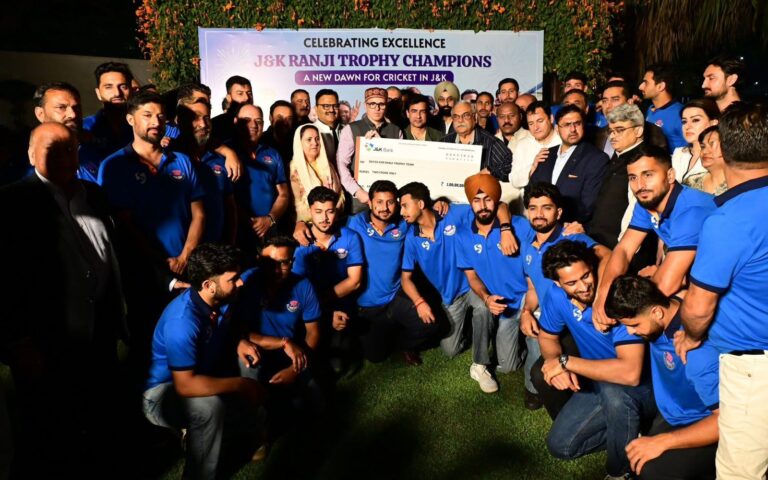
JAMMU, MARCH 09: Chief Minister Omar Abdullah today hosted a dinner in honour of the Jammu & Kashmir Ranji Trophy champion team, celebrating their remarkable achievement.

The team was warmly received by the Chief Minister in the presence of his Cabinet colleagues and senior officers. On the occasion, the players were also presented with an award money of ₹2 crore in recognition of their outstanding performance.
President of the Board of Control for Cricket in India, Mithun Manhas, was also present at the event.

Congratulating the players, the Chief Minister lauded their dedication and perseverance, saying their achievement has brought immense pride to Jammu & Kashmir. He wished them continued success and encouraged them to keep striving for excellence and making the region proud on the national stage.

Among those present on the occasion were Deputy Chief Minister Surinder Choudhary; Ministers Sakina Itoo, Javed Ahmad Rana, Javid Ahmed Dar and Satish Sharma; Chief Secretary Atal Dulloo; Commissioner Secretary Youth Services & Sports Shahid Iqbal Choudhary; Director General Youth Services & Sports, JKCA administrators and members, Secretary Sports Council and other senior officers.

Drug Peddler Held With Charas in Ganderbal

0

Touseef Wani

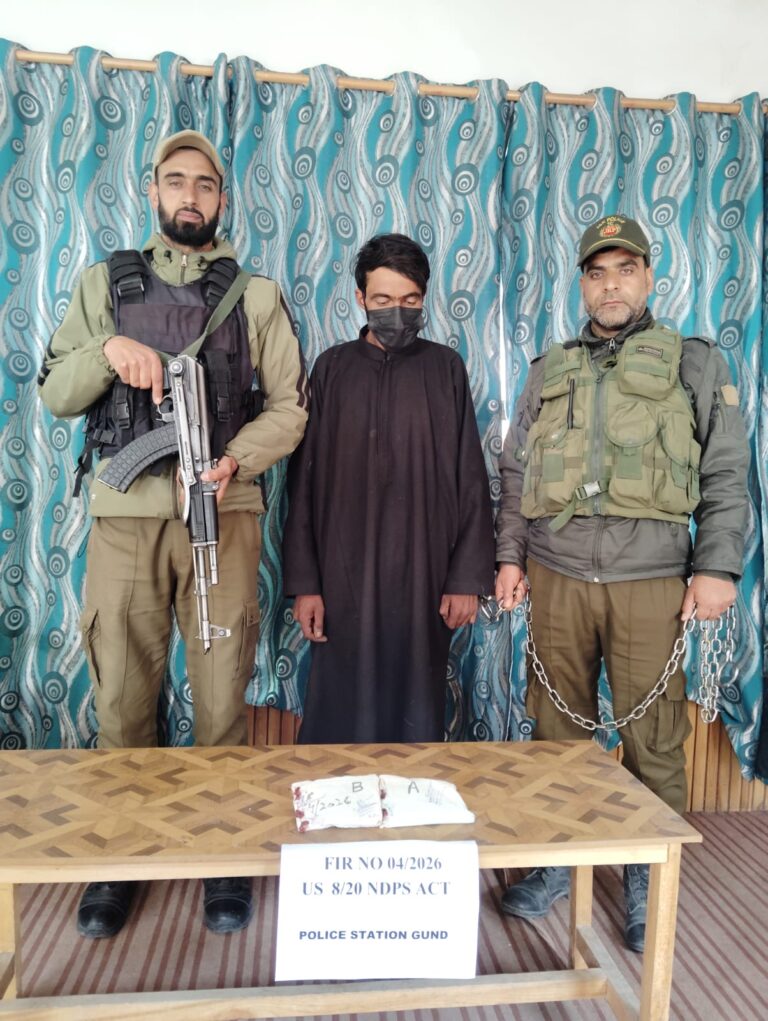
Ganderbal, Mar 9 : Police have apprehended a suspected drug peddler and recovered a charas-like contraband substance from his possession in Jammu and Kashmir’s Ganderbal district, officials said on Monday.

The arrest was made during a surprise naka laid at Syed Basti Surfraw in the jurisdiction of Police Station Gund, they said.

Police intercepted a youth who was moving in a suspicious manner during routine checking. Upon personal search, a charas-like substance was recovered from his possession.

The accused has been identified as Shabir Ahmad Bokda, son of Sooba Bokda, a resident of Syed Basti Surfraw.

A case has been registered under relevant provisions of the Narcotic Drugs and Psychotropic Substances Act at Police Station Gund and further investigation has been taken up, officials said.

Police reiterated their commitment to curb drug trafficking and urged the public to share information about drug peddling to help authorities take strict legal action against offenders.

High Court holds Full Court Reference to condole Justice Jhanjis’s demise

0

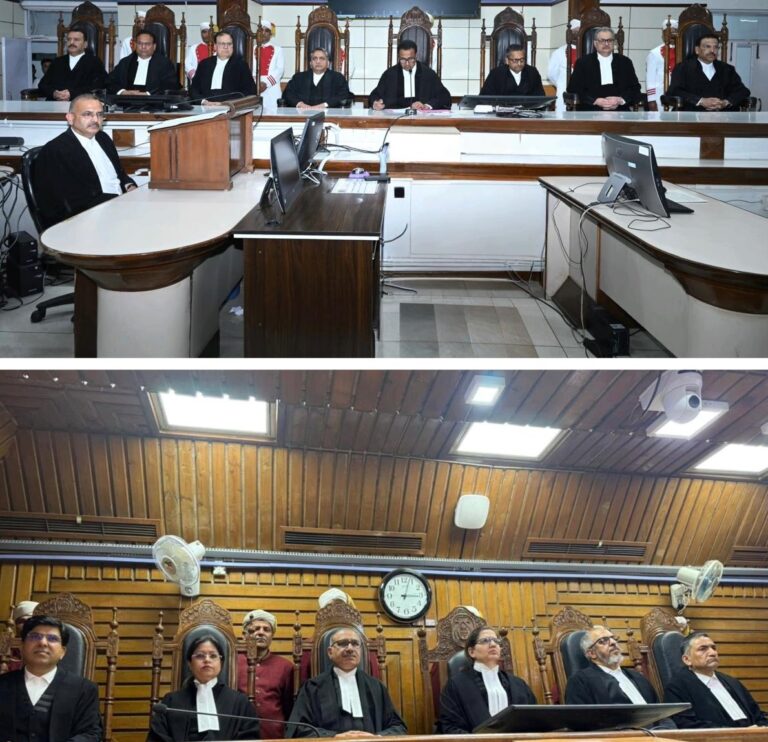
JAMMU, MARCH 09: A Full Court Reference was held today in the Courtroom of the Chief Justice at Jammu Wing of the High Court of Jammu & Kashmir and Ladakh to condole the demise of Justice V. K. Jhanji, Former Judge/Acting Chief Justice of the High Court of Jammu & Kashmir and Ladakh, who passed away on 23rd February, 2026.

The Full Court Reference was convened in accordance with the long-standing conventions and institutional traditions of the High Court.

The Reference was attended by all the Judges of the High Court with the Judges from the Jammu Wing joined the Reference physically, while those present in the Srinagar Wing joined through virtual mode.

The proceedings were also attended by family members of Justice V. K. Jhanji, former Chief Justices and former Judges of the High Court of J&K and Ladakh; Senior Additional Advocate General; Deputy Solicitors General of India at Jammu and Srinagar; President, Jammu & Kashmir High Court Bar Association, Jammu; Senior Advocates; Principal District and Sessions Judge, Jammu; Judicial Officers and officers of the Registry. Besides, officers and officials and Advocates of the High Court from the Srinagar Wing joined the proceedings through virtual mode.

On the occasion, the Senior Additional Advocate General and the President, Jammu and Kashmir High Court Bar Association, Jammu, in their condolence addresses, remembered the distinguished judicial career and invaluable contribution of late Justice V. K. Jhanji to the administration of justice. They prayed for eternal peace to the departed soul and strength to the bereaved family to bear the irreparable loss.

Chief Justice of the High Court of J&K and Ladakh, Arun Palli, in his condolence address, recalled the remarkable judicial career of Justice V. K. Jhanji and observed that his profound knowledge of law and commitment to justice has left a lasting impression on the legal fraternity. He recalled the justice jhanji’s capacity to decide the complex legal issues.
The Chief Justice, on behalf of all the Judges of the High Court, placed on record collective respect and gratitude for the life and service of Justice Jhanji.

The proceedings concluded with observance of a minute’s silence as a mark of respect to the departed soul and the Court work was suspended for the rest of the day.
The proceedings were conducted by M.K Sharma, Registrar General.

Apni Party condoles the passing of Mohammad Hashim Khan; Leaders extend condolences, express solidarity

0

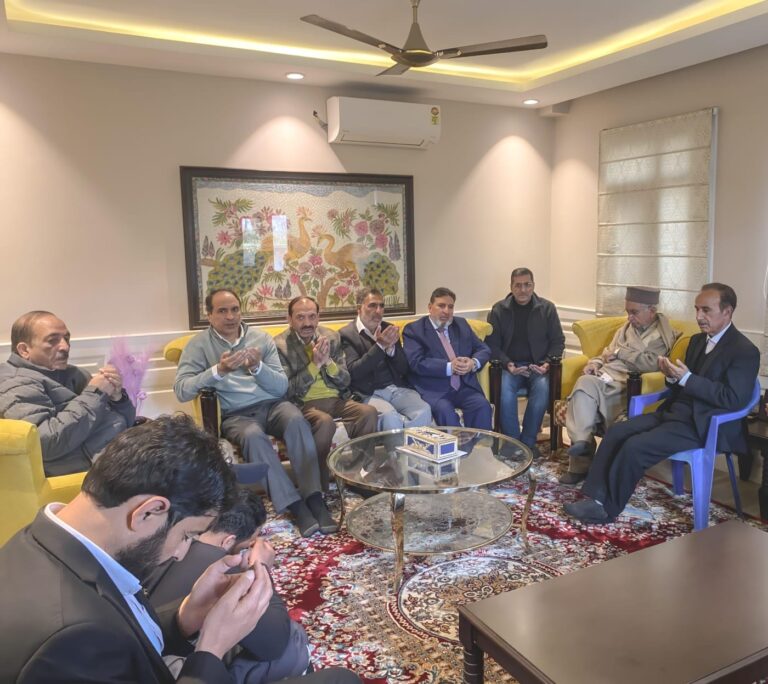
Syed Mohammad Altaf Bukhari led a party delegation to the bereaved family in Bemina

Srinagar, March 9: Apni Party has extended condolences over the passing of Mohammad Hashim Khan of Iqbal Abad, Bemina. The deceased was a close relative (samdhi) of Apni Party Senior Vice President Ghulam Hassan Mir. He was the beloved father of Mir Sahib’s son-in-law, Muhammad Fareed Khan.

According to a party statement, Syed Mohammad Altaf Bukhari led a delegation of party leaders to the Bemina residence of Mohammad Fareed Khan to express condolences over the passing of his father. The leaders met the bereaved family members and expressed solidarity with them in this hour of grief.

Besides Syed Mohammad Altaf Bukhari, those who were part of the condolence delegation included Chairman of party’s PAC Mohammad Dilawar Mir, Provincial President Kashmir Mohammad Ashraf Mir, Chief Spokesperson & State Secretary Muntazir Mohiuddin, District President Ganderbal Javaid Mir, Provincial Publicity Secretary Kashmir Muzaffar Ahmad Reshi, Vice President Srinagar Aijaz Ahmad Rather, Vice President Srinagar & Constituency In-charge Central Shaltang Zaffar Habib, Ward President Hyderpora Sheikh Muzaffar Ali, Office Secretary District Srinagar Tauseef Bashir, and others.

Earlier, Syed Mohammad Altaf Bukhari issued a condolence message on his X handle. He wrote: “It is saddening to hear of the passing of Mohammad Hashim Khan, who was a close relative (Samdhi) of my respected colleague and Apni Party’s Senior Vice President, Ghulam Hassan Mir Sahib. The deceased, who was the beloved father of Mir Sahib’s son-in-law, Fareed Ahmad Khan, breathed his last today at his residence in Iqbal Abad, Bemina, Srinagar.”

He further said, “On this bereavement, I extend my heartfelt condolences to Mir Sahib, his son-in-law Fareed Sahib, and all other members of the grieving families.”

“May the Almighty grant the departed soul the highest place in Jannah and bless the family with patience to endure this irreparable loss,” Mr. Bukhari prayed.

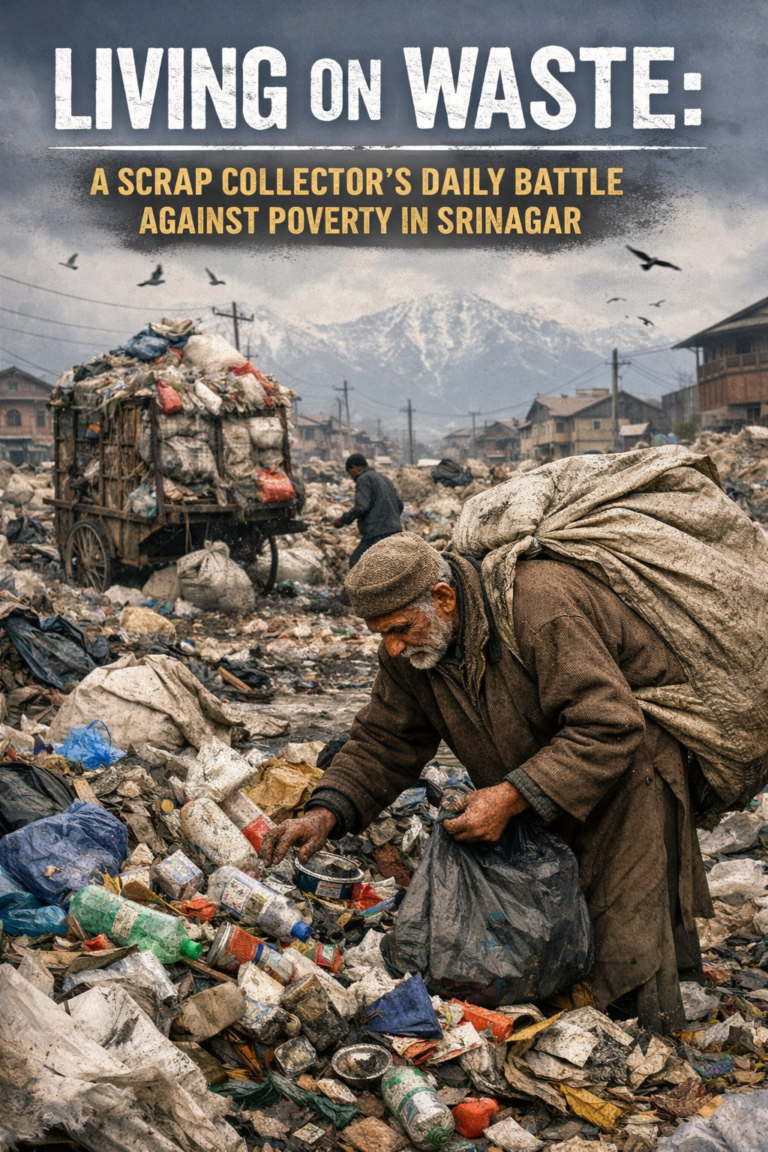
Living on Waste: A Scrap Collector’s Daily Battle Against Poverty in Srinagar

0

TAQWA SHAFI

SRINAGAR, Match 9: As the first faint light of dawn spreads across the sky and most of Srinagar remains wrapped in sleep, Abdul Rehman begins another day of relentless struggle.
The narrow lanes of Saderbal near the Hazratbal area are still silent when the 40-year-old quietly steps out of his modest home. The early morning air carries a sharp chill, and the streets remain empty except for an occasional stray dog wandering through the shadows.
In his hand, Abdul Rehman grips a long iron hook—his essential tool for the day’s work. Slung over his shoulder is a faded, worn-out sack that will soon be filled with the city’s discarded waste. For him, the sack represents far more than garbage. It carries the fragile hope of survival.
For Abdul Rehman, every morning begins the same way—with determination overshadowed by uncertainty.
He begins walking through Srinagar’s bustling markets, residential lanes, and roadside dumps, searching for what others have thrown away. Plastic bottles, crushed cans, broken metal pieces, discarded cardboard boxes—items that most people consider worthless.
But to Abdul Rehman, every piece of scrap has value.
Each plastic bottle means a few rupees. A bundle of cardboard may fetch enough to buy vegetables for dinner. A handful of scrap metal might help pay for his children’s school notebooks.
Carefully, he lifts each item using his iron hook and drops it into the sack strapped to his back.
“I cannot afford to miss even a single day,” Abdul Rehman says quietly. “If I don’t work, my children don’t eat.”
A Home Filled with Hope and Hardship
Abdul Rehman lives with his wife and three children in a single-room house in Saderbal. The structure is modest and fragile. During winter, dampness creeps into the walls, making the room unbearably cold. In summer, the small space turns suffocatingly warm.
Despite the difficult living conditions, the room carries signs of hope.
Near the door, two school uniforms hang neatly on a nail. In one corner, a small stack of schoolbooks and notebooks is carefully arranged.
Abdul Rehman’s two sons—aged 11 and 9—attend a nearby government school, while his youngest child, a six-year-old daughter, has recently begun learning to read.
Watching them study fills him with quiet determination.
“I never had the chance to go to school,” he says, his voice softening. “I started working when I was very young. But my children must study. They must have a better life.”
Keeping them in school, however, is an ongoing challenge.
On a good day, Abdul Rehman manages to earn between ₹500 and ₹800 by selling collected scrap to local junk dealers. But such days are rare.
When waste is scarce or market prices drop, he may return home with barely ₹250 in his pocket.
From this small and uncertain income, he must manage household expenses—food, school supplies, clothing, and occasionally medicine.
“It is never enough,” he admits, lowering his gaze.
A Day of Exhaustion and Humiliation
From early morning until late afternoon, Abdul Rehman roams across different parts of Srinagar, carrying his ever-growing sack of scrap.
The work is physically draining.
He spends hours bending over garbage piles and roadside bins. His back aches constantly, and his hands are often cut by sharp glass shards or rusted metal hidden beneath layers of waste.
The smell of garbage clings stubbornly to his clothes.
Sometimes people pass by without noticing him. At other times, they stare with visible disgust.
“There are days when people treat us like we are not human,” he says quietly. “Some shout at us to move away, as if we are the garbage.”
Yet he continues working.
Because stopping is simply not an option.
Winter Makes Survival Harder
The challenges become even more severe during Kashmir’s harsh winters.
When icy winds sweep across Srinagar, Abdul Rehman’s work becomes painfully difficult. His fingers grow numb while sorting through wet waste, and the cold cuts through his thin clothing.
Still, he pushes forward.
Because missing a day’s work could mean an empty dinner table.
Invisible Workers of the City
Across Srinagar, hundreds of scrap collectors like Abdul Rehman quietly perform an essential yet largely unrecognized service.
Every day, they gather plastic, paper, metal, and other recyclable materials that would otherwise accumulate on the city’s streets and landfills. Their work indirectly supports the recycling industry and contributes to waste management.
Yet their own lives remain invisible.
They work without protective gloves, masks, or safety equipment. Their income depends entirely on how much scrap they can collect each day.
For them, the city’s garbage is both a workplace and a lifeline.
A Father’s Dream
As evening approaches, Abdul Rehman slowly makes his way back through the streets of Srinagar.
His sack is now lighter, emptied at the scrap dealer’s shop. But his body feels heavy with exhaustion after a long day of walking and lifting.
When he turns into the narrow lane leading to his home in Saderbal, a familiar sight often awaits him.
His children run toward him with bright smiles.
In that moment, the fatigue of the day begins to fade.
His sons sit beside him and show him their school notebooks. Sometimes they read aloud what they learned in class that day.
Abdul Rehman listens attentively, even though many of the words are unfamiliar to him.
Still, he nods proudly.
“These books are their future,” he says with quiet conviction. “If they study well, maybe they will never have to search through garbage like me.”
Dinner in the small home is often simple—just rice and tea. Yet the family sits together, sharing laughter and stories from the day.
Before going to sleep, Abdul Rehman carefully folds his empty sack and places it near the door.
It will be needed again tomorrow.
Because before the sun rises over Srinagar, Abdul Rehman will once again step out into the silent streets.
Once again, he will search through the city’s discarded waste.

Not because he chooses to.
But because somewhere among those crushed bottles and torn pieces of cardboard lies the fragile hope of building a better future for his children.

NCB Busts Pan-India Darknet Drug Network “Team Kalki”; Large Seizure of LSD, MDMA and Liquid MDMA

0

New Delhi: In a major breakthrough against darknet-enabled narcotics trafficking, the Narcotics Control Bureau (NCB) has dismantled a pan-India drug distribution network operating under the name “Team Kalki.” The network had been active on darknet platforms and the encrypted Session messaging application since January 2025. Acting on intelligence developed in last three months, NCB conducted an operation in New Delhi, leading to the bust of the network.

During the operation, NCB officers seized 2,338 LSD blotters, 160 MDMA (Ecstasy) pills weighing 77.517 grams, 73.612 grams of charas, 3.642 grams of amphetamine, and 3.6 kg of liquid MDMA from 13 domestically intercepted parcels and 2 parcels originating from the Netherlands linked to the network. The seizure highlights the growing use of darknet marketplaces and encrypted communication platforms by drug traffickers to distribute narcotic drugs and psychotropic substances. The operation marks one of the significant crackdowns on darknet-based narcotics trafficking networks operating in India.

Investigation so far has revealed that the darknet vendor “Team Kalki” was operated by Anurag Thakur along with his associate Vikas Rathi. Both accused are habitual offenders and were previously arrested in cases registered under the Narcotic Drugs and Psychotropic Substances (NDPS) Act, 1985. Vikas Rathi had earlier been lodged in Tihar Jail in connection with a charas trafficking case registered by the Delhi Police Special Cell, while Anurag Thakur had been imprisoned in a methamphetamine trafficking case registered by the Delhi Police Crime Branch. Both were lodged in Tihar Jail for the same time, during which they came together and later operated the darknet drug network “Team Kalki.”

Initially, the accused were active on the dark web forum “Dread,” where the vendor account maintained a four-star rating, indicating successful completion of a large number of orders. Once they established on Dread, also started their operations to the encrypted Session messaging application for vending and order fulfilment.

Preliminary investigation indicates that the network had a pan-India distribution footprint and employed sophisticated methods to evade law enforcement detection. It has further been revealed that the accused allegedly sourced LSD and MDMA from international darknet vendors based in the Netherlands, Poland and Germany. Orders from customers across India were received through encrypted platforms such as the dark web forum “Dread” and the Session messaging application, enabling anonymity and concealment of digital footprints.

Upon receiving orders from customers, one of the accused would relay the order details to his associate, who handled the packaging and dispatch of the narcotic consignments. The drugs were subsequently sent to customers across various parts of the country through courier and parcel services.

The investigation has also uncovered the use of a “dead drop” delivery technique, wherein parcels containing narcotic drugs and psychotropic substances were placed at pre-determined locations instead of being handed over directly to customers. Buyers were subsequently informed of the location details, enabling them to collect the parcels while minimizing the risk of detection. The “dead drop” delivery method was used only in limited areas of Delhi, and primarily for customers with a history of multiple prior orders. For pan-India deliveries, the accused predominantly used Speed Post and other courier/parcel services. As part of a cautious operational approach to avoid detection, a different courier or parcel service booking office was used for each consignment.

Further investigation has revealed that the network had dispatched narcotic drugs to several states across India. Some consignments were intercepted and seized by law enforcement agencies before delivery in Delhi, Tamil Nadu, Telangana, Kerala and Karnataka, and the details of such cases are being analysed.

The network is suspected to have dispatched more than 1,000 consignments since Jan 2025. Multiple electronic devices have been recovered from the accused, and a cryptocurrency wallet linked to the operation has been identified.

The accused accepted payments through cryptocurrencies using unhosted wallets, including Monero and USDT. The proceeds were routed through multiple intermediary wallets, with conversion charges of up to 10%, to convert the funds into USDT, which was subsequently stored in cold wallets. In certain instances, mule KYC-compliant wallets were also used to route the proceeds into the formal banking system.

For receiving USDT payments, temporary unhosted wallets were created dynamically, and the funds received were immediately transferred through multiple layers of intermediary wallets to beneficiary wallets, thereby attempting to obscure the transaction trail and hinder tracking by law enforcement agencies.

NCB is continuing the investigation to identify other associates, trace financial transactions, and uncover the international supply chain linked to the network. Further efforts are underway to dismantle the entire operational ecosystem of “Team Kalki.”

This operation is part of NCB’s sustained nationwide crackdown on darknet-enabled drug trafficking and synthetic drug networks. In past also, NCB has successfully conducted several major operations including Operation Ketamelon (2025) and Operation Zambada (2023), targeting organized drug trafficking syndicates and dismantling supply chains linked to international darknet markets.

This action reflects India’s Zero Tolerance Policy against narcotics and the Government’s resolve to dismantle drug trafficking networks operating both in the physical and virtual domains. NCB reiterates its unwavering commitment to dismantling organized drug trafficking networks and safeguarding society from the menace of narcotics. The public is encouraged to share information related to sale, transport or trafficking of narcotics through the MANAS – National Narcotics Helpline (Toll Free No. 1933). The identity of informers is kept strictly confidential.