High level meet stresses curbing avoidable cases and strengthening ADR
VINOD BHAT
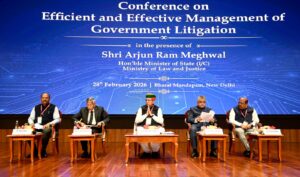
NEW DELHI, Mar 2: In a concerted push to reform and streamline the handling of government cases across ministries, the Government of India on February 28 held a high-level National Conference of Union Secretaries and Learned (Ld.) Law Officers on “Efficient and Effective Management of Government Litigation” at Bharat Mandapam, New Delhi. The conference was organised under the theme “Strengthening Institutional Litigation Governance for Viksit Bharat @2047”, reflecting the Centre’s long-term vision of building a robust and accountable legal framework aligned with national development goals.
The conference brought together Union Secretaries, senior government officials, Law Officers, and representatives from various departments to deliberate on strengthening litigation practices, enhancing coordination, and improving institutional efficiency. The event was graced by Shri Arjun Ram Meghwal, Hon’ble Union Minister of State (Independent Charge), Ministry of Law and Justice; Dr. T.V. Somanathan, Cabinet Secretary; Shri R. Venkataramani, Attorney General for India; Shri Tushar Mehta, Learned Solicitor General of India; Dr. Niraj Verma, Secretary, Department of Justice; and Dr. Rajiv Mani, Secretary, Department of Legal Affairs.

The deliberations provided a comprehensive review of the prevailing litigation landscape across key sectors, including service, pension and employment matters; infrastructure, compensation and contractual disputes; fiscal, taxation and revenue cases; as well as regulatory, enforcement and compliance-driven litigation. Participants acknowledged that government litigation continues to face persistent structural and procedural challenges that require systemic reforms rather than isolated interventions.
In service-related matters, repetitive litigation was identified as a significant concern, largely arising from the non-uniform implementation of established legal positions across ministries and departments. Officials observed that insufficient consultation before filing counter affidavits, divergent stands adopted by different ministries, and weak coordination between departments and panel counsels have often led to avoidable disputes and inconsistent legal representation. A growing tendency to file appeals as a default reaction—rather than as a carefully evaluated policy decision—was also highlighted as a practice contributing to mounting case burdens and unnecessary judicial escalation.
The discussions on infrastructure and compensation-related litigation underscored the increasing financial exposure faced by the government. Escalating land compensation disputes and mounting interest liabilities were flagged as areas of serious concern.
Participants noted that arbitral awards are frequently challenged as a routine measure, even in cases where substantial legal or financial stakes may not be involved. The technical complexity of infrastructure contracts, coupled with inadequate legal vetting at early stages, has further compounded disputes. Fragmented coordination between technical divisions and legal teams and the under-utilisation of Alternative Dispute Resolution (ADR) mechanisms and pre-litigation mediation were identified as systemic gaps requiring urgent attention.
A central thrust of the conference was the reduction of avoidable litigation and delays in filing cases through the introduction of robust filtering mechanisms, improved coordination, and early dispute resolution. The need for clearly defined appeal-filtering criteria in service and other matters was strongly emphasized to ensure that appeals are filed only after careful consideration. Ministries were encouraged to nominate designated officers responsible for coordinated handling of litigation to ensure accountability and consistency in legal strategy. Equally important was the establishment of mechanisms for time-bound implementation of court judgments to prevent repetitive and contempt litigation resulting from delayed compliance.

Participants stressed the importance of close and structured coordination with the Department of Legal Affairs and Learned Law Officers, particularly in important and policy-sensitive cases, to ensure that a consistent and unified legal position is maintained across ministries. In matters relating to infrastructure, compensation and contractual disputes, the conference endorsed institutionalising structured pre-litigation ADR, especially for land and infrastructure disputes, and promoting structured settlements in compensation matters to prevent prolonged court battles.
The deliberations also recommended exploring financial exposure thresholds before challenging arbitral awards, with decisions to be taken after consultation through designated committees so that challenges are confined to cases involving substantial legal or financial implications. Early and mandatory legal vetting of termination, debarment and other high-value contractual decisions was identified as a critical safeguard to prevent fresh litigation. Strengthening in-house mechanisms for quick, fair and efficient dispute resolution was seen as essential to reducing the flow of new cases into the judicial system.
In fiscal, taxation, revenue and regulatory or enforcement-related litigation, participants emphasized the need to streamline enforcement strategies and strengthen compliance mechanisms so that disputes are resolved at earlier stages and unnecessary matters are not carried to higher judicial forums. Resolving issues proactively at departmental levels, it was noted, would significantly reduce litigation burdens and promote administrative efficiency.
The conference concluded with a reaffirmation of the Government of India’s commitment to responsible, disciplined and policy-driven litigation. The focus remains on reducing avoidable cases, ensuring timely filing and implementation of court decisions, and strengthening alternative dispute resolution systems to enhance ease of doing business and foster citizen trust in government processes. The deliberations underscored that efficient litigation governance is integral to achieving the broader national objective of Viksit Bharat @2047, marking a decisive step toward institutionalising structured, consistent and accountable management of government litigation.

