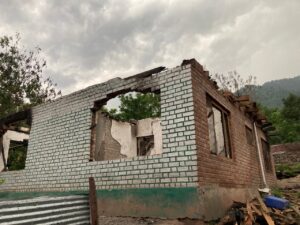
Destroyed in shelling, yet billed for power: Uri residents allege PDD negligence
TAUSEEF AHMAD
SRINAGAR, Jan 16: Months after cross-border shelling reduced dozens of houses to rubble in Salamabad village of north Kashmir’s Uri subdivision, several affected families have alleged that the Power Development Department (PDD) continues to issue electricity bills against their destroyed homes, compounding the misery of already displaced residents.
The shelling, which followed Operation Sindoor in May last year, left many residential structures completely damaged or uninhabitable. Since then, affected families say they have been forced to abandon their homes and take shelter in government quarters, relatives’ houses, or makeshift accommodations. Despite this, they allege that electricity connections linked to the destroyed houses were neither disconnected nor officially suspended, resulting in the generation of monthly power bills.
Speaking to Kashmir Despatch, several residents said that even though no one has lived in their damaged homes for nearly eight months, electricity bills continue to be issued in their names. In many cases, the cumulative amount has reportedly reached between ₹20,000 and ₹30,000, pushing families already struggling with displacement and reconstruction costs into deeper financial distress.
Saima, a resident of Salamabad whose house was flattened during the shelling, said the continued billing reflects administrative insensitivity. “Our house was destroyed in May. We have not stayed there since then. Still, electricity bills keep coming every month. We are already homeless and trying to rebuild our lives—how can we be expected to pay for power we never used?” she asked.
Another affected resident echoed similar concerns, questioning the logic behind billing non-existent households. “If our homes no longer exist and no electricity is being consumed, why are we being charged? The authorities should have disconnected these connections immediately after the damage assessment,” he said, adding that many families fear penalties or legal action if the dues remain unpaid.
Social activist Ishtiaq Ahmad, who recently visited the shelling-affected area, blamed administrative lapses for the situation. He said the failure to promptly disconnect electricity connections or conduct a proper post-shelling survey has placed an unfair burden on vulnerable families. “When houses are damaged and unoccupied, billing should automatically stop. The government must clarify who will bear this financial burden and why timely action was not taken by the department,” he said.
Residents have also accused the local administration of failing to carry out a comprehensive assessment of damaged properties to ensure that basic relief measures—such as suspension of utility charges—were implemented. They have urged the MLA Uri and senior district officials to intervene, waive the accumulated bills, and ensure that no further charges are imposed until homes are reconstructed and families return.
Responding to the allegations, Assistant Engineer (AE), PDD Uri, Imran Ahmad, said that the department has already taken steps to reduce the financial burden on the affected families. “We have stopped regular electricity assessment for such houses and reduced billing to minimum charges only,” he said, adding that the minimum demand being charged is around ₹50 to ₹60.
He clarified that the high amounts reflected in some bills are largely due to previous outstanding arrears, not fresh electricity consumption after the shelling. “The bills people are seeing are mostly old dues. There is no regular assessment being done now,” he said.
The AE further assured that regular billing would remain suspended until reconstruction is completed. “If anyone is still being billed incorrectly, we will ensure their billing is restricted to minimum charges of ₹60 until their houses are rebuilt. However, old arrears will have to be cleared as per rules,” he added.
Despite the clarification, residents insist that all pending charges should be waived, arguing that displacement due to shelling is an extraordinary situation requiring humanitarian consideration rather than routine administrative procedures.