spot_imgspot_img
spot_img
Home Blog Page 16

Kashmir Set for Census 2026 Self-Enumeration Exercise Beginning From May 17-31 May

0

“Shadow Areas to See Internet Boost to Support Census Operations, Administration fully prepared for any challenges”

Tauseef Ahmad

Srinagar, May 16: Jammu and Kashmir will begin the first phase of Census 2027 from May 17 with the launch of digital self-enumeration and House Listing Operations (HLO) across the Union Territory, officials said on Friday.

The self-enumeration process will continue till May 31, while physical house-listing operations will be conducted from June 1 to June 30. Residents will be able to submit household details online through the official census self-enumeration portal, .

For the first time, the census exercise in J&K will be conducted in a fully digital mode, with authorities deploying mobile applications and online platforms for data collection. Officials said extensive training of enumerators and supervisors had already been completed across districts.

In north Kashmir’s Bandipora district, Deputy Commissioner Bandipora, while addressing the media, said all preparations for the first phase had been finalized and field officials trained for smooth conduct of the exercise. The DC said the census was “as important as voting” as it would determine future welfare schemes, infrastructure planning and government programmes.

The official added that shadow and remote areas in Bandipora would receive a boost in high-speed internet connectivity during the first phase to facilitate digital census operations and self-enumeration.

Officials said the second phase involving population enumeration would begin in September 2026 in winter or snow-bound zones of Jammu and Kashmir, while enumeration in non-snowbound areas would be conducted later in February 2027. The exercise will include detailed demographic and socio-economic data collection across the Union Territory.

JEI-linked UAPA Case: Sopore police conduct raids at multiple locations

0

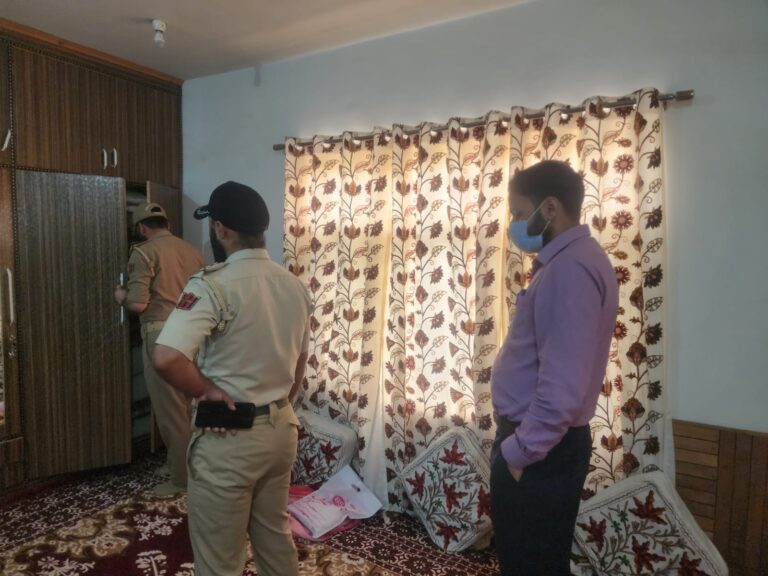
Sopore, May 16: Sopore Police on Saturday conducted searches at around 15 locations across the district in connection with a case linked to Jamaat-e-Islami (JeI), officials said.

An official told, that the searches were carried out in connection with cases registered under the Unlawful Activities (Prevention) Act (UAPA).

The raids were conducted in several areas, including Sopore, Bomai and Tarzoo.

During the searches, officials said incriminating material, including literature linked to the banned organisation, was seized.—(KNO)

Three Years Strong: PARAS Health Srinagar’s Mission of Hope, Healing and Humanity

0

‘PARAS Health Srinagar’s Three-Year Journey of Healing and Trust’

Srinagar, May 15: Paras Health Srinagar marked the completion of three remarkable years of service in Kashmir — a milestone that celebrated not merely the passage of time, but a journey of compassion, resilience, and trust built with the people of the Valley.

What began as a vision to bring quality healthcare closer to communities has, over the years, transformed into one of India’s most trusted healthcare networks. From its inception in Gurugram in 2006 as the region’s first corporate hospital, Paras Health has steadily expanded its footprint across Gurugram, Patna, Darbhanga, Panchkula, Ranchi, Udaipur, Kanpur, and Srinagar — carrying forward a singular philosophy: care beyond medicine.

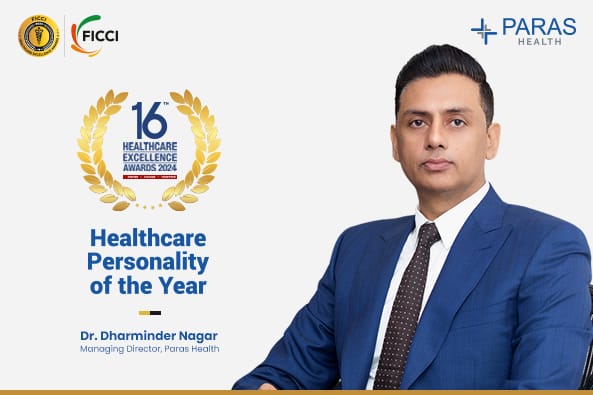
Managing Director Dr. Dharminder Nagar reflected on the deeper meaning behind building healthcare institutions and the philosophy that shaped Paras Health’s journey.

“A hospital is never just a building or infrastructure. Its true strength lies in its people — the doctors, nurses, and healthcare professionals who dedicate themselves to serving humanity every single day,” said Dr. Nagar.

He emphasized that the vision behind Paras Health Srinagar was rooted in making advanced, quality-driven healthcare accessible within Kashmir itself.

“We are here because Paras Health wants to ensure impactful, accessible, and quality healthcare reaches the people of Kashmir closer to their homes. Patients should not have to move outside unnecessarily or bear additional emotional and financial burdens. Their own doctors, their own capable teams are here to serve them with excellence and compassion,” he added.

In this regard, a glorious event will be held in Srinagar today. The evening would highlight the inspiring journey of Paras Health under Dr. Nagar’s leadership — a journey shaped not by shortcuts, but by perseverance, patience, and purpose. While many focused on metropolitan expansion, Paras Health chose to invest in regions where quality healthcare was needed most, often overcoming financial, operational, and infrastructural challenges to build institutions grounded in trust and humanity.

Paras Health Srinagar, nestled amidst the scenic beauty of Kashmir, stands today as a symbol of that commitment. Over the past three years, the hospital has emerged as a trusted healthcare destination in the Valley, touching thousands of lives through advanced treatment, compassionate care, and dedicated medical expertise.

Zonal Director Seema Vig acknowledged the collective efforts of doctors, nurses, support staff, and healthcare workers who contributed to the hospital’s growth and reputation.

Facility Director, Paras Health Srinagar, Dr. Muruza Habib, also expressed gratitude towards the people of Kashmir for placing their faith in the institution and reaffirmed the hospital’s commitment to continuously strengthening healthcare services in the region.

The celebration served not only as an anniversary event but as a tribute to every patient healed, every family comforted, and every healthcare professional who stood steadfast through challenges and triumphs alike.

“Paras Health Srinagar is not simply a healthcare institution, but a growing relationship built on trust, dignity, compassion, and hope for a healthier Kashmir,” said PARAS Health Srinagar management.

Leh Bids Emotional Farewell to Sacred Piprahwa Relics After Historic Exposition

0

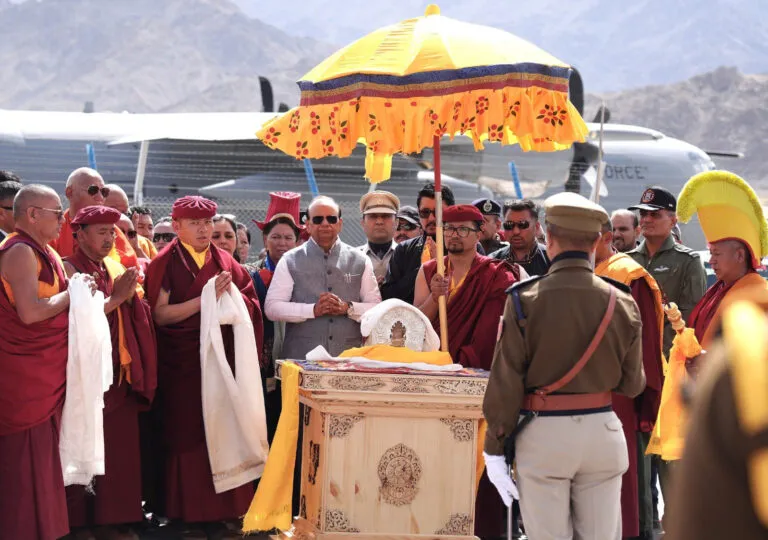
LEH/JAMMU, May 15: The sacred Piprahwa relics of Lord Buddha were accorded an emotional farewell at Leh Airport on Friday after the conclusion of a 14-day-long grand exposition in Ladakh, during which more than 1.18 lakh devotees paid obeisance to the holy relics, making it one of the largest spiritual gatherings organised in the Union Territory.

Ladakh Lieutenant Governor Vinai Kumar Saxena attended the farewell ceremony, which witnessed participation from people from different walks of life.


“Joined the people of Ladakh in bidding an emotional farewell to the holy relics of the Tathagata, as it departed from Ladakh after a memorable 14-day exposition, with a ceremonial guard of honour at Leh Airport,” the lieutenant governor said in a post on X.

He said the sacred days transformed Ladakh into a land of prayer, compassion and spiritual awakening. “From monasteries to remote villages and from mountainous terrains to bustling markets, the entire Ladakh resonated with devotion, peace and reverence,” he said.

Saxena expressed hope that the teachings of Lord Buddha would continue to unite humanity beyond borders and differences, and foster peace, compassion, harmony and brotherhood across the world.

“I extend my heartfelt gratitude to every single individual involved with this historic exposition, whose dedication and untiring efforts made it a grand success,” he added.

The 14-day exposition concluded on Thursday with thousands of devotees gathering at the Dharma Centre in Choglamsar to pay their final respects to the relics.

The arrival of the holy relics in Leh on April 29 had evoked an emotional response, with thousands of residents dressed in traditional attire lining the roads from Leh Airport to Jivetsal to welcome the relics.

The relics were formally inaugurated for public exposition on May 1 on the occasion of the 2569th Buddha Purnima by Union Home Minister Amit Shah at Jivetsal in Leh.

Shah had spent two days in Ladakh during the inauguration ceremonies. Several dignitaries attended the exposition, including Arunachal Pradesh Chief Minister Pema Khandu, Union Minister Kiren Rijiju, ambassadors of Sri Lanka and Thailand, members of parliament, senior Buddhist leaders, monks, scholars and international pilgrims.

Officials said the relics remained on public display at Jivetsal for nine days before being taken to Karsha Gonpa in Zanskar on May 11 and 12.

Special prayers, cultural programmes, conferences and spiritual activities were organised during the exposition. The concluding ceremony coincided with the sacred Monlam Chenmo, the annual Great Prayer Festival of Ladakh dedicated to world peace and universal happiness.

Thousands of monks, nuns, venerable Rinpoches and devotees participated in the festival, while sacred mask dances, known as Chhams, were also performed by monks on the occasion, officials said. (Agencies)

India’s first SME-led Semiconductor facility by Sahasra Semiconductors inaugurated at Bhiwadi

0

Vinod Bhat

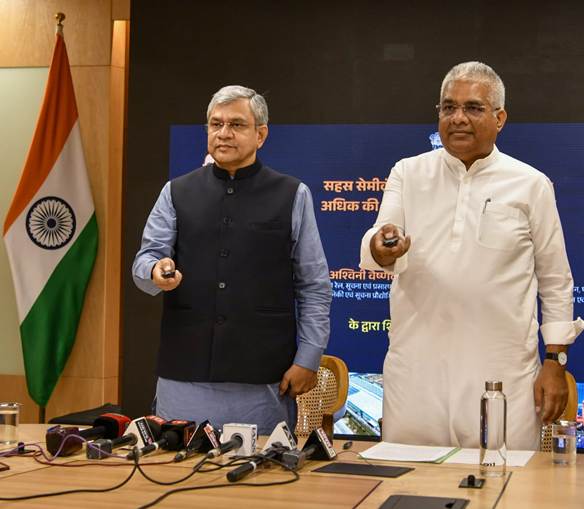
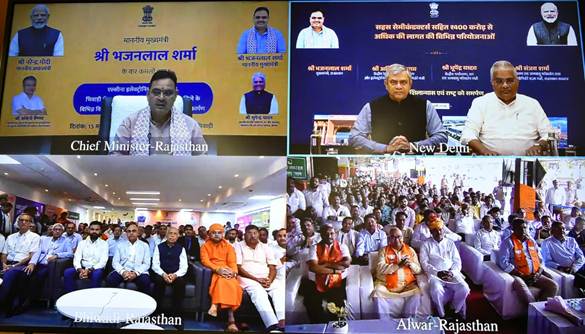
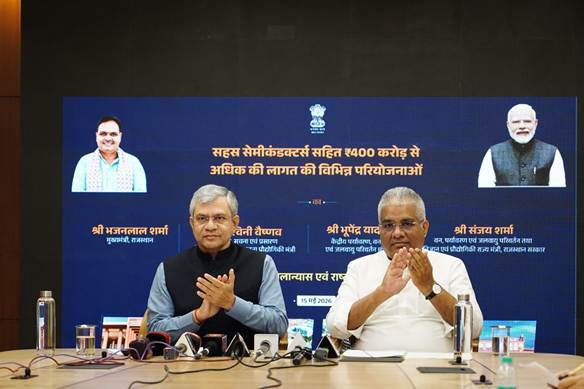
New Delhi: The Electronics Manufacturing Cluster (EMC) developed by ELCINA at Salarpur, Khushkhera, Bhiwadi, Rajasthan, along with the Semiconductor ATMP/OSAT facility of Sahasra Semiconductors Pvt. Ltd., was virtually inaugurated today by Union Minister for Electronics & Information Technology Shri Ashwini Vaishnaw.


The inauguration took place in the presence of Shri Bhajan Lal Sharma, Chief Minister of Rajasthan, and Shri Bhupender Yadav, Union Minister for Environment, Forest and Climate Change.


The event marks a significant milestone in India’s journey towards becoming a global hub for electronics manufacturing and semiconductors. This progress is being driven by the visionary initiatives of Make in India, Digital India and Atmanirbhar Bharat, launched under the leadership of Prime Minister Shri Narendra Modi.


Addressing the gathering, Shri Ashwini Vaishnaw called this a historic day for the state of Rajasthan as it enters the semiconductor industry – a strategically critical industry globally from a geopolitical perspective.

He highlighted India’s rapid progress in electronics manufacturing over the last 12 years, with production growing 6 times to nearly ₹ 13 lakh crores; and exports rising to around ₹ 4.24 lakh crores. He underscored that mobile phones have now become India’s top export commodity.

The Union Minister credited this to Prime Minister Narendra Modi’s treatment of electronics and semiconductors as focus sectors. He added that schemes like Electronics Component Manufacturing Scheme (ECMS), Electronics Manufacturing Clusters (EMC), India Semiconductor Mission (ISM) and Production Linked Incentives (PLI) are implemented methodically by working together with the state governments and industries.

Shri Bhajan Lal Sharma, Chief Minister, Rajasthan underlined that the state government has in March 2026 come out with a Rajasthan Semiconductor Policy and outlined his priority to develop the region close to Delhi NCR into a manufacturing hub.

Union Minister Shri Bhupender Yadav also noted that earlier, Bhiwadi region was known mainly for the automobile sector, but now semiconductor and electronics industries are also being promoted.


ELCINA Electronics Manufacturing Cluster (EMC)

This cluster at Bhiwadi has been developed over 50.3 acres with a project cost of ₹46.09 crore. Government of India has provided a direct support of ₹20.24 crore under the EMC scheme.

The cluster has been established by M/s. ELCINA Electronics Manufacturing Cluster Pvt. Ltd. (SPV), a joint collaborative initiative of MSME industry players under the banner of ELCINA.

It is equipped with world-class infrastructure including uninterrupted power and water supply, internal roads, centralized administrative facilities, testing and training centres, and a dedicated Skill Development Centre with smart classrooms and laboratories.

The cluster is strategically located near the National Capital Region with strong road, rail and air connectivity. With this the cluster is expected to emerge as a major destination for electronics component manufacturing.

The EMC has already attracted planned investments of over ₹1,200 crore by 20 companies. These companies are engaged in sectors ranging from semiconductor packaging and electronic components to air conditioners, RFID technologies, EV parts and industrial electronics. Eleven companies are currently operational with cumulative investments of over ₹ 900 crore, generating employment for over 2,700 persons.

Among the major companies operational in the cluster are Aisan Fiem Industries, E-Pack Durable, Sahasra Semiconductor, Sahasra Electronics, Varada Green Energy, Duggar Power Products and the Electronics Sector Skill Council of India etc.

Semiconductor ATMP/OSAT facility

This facility of M/s. Sahasra Semiconductors Pvt. Ltd. is India’s 1st Small and Medium Enterprise (SME) to start commercial production of semiconductor chips.

Developed under MeitY’s Scheme for Promotion of Manufacturing of Electronic Components and Semiconductors (SPECS), the facility has been set up with an investment of over ₹150 crore. It is spread over 57,000 sq. ft. and equipped with Class 10K and 100K cleanrooms. The facility will package memory chips for products such as Micro SD and flash storage, along with LED driver ICs, eSIMs and RFID products.

The unit currently has an annual packaging capacity of 60 million semiconductor units with SPECS-supported projected capacity of about 43 million units. It has plans to scale up to nearly 400-600 million units annually over the next 2–3 years.

The facility is already exporting more than 60% of its production to global markets including the United States, Germany, France and Eastern Europe, China and Nepal.

The facility is now moving towards its own product R&D, including LED driver chips and other semiconductor products. It will also support training of youth in semiconductor packaging and high-tech manufacturing in collaboration with ESSCI and technical institutes.

The event was held virtually in view of Prime Minister Shri Narendra Modi’s appeal to reduce fuel usage, wherever possible, in light of the current global situation.

Blending Rajasthan Architectural Heritage with Modern Infrastructure, Alwar Station Redevelopment Progressing Rapidly: Ashwini Vaishnaw

0

Vinod Bhat

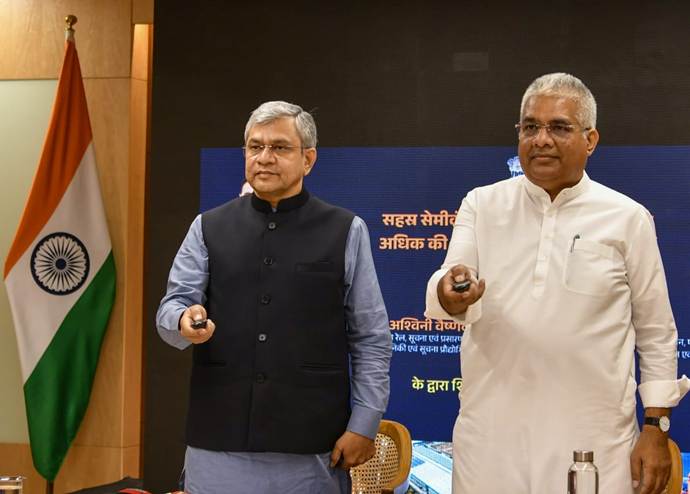
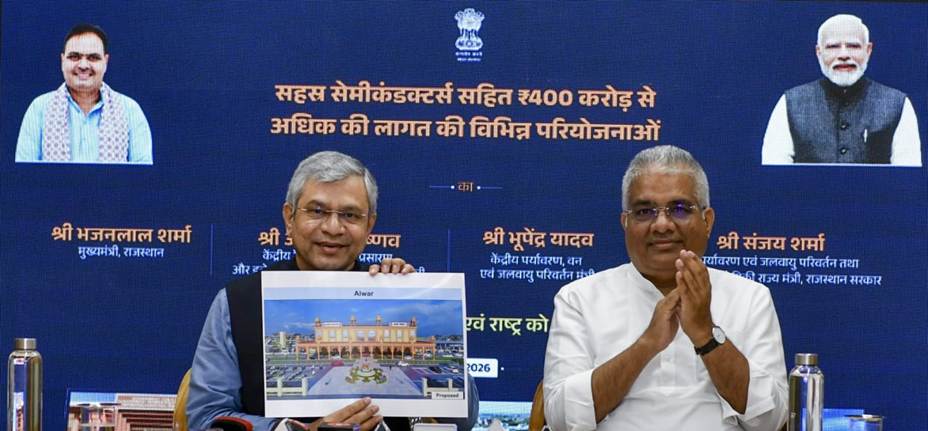
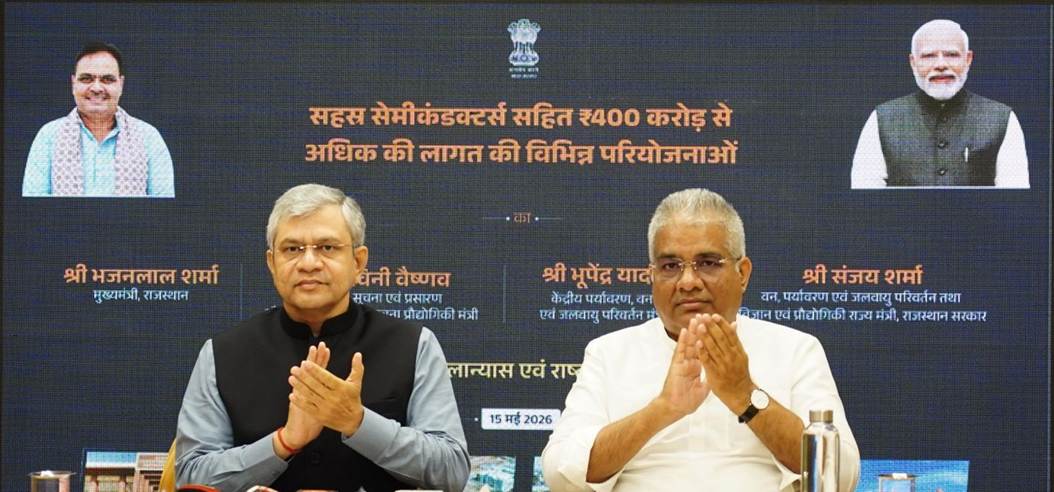
New Delhi: The Union Minister for Railways, Information & Broadcasting, and Electronics & Information Technology, Shri Ashwini Vaishnaw, Union Minister for Environment, Forest and Climate Change, Shri Bhupender Yadav,  Chief Minister of Rajasthan, Shri Bhajanlal Sharma laid the foundation stone and dedicated to the nation various projects worth over ₹400 crore in Rajasthan virtually today. State Minister Shri Sanjay Sharma, along with other dignitaries and senior railway officials also attended the event virtually.
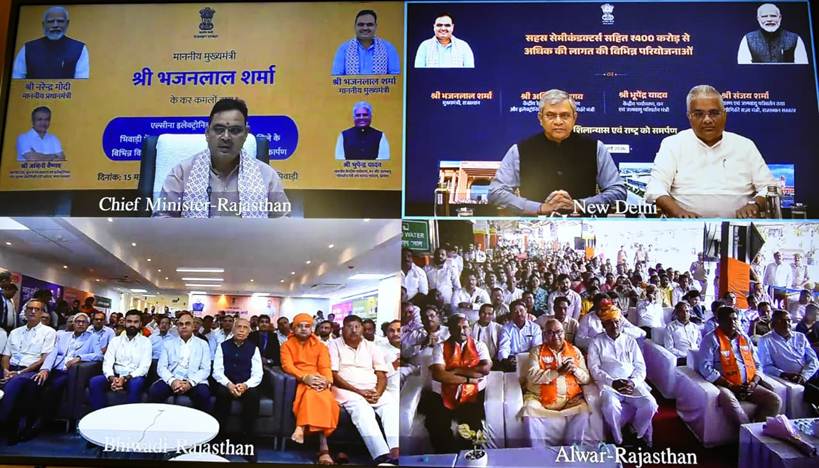
The Railway Minister said that redevelopment work at Alwar railway station worth ₹112 crore is being undertaken under the Amrit Bharat Station scheme. Strategically located on the important Delhi-Jaipur route, Alwar station serves as a major hub catering to thousands of passengers every day. Keeping in view the continuously rising passenger footfall, the station is being upgraded with improved traffic management systems, ample parking facilities, organised arrival and departure areas, and modern passenger amenities.
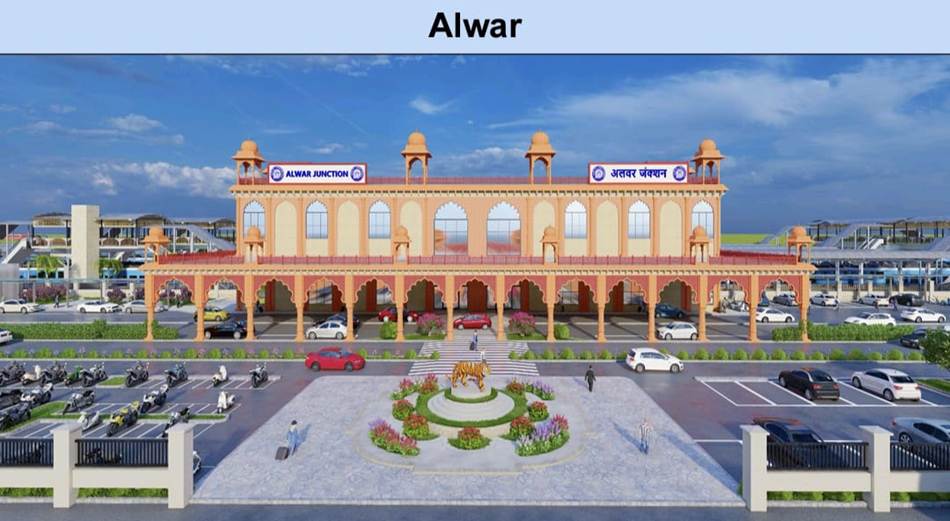
Shri Vaishnaw said that redevelopment work at Alwar Railway Station is progressing rapidly and the station will emerge as a modern and aesthetically designed facility after completion. He said that the redevelopment of Alwar station has been planned in line with the vision of Prime Minister Shri Narendra Modi that railway stations should act as connectors for cities. He added entry facilities are being developed on both sides of the station to improve urban connectivity. The station buildings are being constructed in accordance with the cultural and architectural heritage of Rajasthan. Modern platforms, foot overbridges, parking arrangements and passenger movement facilities are also being developed, Shri Vaishnaw added.

Under the redevelopment project, passengers will benefit from improved and seamless entry and exit arrangements at both the main and secondary entrances of the station. The new station complex, being developed over an area of nearly 16,000 square metres, will showcase modern infrastructure and passenger-centric facilities. An additional high-level platform, two foot overbridges of 6-metre width, and nine modern lifts are also being developed for enhanced passenger convenience.

Dedicated pick-up and drop-off zones for private vehicles, taxis and auto-rickshaws are also being created to streamline passenger movement. A new parking facility spread across approximately 4,500 square metres will further improve accessibility and ease congestion in and around the station area. In addition, a comprehensive traffic circulation plan has also been prepared for the outer area of the station to ensure smoother vehicular movement.

The redevelopment project also includes the development of nearly 1,900 square metres of space for commercial activities. Besides providing world-class passenger facilities, the project is expected to strengthen Alwar’s position as an emerging centre for tourism, trade and employment in the region.

The Railway Minister said that under the Amrit Bharat Station Scheme, three stations in Alwar area, Govind Garh, Rajgarh and Khairthal have already been completed. Across Rajasthan, redevelopment work is underway at 85 stations, out of which 15 stations have been completed so far. Shri Vaishnaw said that the completed stations include Barmer, Bundi, Dausa, Deeg, Deshnok, Fatehpur Shekhawati, Gangapur City, Gogamedi, Govind Garh, Rajgarh, Khairthal, Jaisalmer, Mandalgarh, Mandawar Mahwa Road and Somesar. Across the nation, 1,340 stations have been identified for development under the Amrit Bharat Station Scheme.

Shri Vaishnaw said that Rajasthan currently has five Vande Bharat Express trains in operation, while one Amrit Bharat Express has also been introduced. Shri Vaishnaw said that several new train services have also been introduced for Rajasthan in the last 1 year. These include Vande Bharat Express services from Delhi to Jodhpur and Delhi to Bikaner, Udaipur City to Ahmedabad Vande Bharat Express, the Swarna Nagri Express connecting Jaisalmer with Delhi, the Hyderabad–Jodhpur Bhagat Ki Kothi Express and the Pune–Jodhpur Express. He added a total of 46 new trains have been provided for Rajasthan in recent years, significantly improving connectivity and passenger convenience across the state.

The Railway Minister stated that the Railway Budget allocation for Rajasthan has increased to ₹10,228 crore under the present government, compared to about ₹682 crore during the earlier governments.

Highlighting railway infrastructure growth in the state, Shri Vaishnaw said that nearly 3,900 kilometres of railway tracks have been laid in Rajasthan since 2014. Ten Gati Shakti Cargo Terminals have already been commissioned in locations including Marwar Mundwa, Khemli, Bhupal Sagar, Sonu, Hanwant, Sundlak, Mandalgarh, New Saradhana, Hirnoda and Kairla. He added that six more cargo terminals are under construction at Jogi Magra, Lanela, Dhankya, Kota Junction, Nawalgarh and Biradhwal, while approval has also been granted for eight additional terminals.

The Railway Minister said that Indian Railways is fully committed to supporting industries in Rajasthan by ensuring seamless freight connectivity to ports across the country for sectors ranging from cement and textiles to handicrafts, semiconductors and engineering products.

Shri Vaishnaw said that several major railway infrastructure projects are progressing simultaneously across Rajasthan. These include doubling works on the Agra–Bandikui, Ajmer–Chittorgarh, Bikaner–Lalgarh, Churu-Sadulpur and Luni–Bhildi sections; gauge conversion projects including Dholpur–Sirmathura–Gangapur City and Devgarh Madariya–Nathdwara; the third line between Mathura and Jhansi; third and fourth lines between Mathura and Nagda; and new lines such as Nimach–Badi Sadri and Pushkar–Merta City.

The Railway Minister further said that doubling work on the Rewari–Khatuwas and Ringus -Sikar section is also progressing. He added that the Sheopur Kalan–Kota new line and the Taranga Hill–Abu Road new line projects are also moving ahead. In addition, Umra–Debari doubling work is underway, ensuring railway development reaches all regions of Rajasthan.

Shri Bhupender Yadav thanked Shri Ashwini Vaishnaw for strengthening railway connectivity in the Alwar region and said that several train services have either been introduced or extended for the benefit of passengers. Shri Yadav said that the redevelopment of Alwar Railway Station reflects the grandeur and architectural identity of Rajasthan. He expressed confidence that the modernised Alwar station would emerge as one of the finest railway stations in the state. Shri Yadav also thanked the Railway Ministry for sanctioning and completing several railway overbridge and underpass projects in the region. He said that the project would greatly benefit the people of Khairthal, Kishangarh Bas, Behror and surrounding areas by improving connectivity and easing transportation.
Shri Bhajan Lal Sharma said that Rajasthan is benefiting from its proximity to Delhi, which is strengthening industrial and transport connectivity in the state. He said industrial centres such as Bhiwadi, Neemrana and Khushkhera are being connected through improved railway and transport infrastructure. He said that two major rail connectivity corridors are being planned for the region, including one railway line towards Alwar and an RRTS corridor towards Behror. He added that these projects would improve integration with both conventional railway infrastructure and regional rapid transit systems, and the state government is committed to expediting their implementation.

Indian Railways continues to move ahead as a symbol of progress, trust and a developed New India. It is continuously working towards strengthening passenger amenities to ensure safe, convenient and comfortable travel for every passenger.

SKIMS Medical College Holds Awareness Walk to Mark World HAE Day

0

Timely awareness can save lives: Prof. Fazlul Qadir Parray

KD NEWS SERVICE

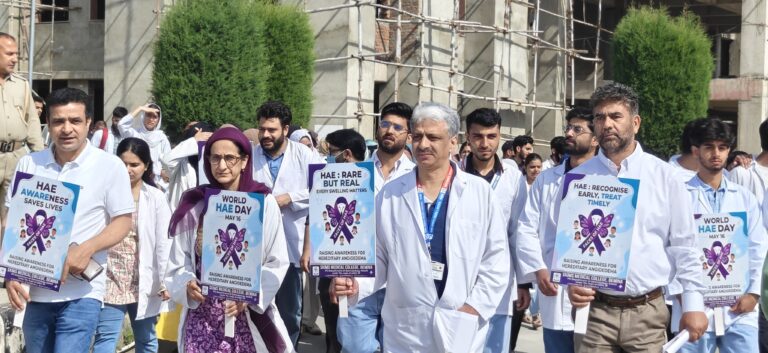
SRINAGAR, May 15: SKIMS Medical College Hospital (MCH), Bemina, organized a morning awareness walk on the eve of World Hereditary Angioedema (HAE) Day, observed annually on May 16, 2026, with the aim of spreading awareness about Hereditary Angioedema, a rare yet potentially life-threatening medical condition. The awareness drive witnessed enthusiastic participation from medical students, healthcare professionals, faculty members, and paramedical staff, reflecting the institution’s commitment to public health education and preventive healthcare initiatives.

The awareness walk was conducted within the college premises and focused on sensitizing participants and the general public about the seriousness of Hereditary Angioedema (HAE), a rare inherited disorder characterized by recurrent episodes of swelling affecting various parts of the body, including the face, hands, feet, abdomen, and throat. Medical experts highlighted that unlike common allergic reactions, HAE-related swelling is not usually accompanied by itching or hives and often does not respond to standard anti-allergy medications, making timely diagnosis and specialized treatment crucial.

Doctors and faculty members emphasized that one of the most dangerous complications of HAE is swelling of the throat and airways, which can obstruct breathing and become fatal if immediate medical attention is not provided. The event aimed to educate future healthcare providers about recognizing the diverse clinical manifestations of the disease and ensuring early intervention for affected patients.

The awareness campaign saw the participation of several distinguished faculty members and dignitaries from SKIMS Medical College and the Indian Association of Dermatologists, Venereologists and Leprologists (IADVL), Jammu and Kashmir chapter. Among those present were Principal SKIMS MCH, Prof. Dr. Fazlul Qadir Parray; Associate Dean, Prof. Aijaz Rather; Head of the Department of Dermatology and President IADVL J&K, Prof. Dr. Seema Qayoom; Honorary Secretary IADVL J&K, Dr. Peerzada Sajad; Treasurer IADVL J&K, Dr. Khalid Abbas; Professor, Department of Dermatology, Prof. (Dr.) Farah Sameem; and Professor, Department of Pathology, Dr. J.B. Singh.

Addressing the participants on the occasion, Principal SKIMS MCH, Prof. Dr. Fazlul Qadir Parray, encouraged students and healthcare workers to adopt healthy lifestyle practices and actively participate in awareness activities that contribute to better public understanding of serious medical conditions. He appreciated the collective efforts of the faculty, students, and organizing team in promoting awareness regarding rare diseases that often remain underdiagnosed due to limited public knowledge.

The event also served as a message of solidarity with patients living with Hereditary Angioedema, many of whom face challenges due to delayed diagnosis and lack of awareness regarding the condition. Organizers reiterated that increasing awareness among medical professionals and the public can significantly improve patient outcomes and quality of life through timely identification and appropriate management.

Participants carrying awareness messages and engaging in discussions during the walk underscored the importance of continued educational campaigns in the field of rare diseases. The initiative concluded with a renewed commitment from the institution and participating healthcare professionals to continue promoting awareness, early diagnosis, and compassionate care for individuals affected by HAE.

New Districts and  rumblings in Ladakh, set- back to the bonhomie & the way forward

0

By: Latief U Zaman Deva

The  Ladakh high altitude desert known as Indus Valley of the erstwhile State of J&K & now ,post August 05,2019 , the Union  Territory  of Ladakh is again a   subject of intense political scrutiny  due to creation of five  more Districts carved out from the existing two Districts of Leh & Kargil.

A Region always contested.

Ladakh lost its centuries old independent status and sovereignty  after  its occupation by Dogra Army during 1834-42 & thus  the beginning of an era of insecurity,   identity crisis, fears of demographic onslaughts & Victimhood which in  varied dimensions remained unflinching even after its split  from J&K despite  180 years  of togetherness and grant of the status of Union Territory, the one & only demand of the Buddhist Association spearheading  the agitation  from 1989. During the  freedom movement against despotic rule  in J&K the minorities including elite & religious Institutions of Buddhists  saddled themselves with  the Maharaja  ostensibly  due to  emergence of a movement in Muslim majority regions for redemption of slavery & dawn of Independence. With the heralding of a new era after partition of the sub- Continent in 1947 an iconic personality of Kaushik Bakula Rimpochee got elected to the constituent Assembly  as a candidate of National conference and in his speeches initially  on the floor of the House he would  lambast even the tallest leader of the State amid thumping of desks by legislators on the mention of merely his name until Member from Kargil made them vigilant about the contents of speeches delivered in ladakhi.

Decades of neglect

 Admittedly no measures worth mentioning were taken by successive Govtts for the purpose of mainstreaming not only the Buddhists but Muslims also in the set up of the State through decentralized & empowered  fiats but the fact also is that the financial support  base wasn’t commensurate enough for meeting  the genuine aspirations of all the sections of the Society.  Sheikh Mohammed Abdullah in 1980 indicated to his cabinet a plan for upgrading Ladakh into a Division but spontaneous protests in Kargil thwarted its implementation. Kargilites demanded   headquarters for the Division at Kargil on the logic of it being equidistant between Srinagar & Leh. Ealier during 1972-74   Syed Mir Qasim deputed Ali Mohammad Naik, an independent MLA  with a plebiscite background, to Kargil for deliberations with local religious leadership for persuading  them about societal transformation through literacy particularly in Women. A decisive push , however, remained elusive in the half-hearted endeavours.

If Leh didn’t get the attention it deserved & by the same logic the Kargil region was most backward, be it the  infrastructure, delivery of public services, medical care & status of education , promotion of tourism particularly adventure & asymmetrical employment opportunities. This reflects that the Ladakh imbroglio had intra- regional and  inter-regional dimensions .  The distance could have been abridged in 1978 by grant of the status of Division to Ladakh in tandem with carving out Kargil as a full-fledged District from  Leh, its predecessor. By & large Buddhists didn’t reconcile with Kargil  deserving on merits District   but  summed it up, as a split of Ladakh on communal  considerations. There is no gainsaying in the admission of the fact that Kargil got transformed fully only after creation of the Distt in 1978 but yet far behind Leh District and hence intra-regional sharp disparities. The four pronged strategy involving  creation of the two Hill Development Councils , direct grant  of  Plan outlays, adoption of well defined criteria in budgetary allocations & practice of induction of two Ministers in the Council of Ministers  from the region had ingrained  an element of continuity  of the State in otherwise votaries of UT  but  Separatist zeal got rekindled by BJP to suit its known narratives. Now it is the turn of majority community  in Ladakh, who feel neglected in the current phase of the reorganization of the Administrative Units, whose hurt sensitivities need be addressed lest the expectations turn into ambers.  No responsive & human State can afford discontentment in  any section of Society moreso in border areas being prone to infidelity by enemy Countries.Double standards & non- parity  calls for reversal. If dying demand for UT status anchored by Buddhists could be reignited by the BJP, nothing harmful in accommodating genuine aspirations of Muslims.

New Initiative

District No of Villages Area (Sq Kms) Population (2011 Census) Predecessor District Population by Religion
Changthan 24 21000 25000 Leh Buddhist
Drass 19 2646 45000 Kargil Muslim
Kargil 80 4000 75000 Kargil Muslim
Leh 44 12000 60000 Leh Buddhist
Nubra 30 9500 35000 Leh Buddhist
Sham 27 14086 15000 Leh Buddhist
Zanskar 26 3000 20000 Kargil Buddhist
  250# 59146 274289    

# Inhabited villages are 239 ( 112 in Leh & 127 in Kargil)

Population conundrum

The population of Leh & Kargil in accordance with Census 2011 is 133487 & 140802 respectively (  total 274289) which includes 35486 Hindus & Sikhs. In the Mother Tongue Returns these people in general have identified themselves as speakers of mother tongues prevalent in rest of the Country which  are neither spoken in Ladakh nor in J&K barring Urdu & Hindi. In the Electoral Rolls  of Ladakh few families from rest of J&K are recorded as electors who are  countable on fingers & settled permanently  from long in the region as Permanent Residents of the erstwhile state. This  non native  segment of  people  comprises of  Central Govtt employees and other categories of work forces who had been living in the two  Districts (now seven) for periods exceeding   six months during census enumeration 2011. By now most of them may have returned to their  native places and replaced by new arrivals. Postings are  tenure based temporarily  for non natives and workmen including Unskilled labourers  are seasonal only. In contrast with J&K the  Ladakh Domiciles Rules  are prospective in application and therefore non ladakhi  residents  eligible & desirous of seeking Domicile certificates would be entitled for the purpose by 2035/40  only.  By excluding 35486  non natives the actual population of the arid UT  reduces to 238803  from 274289 & District wise break up for Leh is 109434  & 129369  for Kargil. Permanently domiciled population & number of inhabited villages as a twin criteria is also accorded weightage in creation of the administrative units rather than merely  relying on area factor.  The area of National Capital Territory  is 1483 Sq kms only  but the number of Districts is  11 on grounds of  primarily the population & other factors linked with being a National capital. The area for Leh & population for Kargil as distinct weightages should have led to parity between the two Districts in allocation of additional Districts carved out from the two predecessor Districts.

Civilizational Bonds & political suspicion

By dint of  spiritual, cultural &  civilizational  affinities & geographic contiguity the majority of population in UT shall in one form or other remain associated with J&K which need not evoke suspicion on their loyalty to the Constitution and the Country.  The events & archaeological  sites associated with Buddhism  in J&K in itself  manifest a never ending connect between the two territories. Be it  the Fourth Buddhist Council held in 72 AD  at Harwan  Srinagar under Kushan King Kanishka  or the sites  at Zanipur, Ushkur & Parihaspur in District Baramulla, all evidentiary towards civilizational bonds between the two. For Muslims  of the region  kashmir is their soul & as body can’t survive sans soul the degree of affinities can be well imagined. The people in Kargil fiercely opposed their separation from the erstwhile state but by now reconciled subject to fulfillment of demands jointly projected by Leh & Kargil based leaderships before Ministry of Home Affairs. In the din of commotion coupled with jubilation on split of the erstwhile state and creation of UT Ladakh The Buddhist Students  Association based in Jammu warned of pitching for Greater Ladakh should Kargilites not stop opposition to the new territorial order. The Greater Ladakh is envisioned to include Zanaskar & contiguous Villages from Kargil District, now Kargil & Zanaskar Districts, Padder from Kishtwar District of J&K & contiguous villages from Himachal Pradesh. By coming into existence of Zanaskar as a separate District  the  Village Rangdum from Tehsil/ Sub-Division  Sankoo Distt Kargil  has been excluded from existing Tehsil & District  for inclusion in Zanaskar on  extraneous grounds   of a Monestry  being in Zanaskar &  Buddhist habitations in Sankoo. The  apprehensions in the minds of people are but logical outcomes   from this  act who got further embittered by five Districts ending up as Buddhist majority ones.

The population of Buddhists  in Kargil  is  20126  &  mostly residing in Zanaskar which is connected with Kargil & Leh involving a surface distance of 240 Km  & 275 Km  respectively. In Leh the Muslim population is 19057 but spread across Leh  (3/4th ) & Nubra (1/4th  )with a few households in Sham & none in Changthang. Since MHA  had already sanctioned five Districts only  without any public feedback particularly from Hill Development Councils therefore the Committee on fixation of boundaries amongst the Districts had a limited mandate . The Committee evidently has adopted territorial jurisdiction positions of Sub- Divisions Nubra, Zanskar & Drass for Districts also insofar as these three places are concerned barring an aberration in Zanaskar which is reminiscent of partition woes . The  sooner it is done away with the better.

Across LOC

Gilgit Baltistan,  cartographically a part of Ladakh, has three Divisions and 14  Districts for an area of  72496 Sq km. Incidentally Gilgit & Diamir  Divisions have  never been ever segments of Ladakh excepting Baltistan , the winter capital of Ladakh.

Way forward

  1. I)Ministry of Home Affairs may consider increasing the number of Districts by one more & specify Sankoo as 8th District of Ladakh in order to off-set the existing lopsided  ratio of 4:3  between the two sub- regions  & 5:2  between the  two  religious communities to an equitable  matrics of  4:4 & 5:3  respectively;
  2. II)With a view to preserve and perpetuate for good  the two identities of Leh & Kargil, the number of Divisions need be raised from one to two. Leh & Kargil the two Divisions. The Districts  of Changthen,Leh,Nubra & Sham shall constitute Leh Division & Drass, Kargil, Sankoo (suggested)  & Zanaskar  the Kargil Division;

III)                  Four tyre self governance model to be introduced encompassing Panchayat, Block Development Board, District Development Board  substituting Hill Development Council &  the Ladakh Divisional Development  Board at the apex in each of the two suggested Divisions. The Ladakh Panchayat Raj Act and the Ladakh Hill Development Councils Act need be amended to comport with the roadmap suggested apart from vesting the powers in the two Apex bodies similar to powers exercised by the Ministers in Union Territories of J&K, Delhi & Puducherry.

 (The author is IAS (Retd)  & former Chairman of J&K Public Service Commission. Opinions express in the article are the Author’s own, and do not necessarily reflect the editorial stand of Kashmir Despatch)

BJP protests against liquor sale in Kashmir, marches towards CM Omar’s residence

0

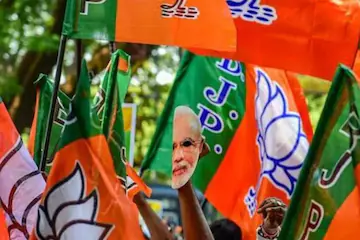
Srinagar, May 15 : The Bharatiya Janata Party (BJP) on Friday staged a protest in Srinagar against the operation of wine shops in Kashmir, demanding a complete ban on liquor sale in the Valley.

The march began from Ram Munshi Bagh in Sonwar and moved towards Gupkar Road, where the residence of Jammu and Kashmir Chief Minister Omar Abdullah is located.

BJP leaders and workers raised slogans against liquor sale and accused the ruling National Conference (NC) of promoting alcohol in the region.

BJP state co-media incharge Advocate Sajid Yousuf Shah said the party was seeking an immediate ban, calling the issue linked to the Valley’s social and religious values.

“The sale of liquor in Kashmir Valley is a direct assault on our social and religious ethos. The government must respect public sentiment and impose a complete ban on wine shops,” he said.

He added that tourists visit Kashmir for its natural beauty, culture and hospitality, not for alcohol, and termed the promotion of liquor in the name of tourism “unacceptable”.

Meanwhile, police stopped the protesters from marching further towards Gupkar—(KNO)

ANMT School Bandipora Cries for Attention Amid Lack of Basic Facilities

0

Students Demand Tutors, Transport, Smart Classrooms and Safe Infrastructure


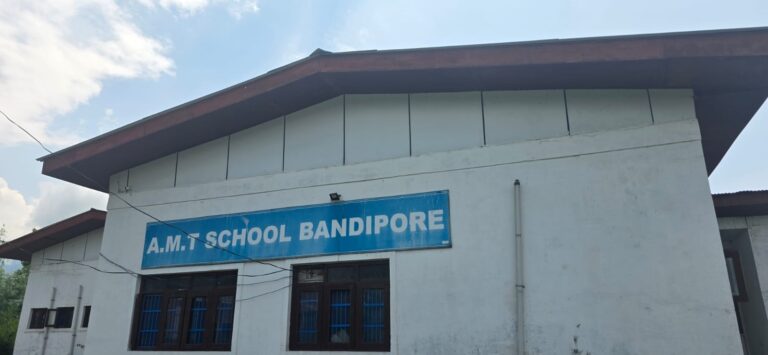
Bandipora, May 14: The Auxiliary Nursing and Midwifery Training (ANMT) School in Bandipora is allegedly struggling with severe infrastructural and academic shortcomings, leaving students worried about the quality of education and training being provided at the institution.

Students and locals have raised serious concerns over the absence of basic facilities, shortage of teaching staff and poor administrative support at the school, which plays a crucial role in preparing healthcare workers for the district.

According to students, the institution presently lacks a dedicated tutor for Pharmacology, affecting regular academic sessions and creating gaps in professional learning. They said several classes are being managed by deputed staff from the District Hospital Bandipora and the ISM Department instead of permanent faculty members.

The students further alleged that the school bus remains parked at the CMO Office premises without a driver, while another Bolero vehicle belonging to the institution is reportedly being used for official purposes at the CMO office. They said transportation issues continue to affect students, especially those coming from far-off areas.

Apart from academic concerns, students also complained about the absence of smart boards and modern teaching facilities in classrooms, saying nursing students deserve updated learning infrastructure in line with present-day educational standards.

The school ground, according to students, remains submerged during rains, creating inconvenience and safety risks. They also demanded proper fencing around the institution to ensure security and protection of the campus.

“We are pursuing a professional healthcare course, but unfortunately the institution lacks even the basic facilities needed for proper learning and training,” several students said while requesting the authorities to intervene immediately.

The students and locals have appealed to the District Administration and Health Department to look into the issues and provide adequate teaching staff, transportation facilities, smart classrooms, fencing and other necessary infrastructure for the smooth functioning of the institution.

They said improving facilities at the ANMT School Bandipora is essential for strengthening healthcare education and ensuring better future opportunities for aspiring nursing students in the district. (KNS)