By: Deepak Kumar Nayak
On March 30, 2026, Andhra Pradesh Director General of Police (DGP) Harish Kumar Gupta formally declared that the state had been rendered free of the Communist Party of India-Maoist (CPI-Maoist), achieving this milestone a day ahead of the Union Government’s stipulated deadline of March 31, 2026.
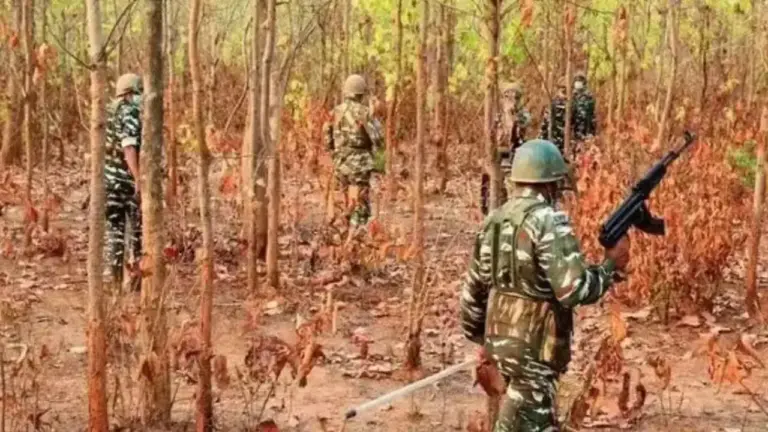
Addressing a press conference at the Vijayawada Police Command and Control Centre, the DGP outlined the scale, intensity, and success of sustained counter-insurgency operations conducted over the preceding months.
He revealed that, over the past 18 months, a total of 18 Maoists had been eliminated in exchange-of-fire incidents across the state. Among those killed were several high-ranking leaders, including Central Committee members Madvi Hidma, Gajarla Ravi alias Uday, and Metturi Jogarao alias Tech Shankar. Additionally, key figures from the Andhra-Odisha Border (AOB) Special Zonal Committee—Venkata Ravi Chaitanya alias Aruna, Kakuri Pandanna alias Jagan, and Madakam Raje—were also neutralised.
Beyond these fatalities, the police achieved significant operational gains through arrests and surrenders. A total of 81 Maoists were arrested, while 106 cadres voluntarily surrendered. Security forces also recovered 120 weapons during various operations, and efforts are ongoing to locate additional hidden arms caches. The DGP commended the coordinated efforts of multiple units, including the Special Intelligence Branch (SIB), Greyhounds, Intelligence Department, and district police personnel, noting their crucial role in dismantling Left-Wing Extremism (LWE) in the state. He further assured that surrendered Maoists would receive cash rewards in accordance with government norms and would be rehabilitated through welfare schemes aimed at reintegration.
Data compiled by the South Asia Terrorism Portal (SATP) indicates that 2025 recorded 18 LWE-linked incidents, compared to 12 in 2024. This marked a reversal in a long-term declining trend observed since 2018, when 37 incidents were recorded. The numbers steadily fell to 30 in 2019, 19 in 2020, 15 in 2021, 14 in 2022, and 12 each in 2023 and 2024. The spike in 2025 was attributed to intensified security force operations in the run-up to the March 31, 2026 deadline, both in Andhra Pradesh and across the country.
A similar pattern is evident in incidents involving killings. These had been on a steady decline since 2019, when seven such incidents were recorded. The number dropped to four in 2020, two in 2021, and one each in 2022, 2023, and 2024. However, 2025 witnessed an increase to four incidents. In terms of fatalities, the trend has also largely been downward since 2020, barring a slight increase in 2021. Fatalities declined from 14 in 2019 to five in 2020, rose to seven in 2021, and then fell again to one each in 2022, 2023, and 2024. In 2025, however, fatalities surged to 18. Historically, the highest number of killings—204 incidents—and 317 fatalities were recorded in 2005.
Civilian casualties have also shown a marked decline. From five civilian deaths in 2019, the number dropped to four in 2020 and has remained at one per year from 2021 through 2024. Notably, no civilian fatalities were recorded in 2025, indicating improved security conditions for the general population.
The last recorded fatality among Security Forces (SFs) dates back to May 5, 2017, when Home Guard Sheikh Valli was killed in a landmine blast triggered by Maoist cadres along the Lothugedda Junction–Balapam stretch in Visakhapatnam District, while returning from a CRPF outpost at Rallagedda. In contrast, Maoist fatalities rose sharply to 18 in 2025. The last major incident involving multiple Maoist casualties occurred on June 16, 2016, when six Maoists were killed in an encounter with Greyhounds personnel in the Theegalemetta Forest area of Koyyuru Mandal under Mampa Police Station limits in Visakhapatnam District.
Arrests and surrenders further highlight the weakening Maoist presence. In 2025, at least 58 Maoists were arrested, a sharp rise from nine arrests in 2024 and five each in 2022 and 2021. Simultaneously, 38 Maoists surrendered in 2025, in addition to 45 surrenders in 2024. The trend has continued into 2026, with 17 Maoists surrendering as of April 12, according to SATP data.
Other indicators also point to a near-total cessation of Maoist activity. In recent years, Maoists have not carried out any major attacks against civilians or security forces. The last significant civilian-targeted incident occurred on February 19, 2023, when three tribals were killed in the Lakkavaram Forest area of G.K. Veedhi Mandal in Visakhapatnam District. The last major attack on security personnel dates back to December 25, 2005, when Maoists killed four Railway Protection Force personnel and injured five others during an attack on a train at Kuneru Railway Station in Vizianagaram District.
The state has also remained free of explosion-related incidents since 2021. The last such incident occurred on August 3, 2020, resulting in the deaths of two civilians. Maoists have not issued any bandh (shutdown) calls since 2022, with the last call being in 2021. On April 26, 2021, they had called for a Bharat Bandh to protest alleged harassment and torture of tribals, social activists, and civil rights activists by security forces.
Significantly, Andhra Pradesh has recorded no fatalities in any category in 2026 up to April 12. During this period, there have been no incidents of explosions, arson, or exchange of fire between Maoists and security forces. No Maoist arrests have been reported, though 17 cadres have surrendered.
A long-term perspective underscores the scale of transformation. Since SATP began tracking LWE data on March 6, 2000, Andhra Pradesh witnessed a peak of 507 incidents in 2005, the same year that recorded the highest civilian fatalities at 132. Security force fatalities peaked in 2001 at 41, while Maoist fatalities reached their highest level in 2003 at 165.
Recent analysis of Maoist activity reveals a drastic geographical contraction. In 2025, Maoist activity was confined to just one district—Alluri Sitarama Raju—out of the state’s 26 districts, and even this was classified as ‘moderately affected’. In 2024, four districts reported Maoist presence, with only Kurnool categorised as ‘moderately affected’ and the others—Alluri Sitarama Raju, Parvathipuram Manyam, and Visakhapatnam—classified as ‘marginally affected’.
Earlier, on November 19, 2025, SIB Chief and Additional Director General of Police Mahesh Chandra Laddha had stated that the Andhra Pradesh Police were intensifying efforts to eliminate Maoist influence by March 2026. His remarks followed two major encounters on November 18 and 19 in Alluri Sitarama Raju District, in which 13 Maoists, including senior leaders, were killed. He disclosed that around 50 Maoists from Chhattisgarh and Telangana had entered Andhra Pradesh seeking refuge, prompting coordinated intelligence-based operations. These operations led to the arrest of over 50 Maoists across multiple districts, including Krishna, Eluru, NTR, Konaseema, Alluri Sitarama Raju, and Kakinada. Laddha also highlighted an encounter near Uttaluru in Maredumilli Mandal, where six Maoists, including Central Committee member Madvi Hidma alias Santosh, were killed and a significant cache of arms and ammunition recovered. He described these operations as among the most comprehensive in recent years, driven by precise intelligence inputs.
The early months of 2026, including the period following the March 31 deadline, have remained largely incident-free, demonstrating sustained dominance of security forces.
However, despite this success, challenges remain within the policing framework. According to Bureau of Police Research and Development (BPR&D) data as of January 1, 2024, the Andhra Pradesh Police had an actual strength of 88,514 personnel against a sanctioned strength of 110,186, indicating a shortfall of 19.66 per cent. The police-area ratio stood at 54.33 personnel per 100 square kilometres, below the national average of 65.78 and significantly below the sanctioned level of 67.63. Similarly, the police-population ratio was 166.18 per 100,000 population, compared to a sanctioned norm of 206.87. The Indian Police Service (IPS) cadre also faced shortages, with 131 officers in position against a sanctioned strength of 144, reflecting a deficit of 9.02 per cent and impacting executive oversight.
Andhra Pradesh now stands at a decisive turning point in its counter-insurgency journey. The near-eradication of Maoist influence marks the culmination of decades of coordinated security operations and developmental initiatives. The developments of 2025—characterised by increased surrenders, reduced violence, and restoration of state control over forested strongholds—laid the groundwork for achieving the March 31, 2026 deadline announced by DGP Harish Kumar Gupta.
Although the state has successfully sustained this trajectory of decline beyond the deadline, residual risks persist. Preventing the spillover of Maoist elements from neighbouring states and addressing deep-rooted socio-economic challenges, particularly in tribal regions, will be critical. The long-term success of this effort will depend on the effective rehabilitation of surrendered cadres and accelerated development initiatives, ensuring that peace in Andhra Pradesh remains durable and irreversible.
(The author is a Research Associate, Institute of Conflict Management)