A Day in the Life of Kashmir’s Elderly Masala Sellers
TAQWA SHAFI
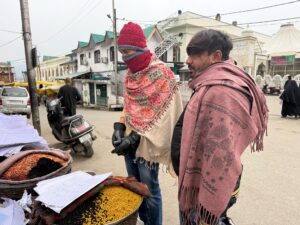
SRINAGAR, Feb 13: On a crisp Friday morning at Hazratbal Shrine in Srinagar, as the faithful stream toward the revered white marble domes for congregational prayers, another ritual quietly unfolds along the pavements.
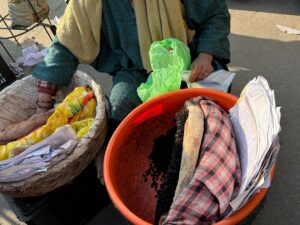
Beneath the open sky, seated on low wooden stools or folded blankets spread across cold concrete, elderly women unwrap their day’s hope. From cloth bags emerge small, neatly folded paper packets—filled with homemade black masala. The aroma rises before the sun fully does: roasted cumin, fennel, coriander, cloves, and the smoky warmth of tradition.
These are not merely spices.
They are survival, dignity, and memory—ground together before dawn.
Zaina’s Battle with Time
Seventy-year-old Zaina Begum adjusts her woollen shawl as she arranges her packets with deliberate care. For more than nine years, this pavement has been her workplace. But her struggle began long before that.
Twenty-five years ago, her husband was killed in a road accident, leaving her widowed with five children—three sons and two daughters—and no steady source of income. There was no pension, no savings, no safety net.
“I did whatever work I could get,” she says, her voice steady but weathered. “My children had to survive.”
She found employment at a local private school. Her duties were unglamorous and exhausting—cleaning toilets, sweeping corridors, serving tea to teachers. The work strained her body but strengthened her resolve. Every rupee went toward school fees, books, and meals.
Years passed. She married off her daughters. Her sons, too, began families of their own. But the promise of rest never came.
After her sons married, Zaina was asked to live separately. She was given a single small room—one space where she now sleeps, cooks, and spends her days alone.
Age tightened its grip. Diabetes followed. Medicines became expensive luxuries. When she finally left her school job, her income stopped—but her expenses did not.
With no pension and no dependable support, she turned to something she had always known: preparing traditional Kashmiri black masala—Masala Wagun.
Each morning before sunrise, Zaina dry-roasts cumin, fennel, coriander, and cloves in an iron pan. The crackle of spices is her morning soundtrack. She grinds them by hand, carefully blending proportions perfected over decades.
“This is not just business,” she says quietly. “This work keeps me alive. I earn with my own hands.”
On good days, she earns between ₹200 and ₹500—barely enough for food and medicines. But it is hers.
Fatima’s Fight for Her Children
A few steps away sits 60-year-old Fatima, her fingers stained faintly with spice dust. Her story echoes hardship of a different kind.
Divorced nearly 15 years ago after her husband remarried, Fatima was left to raise two daughters and a son alone. For a time, her former husband sent ₹10,000 per month. But five years ago, even that support stopped.
“I raised my children alone,” she says, her tone matter-of-fact, not bitter.
With no formal education and limited opportunities, she began selling black masala outside the shrine. What started as a desperate measure became a daily ritual.
Her modest earnings helped educate her children. Her elder daughter, now a graduate, teaches at a private school—the same school she once attended as a student.
“She helps run the house now,” Fatima says, pride flickering across her face. “But I still work.”
Not out of necessity alone—but out of habit, independence, and resilience.
The Spice that Binds Kashmir
Black masala is a staple in Kashmiri kitchens. Sprinkled over boiled eggs, potatoes, or steaming rice, it adds a burst of smoky warmth to simple meals. Unlike factory-made blends, the masala prepared by these women carries the texture of hand-grinding and the depth of slow roasting.
Customers know the difference.
“Whenever I visit the shrine, I make sure to buy from these women,” says Bilal Ahmad, a local schoolteacher. “The masala reminds me of my grandmother’s kitchen.”
Many buyers come not only for flavor but for familiarity. Some ask for the masala by the seller’s name.
“People recognise us here,” Fatima says. “They trust us.”
Trust, however, does not shield them from rising costs. The price of raw spices has nearly doubled in recent years. Selling rates remain largely fixed, leaving little room for profit.
“A few years ago, spices cost ₹200,” Zaina explains. “Now it’s almost double. But we can’t increase the price too much. Customers won’t buy.”
Without formal stalls or protection from the weather, they rely entirely on footfall—on Fridays, on festivals, on faith.
Most of the women here are widowed, divorced, or living alone. Their mats form a fragile marketplace of endurance.
Labour in the Shadows
As afternoon shadows lengthen and prayers conclude, the crowds begin to thin. The women count their earnings carefully—notes folded into the corners of shawls. Unsold packets are tucked away for the next day.
There are no closing announcements. No applause.
Only quiet departure.
“This is not about fame,” Zaina says softly as she gathers her things. “I just want enough to buy my medicines and live with dignity.”
Their labour is steady and largely unnoticed. They do not protest, demand, or complain loudly. They endure.
“We were never taught to ask,” Fatima says with a tired smile. “We were taught to make, to give, to carry on.”
In the shadow of Hazratbal’s gleaming dome, amid devotion and prayer, these elderly women conduct their own act of faith—faith in work, in resilience, and in survival.
Each small paper packet they hand over carries more than spice.
It carries a lifetime of struggle—ground fine, wrapped tight, and sold with grace.