spot_imgspot_img
spot_img
Home Blog Page 124

Thirty Years at the Doorstep of Survival

0


In Baramulla’s Shah Mohalla, a mother’s quiet battle against hunger, loss and humiliation continues—for the sake of her children


TAQWA SHAFI

BARAMULLA, Feb 12: Shah Mohalla does not appear on most maps of Baramulla. It lies about six kilometres from the bustle of the town, down a broken road that narrows into lanes edged with open drains and mounds of unattended garbage. Children run barefoot over damp earth. Smoke rises thinly from tin chimneys. The air carries the smell of damp brick and neglect.

Sandwiched between a heap of refuse and a sluggish drain stands a modest three-room brick house. Its walls are weather-stained, its courtyard uneven. Inside lives 65-year-old Zoon, a widow who has spent the last three decades knocking on doors so her children would not sleep hungry.

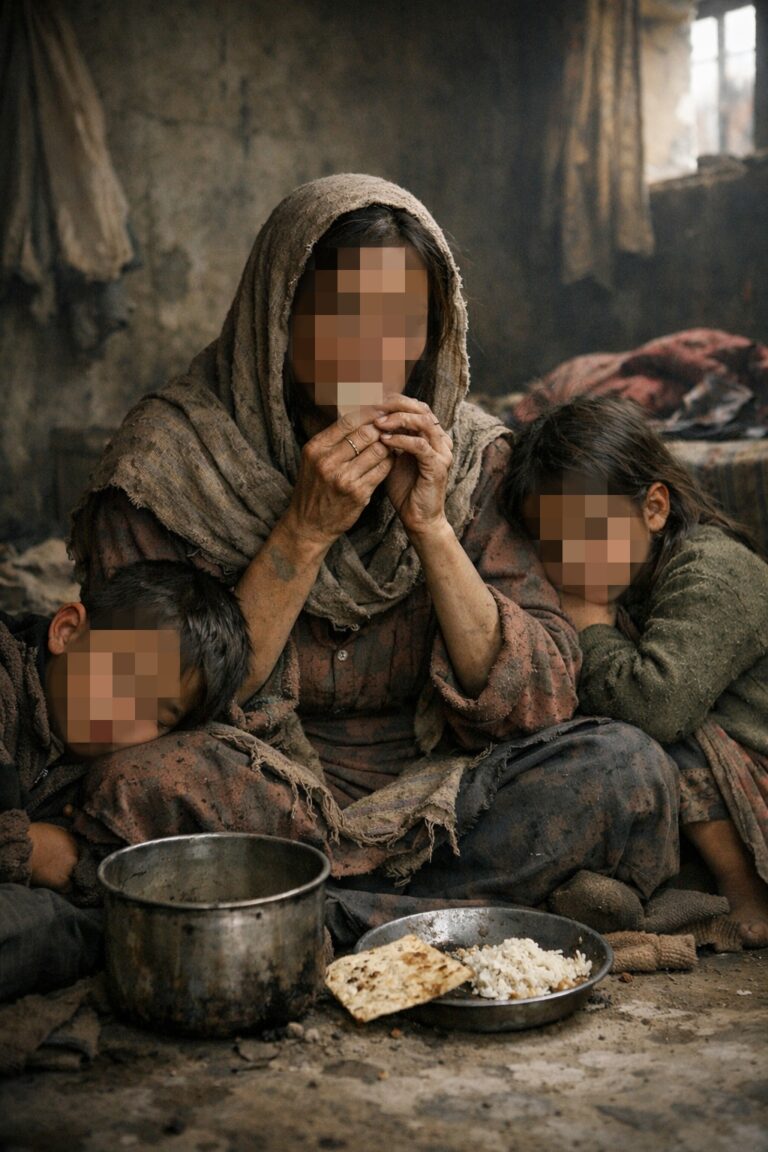
Her kitchen is small and dimly lit. An electric heater hums faintly as her daughter stirs rice in a dented pot. The room is sparse—two worn-out utensils, a cracked plastic bucket, a shelf with a few steel plates stacked neatly. Zoon sits on the floor cushion, her frail hands resting in her lap. Her face, creased by time and toil, darkens when she begins to remember.

“I was 35 when my husband died,” she says quietly. “My eldest was just 12. Four children. No income. No support. I did not know how I would feed them.”

Her husband’s death was not just a personal tragedy; it was an economic collapse. With no formal education and no employable skills, Zoon was left to confront a world that offered little mercy to a young widow with four mouths to feed.

“One day my children were crying from hunger,” she recalls, her voice trembling. “They kept asking for food. I had nothing. Nothing in the house. What can a mother do when her children cry and you have nothing to give?”

That night, she says, her son uttered words that still haunt her. “He told me, ‘If we cannot eat, give us poison so we can sleep.’”

Zoon did not sleep that night. She sat awake, staring at her children’s faces in the dark. Something hardened within her. Or perhaps something softened. By dawn, she had made a decision that would define the rest of her life.

“I decided I would beg,” she says simply. “For my children, I could bear anything.”

Every morning since, for nearly 30 years, Zoon has walked from Shah Mohalla to villages and neighbourhoods across Baramulla district. Through harsh winters when snow buries rooftops. Through summer heat that cracks the earth. Through rain that soaks her pheran and stiffens her bones.

“Every day I knock on hundreds of doors,” she says. “Some people give. Some shout. Some insult. But I keep going.”

In the early days, she says, the humiliation was unbearable. “I was young. I felt ashamed. People would look at me differently. Some would speak harshly. Some would close the door in my face.”

She considered working as a domestic help. But in Shah Mohalla—home to many families who survive on alms—social stigma runs deep.

“For people from our locality, working as a maid in someone’s house is not easy,” she says. “There is little acceptance. People think differently about us.”

So she chose the streets instead.

Sometimes she begged in her own village, sometimes in the crowded markets of Baramulla town, sometimes along dark lanes where shadows stretched longer than hope. She learned which doors might open, which ones would not. She learned to swallow pride. She learned to endure.

Despite everything, Zoon insisted on sending her children to school—an ageing, crumbling building in the neighbourhood.

“I wanted them to at least learn to read and write,” she says. “Even if we were poor, they deserved that.”

Her children—Akhtar, Riyaz, Maymoona and Tabasum—were her world.

“I thought my eldest son would become my shoulder,” she says, a faint smile flickering across her face before fading. “He wanted to help me.”

But fate intervened cruelly again. Akhtar was crippled in a road accident, his dreams collapsing alongside his mother’s quiet expectations. Her second son, Riyaz, she says, struggles with mental health and drug dependency.

“After my eldest son’s accident, I lost hope,” she admits. “But I did not give up.”

Her daughter Maymoona once dreamed of becoming a teacher. Poverty cut that dream short. Today she is married, raising two children of her own. Tabasum remains at home, helping her mother manage the fragile household.

The burden, however, still rests largely on Zoon’s aging shoulders.

There have been moments of kindness. Strangers who pressed a few extra rupees into her palm. Shopkeepers who offered rice or flour. Neighbours who shared leftovers.

“There are kind people in this world,” she says. “If not for them, how would we survive?”

Yet kindness is unpredictable. It cannot be budgeted. It cannot be relied upon like a salary.

As the sun sets over Shah Mohalla, Zoon returns home, her steps slower than they were decades ago. Her knees ache. Her back bends slightly forward. But she still walks.

Inside, the electric heater glows red. The evening meal—simple rice and vegetables—simmers. Zoon watches her daughter cook and reaches out to embrace her.

“I beg out of helplessness,” she says, her voice steady despite everything. “My children deserve a better life. That is all I ever wanted.”

In a society that often reduces beggars to statistics or stereotypes, Zoon’s story resists simplification. It is not merely about poverty. It is about a mother who chose humiliation over hunger for her children. It is about resilience forged in desperation. It is about love that outlasts shame.

Three decades after that sleepless night, Zoon still knocks on doors.

Not because she lacks dignity.

But because she refuses to let hunger win.

 

Court Awards ₹28.08 Lakh Fine, One-Year Jail in 2019 Cheque Bounce Case

0


Awantipora, Feb 12: The Court of Additional Special Mobile Magistrate Awantipora on Thursday convicted two persons in a cheque bounce case dating back to 2019 and sentenced them to one year of simple imprisonment along with a fine of ₹28,08,000.


The case, titled Mukhtar Ahmad Sheikh versus Ess Kay Filling Station and another, was decided by Additional Special Mobile Magistrate Awantipora Muneer Ahmad Bhat. The court convicted Muhammad Sultan Koka, son of Ghulam Mohammad Koka, resident of Parraypora Majeedbagh Srinagar, and Abid Yousuf Dar, son of Mohammad Yousuf Dar, resident of Wuyan Pampore.


The court held that the accused had knowingly issued a cheque to the complainant Mukhtar Ahmad Sheikh, son of Ghulam Mohammad Sheikh, resident of Noorpora Awantipora, which was subsequently dishonoured.


While delivering the judgment, the court observed that the accused had intentionally issued the cheque with knowledge that it would likely be dishonoured, thereby causing financial loss to the complainant. The court noted that the cheque was issued for personal gain despite awareness of insufficient funds.


After examining witnesses and evidence on record, the court sentenced both accused to simple imprisonment for one year. In addition, a fine of ₹28,08,000 was imposed along with six percent interest from the date of issuance of the cheque till the date of judgment.


The court directed that the entire amount be paid to the complainant within three months from the date of pronouncement of judgment. In case of failure to pay within the stipulated period, the accused shall undergo an additional imprisonment of three months. [KNT]

Srinagar Court Grants Interim Injunction in ₹1100-Crore Defamation Suit

0


FIRDOUS AHMAD

SRINAGAR, Feb 12: In a significant development highlighting the growing intersection of social media discourse and reputational rights, the Court of the Additional District Judge, Srinagar, has granted interim relief to a local social activist in a high-stakes defamation suit seeking damages to the tune of ₹1100 crores. The order was passed on February 12, 2026, in a civil suit instituted by Sandeep Mawa, son of Roshan Lal Mawa, a resident of Karun Nagar, Srinagar.

The suit has been filed through Advocate Arzaan Ahmad Dar & Associates against as many as 16 defendants, including religious figures, political functionaries, editors, media platforms, and social media handlers. The principal defendant in the case is Sheikh Ghulam Rasool, also known as Hami, son of Ghulam Mohammad Sheikh, a resident of Iqbal Colony, Mustafa Abad, Zainakote, Srinagar. The other defendants named in the suit include Rakesh Handoo of Faridabad; Karwan Info Centre, Karwan Islamic Institute through its handler Yousuf Khake of Shadipora, Sumbal; Tariq Vigas of Bursal, Ganderbal; Towseef Raza Qadri through handler Towseef Ahmad of Maloora, Srinagar; Sameer-ul-Azam of Chewdara, Beerwah; Parwaz News Hub through its Editor Muheet of Wakura, Ganderbal; Abdul Ahad Mir, also known as Madgoomi, spokesperson and resident of Abroo Tarhama; Jamal Kashmiri of Budgam; Kashmir Pride through Editor Shahbaz Bashir; Yawar Nabi of Makhoom, Budgam; Mirwaiz Maulana Hassan Firdousi of Lawaypora, Srinagar; Vijay Bakaya of Sidrah Housing Colony, Jammu; Sanjay Saraf, Chairman of Lok Jan Shakti Party, resident near Shive Mandir, Indra Nagar, Srinagar; Firdous Ahmad Bhat, son of Ghulam Nabi Bhat; and Rafiq Ahmad Bhat, associated with Janta Dal as Editor to Defendant No. 2.

According to the contents of the plaint, the plaintiff has alleged that the defendants engaged in a coordinated and sustained campaign of defamatory remarks, imputations, and personal attacks against him. The suit claims that the alleged defamatory material was circulated through social media platforms, digital handles, videos, and public addresses. It is further alleged that the imputations extended beyond public criticism and intruded into the plaintiff’s personal life and religious identity, thereby tarnishing his reputation in society.

The plaintiff has contended that he has, in his capacity as a social activist, consistently opposed certain practices which he believed were misleading people in the name of religion, including references to religious relics (Tabrukat). According to the plaint, this opposition allegedly triggered hostility from certain quarters, leading to what has been described as a “scathing attack” on his character. The suit alleges that photographs and other materials relating to the plaintiff were uploaded and circulated without his consent, accompanied by statements that were defamatory, derogatory, and violative of community guidelines.

It has also been alleged that the defendants acted in connivance with one another, amplifying the imputations through various media platforms and digital networks, thereby exaggerating and perpetuating the alleged falsehoods. The plaint states that the controversy created was entirely unfounded and designed to damage the public image of the plaintiff. The reputational harm, the plaintiff claims, has caused him immense mental distress, disrupted his regular life, and lowered his standing in the eyes of society at large.

Seeking redress, the plaintiff has claimed compensation amounting to ₹100 crores, asserting that the damage to his reputation is substantial and irreversible in nature.

While considering the application for interim relief under Order 39(3) of the Code of Civil Procedure, the court observed that the grounds urged in the plaint were well defined and warranted consideration at this stage. The court held that a prima facie case had been established in favour of the plaintiff and that the balance of convenience tilted in his favour. It further noted that if the relief sought was not granted, the plaintiff was likely to suffer irreparable loss, particularly in relation to his personal repute and social status.

In its order, the court observed that the accusations brought against the plaintiff were of grave concern as they allegedly intruded into his personal life and reputation. Stating that the court was bound to intervene to prevent further damage, it dispensed with the requirement of prior notice under Order 39(3) CPC and temporarily restrained the defendants from circulating, publishing, or making any defamatory or derogatory statements against the plaintiff until the next date of hearing.

However, the court clarified that the defendants are at liberty to approach it for modification, variation, or cancellation of the interim order before the next date of hearing. The plaintiff has been directed to furnish copies of the plaint, supporting documents, and affidavits to the defendants at the time of service of summons and to file a service affidavit before the court.

The matter has been listed for hearing on February 20, 2026, when the respondents are expected to file their objections.

The case has attracted attention in legal circles as it underscores the increasing number of defamation disputes arising from digital platforms and public commentary. The proceedings are likely to be closely watched, particularly in the context of balancing freedom of expression with the right to reputation in an era of instantaneous and far-reaching online communication.

J&K Govt rebuts 28 fake news items in 10 months, says no mandate to regulate fact check units

0

JAMMU, Feb 12  : The Jammu and Kashmir administration has rebutted 28 fake or misleading news items in 10 months through its media monitoring cell, but does not have the mandate to regulate websites, digital platforms or private fact-checking units, the Legislative Assembly was informed on Thursday.

In a written reply to a question by legislator R S Pathania, the Information Department said a dedicated Media Monitoring Cell has been set up in the Directorate of Information & Public Relations (DIPR) for real-time tracking of fake news.

“Twenty rebuttals have been issued through Press Releases and eight through social media handles of the DIPR, J&K from April 1, 2025 to January 31, 2026,” the reply stated.

The government, however, made it clear that regulation of websites, digital platforms including online news channels, and Fact Check Units does not come under the purview of the Information Department.

It further said the department neither recognises nor authorises any private Fact Checking Unit (FCU). “As of now, the Information Department does not verify, grade or audit private Fact Check Units,” the reply noted.

The government has now proposed a regulatory framework for new and social media in the draft New Media Policy-2026, which is currently at the inter-departmental consultation stage for finalisation.

On the issue of penal action against entities spreading misinformation, the department submitted that imposition of fines on any organisation or corporate entity for spreading fake news does not come under its mandate.

The reply further said all departments have designated Nodal Officers to monitor department-specific fake news, who have been provided login IDs to upload rebuttals on a dedicated portal.

The J&K Media Policy 2020 authorises DIPR to monitor content for fake news, plagiarism, and unethical or anti-national activities, with powers to de-empanel media houses or withhold government advertisements. For entities registered under the Press & Registration of Periodicals Act 2023, the government can recommend de-registration to the Press Registrar General of India, it said.

On cyber security infrastructure, the Information Technology Department has implemented multi-layered measures including mandatory security audits for websites hosted on State Data Centre and NIC Mini Data Centre. Redundant websites have been systematically decommissioned or DNS de-mapped, the reply said.

Cyber security governance has been institutionalised through monthly review meetings chaired by the Chief Secretary, an Information Security Steering Committee under Secretary, IT Department, and nomination of Internal Security Officers across all departments, it added.

The legal framework governing social media platforms is primarily anchored in the Information Technology Act, 2000, particularly Section 69A which empowers blocking of content in the interest of public order and national security, complemented by the IT (Intermediary Guidelines and Digital Media Ethics Code) Rules, 2021, the government informed the House.

The Bharatiya Nyaya Sanhita, 2023 contains updated provisions including Section 194 criminalising hate speech, Section 195 penalising religious insult, Section 356 covering defamation, and Section 198 addressing spread of rumours and public mischief, all relevant to social media misuse, it said. (KNS)

STATUS OF IMPLEMENTATION OF E-SAKSHYA AND NYAYA SETU APPS

0

VINOD BHAT


Delhi, Feb 11;

‘Police’ and ‘Public order’ are State subjects under the Seventh Schedule to the Constitution of India. The responsibilities to maintain law and order, protection of life and property of the citizens including investigation and prosecution of crime and criminals rest with the respective State/UT Governments which are competent to deal with such offenses under the extant provisions of law. This also includes the implementation, deployment, operational usage, data generation, training of police personnel, and day-to-day functioning of applications across police stations, as well as any assessment thereof.


MHA has launched the eSakshya App and underscored the need for its effective adoption by States and Union Territories in accordance with the provisions of the Naveen Nyaya Sanhitas. It is one of the applications introduced as part of the implementation of the Naveen Nyaya Sanhitas to support Investigating Officers. The application is designed to facilitate capture, storage, and retrieval of evidence through videography and photography, and also enables the recording of witness statements. As per available information, e-Sakshya application is being used in 15,899 Police Stations across 35 States/UTs.


The information on the number of FIRs, witness statements, and digital evidence records uploaded through these apps since their launch, are under the purview of the respective State/UT Governments. These details are not maintained with this Ministry.


As per the available information, Nyaya Setu application was developed by NIC, Chandigarh in consultation with Chandigarh Police, to enable seamless inter-agency coordination, data-driven policing and efficient criminal justice delivery. Further details related to the implementation and effectiveness of the said application are not maintained with this Ministry.


Pensioners, Employees Stage Widespread Protest Across J&K Over Long-Pending Demands

0


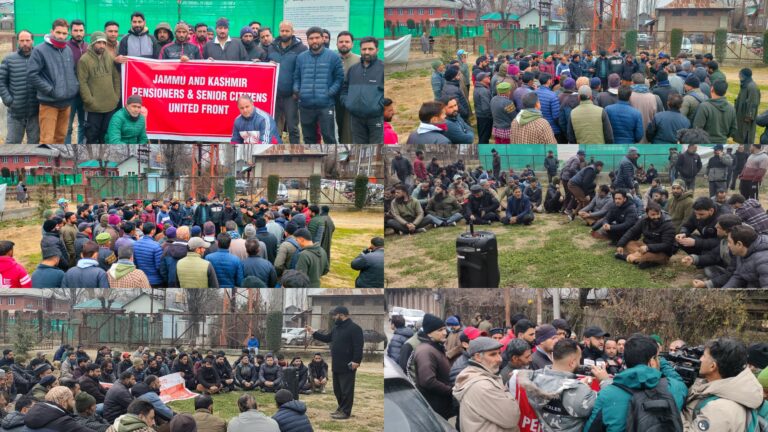
Srinagar, February 11:  In a show of strong unity, thousands of pensioners, senior citizens, government employees, daily wagers, contractual workers, and temporary staff took to the streets today across Jammu and Kashmir under the banner of the Jammu and Kashmir Pensioners & Senior Citizens United Front, in coordination with the Employees Joint Action Committee (R).

Massive demonstrations were held in major locations, including a prominent protest at the Agriculture Complex, Lal Mandi, Srinagar, where scores of daily wagers and temporary workers participated enthusiastically. The Srinagar rally was led by senior trade union leader S. Umar Bhat, along with Mohammad Afzal Bhat Fatehpuri, Ghulam Hassan Yattoo, Mohammed Yousuf, Imran Parray, Javed Ahmad, Mohammad Arif Bhat, and Jehangir Ahmad.

The protesters voiced deep frustration over years of unresolved grievances causing severe financial hardship to families reliant on government service and pensions. Key leaders, including State President Babu Hussain Malik, Chairman Rafiq Ahmad Khanyari, Chief Advisor Girdhari Lal Chanda, General Secretary Yashpaul Sharma, and Muzafer Nabi, condemned government inaction amid rising living costs, unemployment, and stagnation in promotions.

The core demands include immediate regularization of all categories of daily wagers, ad-hoc, contractual, and seasonal workers (including Rehbar-e-Khel, ASHA, Anganwadi, NHM, Home Guards, and others); release of pending GPF, gratuity, leave salary, and other dues withheld for over a year; enhancement of medical allowance to match other UTs; implementation of the Old Pension Scheme (OPS); promotion of KAS and feeding cadre officers against vacant posts; restoration of withheld increments; release of frozen DA from the COVID period; and hike in old age pension to ₹5000.

Leaders warned of intensified agitations if the government fails to act swiftly, stressing that these genuine, long-overdue issues affect administrative efficiency and public welfare. The protest highlighted the urgent need for a fair employment policy to curb youth frustration and job insecurity.

CPMG Calls BPMs the Backbone of Rural Postal Services

0


Holds extensive interactive session with Branch Postmasters at Tangmarg


TAUSEEF AHMAD


TANGMARG, Feb 11: Reaffirming India Post’s enduring commitment to public service, the Chief Postmaster General (CPMG), Jammu & Kashmir Circle, Shri D.S.V.R. Murthy (IPoS), on Tuesday held an extensive interactive session with Branch Postmasters (BPMs) at Tangmarg, reiterating the department’s guiding philosophy of “Dak Sewa, Jan Sewa”.

The interaction was attended by around 30 Branch Postmasters drawn from various rural and semi-urban pockets of the Tangmarg region. The CPMG was accompanied by the Senior Superintendent of Post Offices, Shri Adam Mohiuddin (IPoS), and Sub-Divisional Head Shri Mohd. Shabid Zargar, underscoring the importance the department attaches to strengthening grassroots-level postal administration.

During the interaction, Shri Murthy highlighted the pivotal role played by Branch Postmasters as the first and often the only point of contact between citizens and the postal department, particularly in remote, hilly and far-flung areas. He stressed that post offices continue to remain among the most accessible and trusted public institutions, especially for rural communities that rely heavily on postal services for communication, savings and financial security.

Emphasising service ethics, the CPMG called upon BPMs to ensure timely, transparent and citizen-friendly delivery of services, noting that professionalism and courteous behaviour are essential to sustaining public trust. Addressing the younger BPMs, he encouraged them to discharge their duties with sincerity, dedication and a strong sense of responsibility towards the communities they serve.

Shri Murthy also lauded the contribution of female Branch Postmasters, describing them as strong examples of women empowerment at the grassroots level. He observed that women BPMs have played a significant role in enhancing the credibility of postal services and fostering deeper community engagement, particularly among women beneficiaries.

As part of the visit, the CPMG conducted an individual review of each BPM, assessing performance parameters and discussing area-specific operational challenges. He emphasised the need for greater outreach and awareness regarding key postal banking schemes, including the Sukanya Samriddhi Yojana, Post Office Savings Account, Recurring Deposit and Monthly Income Scheme, especially to encourage a culture of savings among women, youth and rural households.

Highlighting the importance of social security, Shri Murthy advised BPMs to actively promote Postal Life Insurance (PLI) and Rural Postal Life Insurance (RPLI) schemes, pointing out their affordable premiums, reliable coverage and attractive bonus features, which make them secure and beneficial financial instruments for the common public.

The CPMG also underscored India Post’s expanding role in supporting local entrepreneurship and MSMEs, urging BPMs to facilitate logistics and parcel services for local traders and small businesses. He noted that the department’s extensive postal network and last-mile connectivity can play a crucial role in strengthening the local economy by enabling seamless movement of goods from remote areas to larger markets.

The interaction concluded with a reaffirmation of India Post’s mission to remain a people-centric institution, driven by service, accessibility and trust at the grassroots level.

Indian Railways Electrification Cuts Diesel Consumption by 178 Crore Litres in 2024–25, Achieving a 62% Reduction Since 2016–17

0

VINOD BHAT

Delhi, Feb 11:

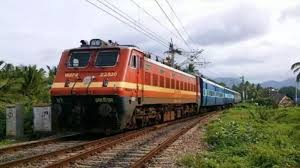
Electrification of railway network on Indian Railways (IR) has been taken up in mission mode. So far, about 99.4% of Broad Gauge (BG) network has been electrified. The electrification in remaining network has been taken up. Electrification carried out during 2014-25 and before 2014 is as under:


Period


Route Kilometer


Before 2014 (about 60 years)


21,801


2014-25


46,900


Zone wise status of electrification is as under:


SN


ZONE


% Electrified


1


Central Railway


100%


2


East Coast Railway


100%


3


East Central Railway


100%


4


Eastern Railway


100%


5


Konkan Railway


100%


6


Kolkata Metro


100%


7


North Central Railway


100%


8


North Eastern Railway


100%


9


Northern Railway


100%


10


South Central Railway


100%


11


South East Central Railway


100%


12


South Eastern Railway


100%


13


West Central Railway


100%


14


Western Railway


100%


15


North Western Railway


99%


16


Northeast Frontier Railway


99%


17


Southern Railway


98%


18


South Western Railway


96%


State/UT wise status of electrification is as under:


SN


STATE


% Electrified


SN


STATE


% Electrified


1


Andhra Pradesh


100%


16


Mizoram


100%


2


Arunachal Pradesh


100%


17


Nagaland


100%


3


Bihar


100%


18


Odisha


100%


4


Chandigarh


100%


19


Puducherry


100%


5


Chhattisgarh


100%


20


Punjab


100%


6


Delhi


100%


21


Telangana


100%


7


Gujarat


100%


22


Tripura


100%


8


Haryana


100%


23


Uttar Pradesh


100%


9


Himachal Pradesh


100%


24


Uttarakhand


100%


10


Jammu & Kashmir


100%


25


West Bengal


100%


11


Jharkhand


100%


26


Rajasthan


99%


12


Kerala


100%


27


Assam


98%


13


Madhya Pradesh


100%


28


Tamil Nadu


97%


14


Maharashtra


100%


29


Karnataka


97%


15


Meghalaya


100%


30


Goa


91%


All new line / multi-tracking projects are being sanctioned and constructed with electrification.


During last five years (2020-21 to 2024-25), expenditure amounting to Rs. 29,826 crore has been done on railway electrification projects including Tamil Nadu.


Since 2023-24, 10,932 Rkm electrification has been done till Jan’ 2026.


The completion of Electrification project(s) depends on various factors like forest clearances by officials of forest department, shifting of infringing utilities, statutory clearances from various authorities, geological and topographical conditions of area, law & order situation in the area of project(s) site, number of working months in a year for particular project site due to climatic conditions etc. All these factors affect the completion time of the project(s).


With electrification, there has been reduction in the consumption of diesel on Indian Railways. Indian Railways have been able to save 178 crore litre in Diesel consumption in the year 2024-25 with respect to 2016-17, which is a saving of 62%, thus reducing the import dependency of crude oil.


Amount spent by Indian Railways on total energy consumption for traction during 2024-25 is ₹ 32,378 crores.


Details of the amount spent by Indian Railways on the maintenance of electric and diesel locomotives are available in Annual Statistical Statement of Indian Railways which is available on website of Indian Railways (https://indianrailways.gov.in).


Railways is moving towards electric traction because of the environmental and cost considerations. While tests on bio-diesel have been done, electric traction is far more beneficial than bio-diesel.


Waste Management


Effective management including disposal of waste generated in trains and Railway stations, catering units and coaches is accorded high priority by Indian Railways for enhanced users’ experience. Various initiatives taken in this regard are as follows:-


• Waste collected inside trains is disposed of at nominated en-route stations, identified for waste disposal.


• On Board Housekeeping Staff are strictly mandated not to throw garbage on tracks and strict penalties are imposed on violation.


• Rag picking is done along railway tracks to maintain cleanliness.


• Plastic Bottle Crushing Machines (PBCMs) are installed at stations as per requirement.


• Provision of two bin type dustbins has been carried out at various stations for segregation of bio-degradable and non-biodegradable waste, at source.


• Based on local conditions, feasibility and requirement, tie-ups for waste disposal, have been made between local Railway authorities and municipal bodies.


• Infrastructure like Sewage treatment plants (STPs), Effluent Treatment plants (ETPs), Material Recovery Facility (MRF) has been installed and commissioned, on need basis, at a number of locations over Indian Railways.


• Passenger awareness campaigns are regularly conducted across Indian Railways for encouraging them to dispose garbage in dustbins provided in trains.


• Regular checks/surprise checks are conducted by supervisors/senior officials at Divisional, Zonal & Headquarter level.


• Special Cleanliness Campaigns under Swachh Bharat Abhiyan and cleanliness drives/campaigns are organized regularly over Indian Railways with the objective to achieve significant and sustainable improvements in cleanliness standards.


• Elimination of direct discharge of human waste from trains through installation of bio-toilets in passenger coaches. The details of provision of Bio-toilets are as under:


Period


No. of Bio-Toilets fitted


2004-14


9,587


2014-till date


3,61,572

A Bucket, A Brush, And Three Futures

0

Divorced, discarded and invisible, how a mother cleans hostel toilets to educate her daughters


TAQWA SHAFI


SRINAGAR, Feb 11: Before the hostel stirs to life—before alarms ring, slippers scrape the floor, and laughter echoes through corridors—she is already there.

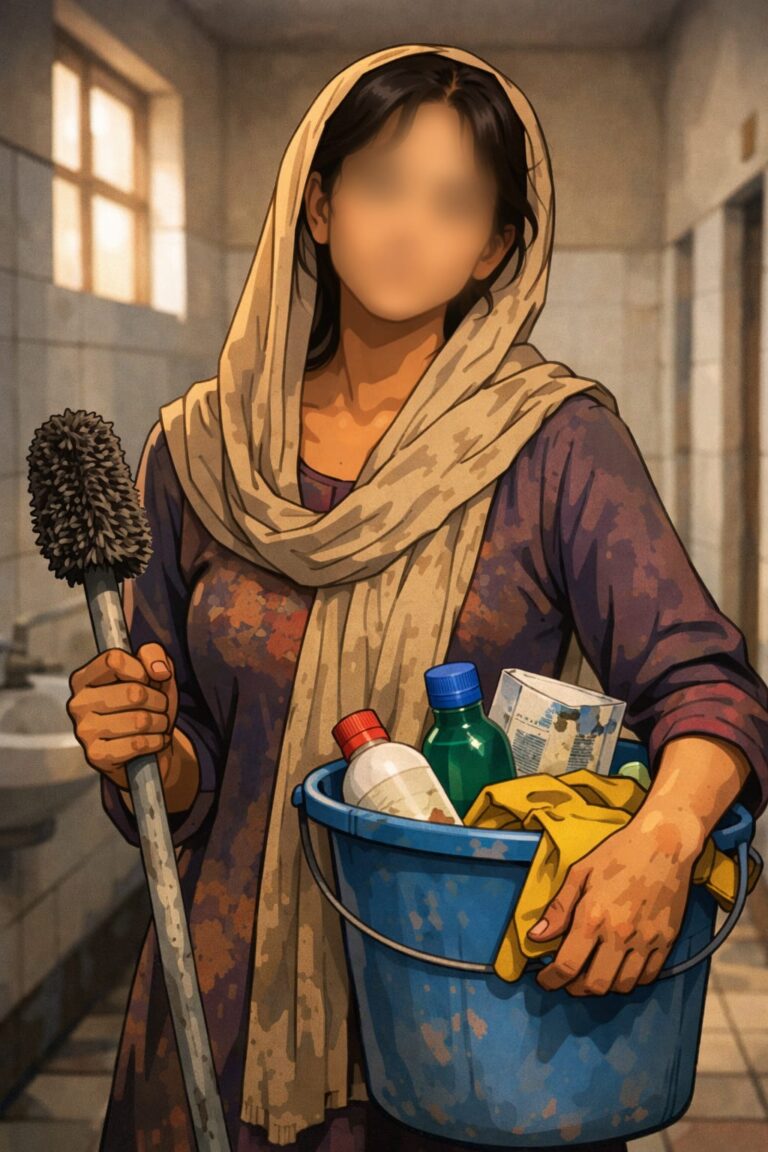
At the break of dawn, under dim fluorescent lights, a 40-year-old woman bends over cold tiled floors with a plastic bucket and a frayed brush. The smell of disinfectant clings to her clothes, her skin, her breath. She scrubs toilets used by hundreds of girls, washes away stains left behind by strangers, and empties dustbins overflowing with the waste of lives far more comfortable than her own.

For the residents of the girls’ hostel, this cleanliness is routine.

For her, it is existence.

She is a sanitation worker—one of those people society looks through, not at. A woman whose labour is visible only when it is missing.

Years ago, her life looked very different. She married by choice, believing love would shield her from hardship. She entered what was considered a stable, financially secure family. But security, she learned too late, can be a fragile illusion—especially for women.

Over time, she gave birth to three daughters. One of them was born physically disabled, requiring lifelong care, patience and medical attention. Instead of support, the child became a reason for blame. Slowly, the warmth of marriage turned into hostility.

Then, without warning, her husband remarried.

She was not consulted. She was not prepared. She was simply discarded.

One day, she and her daughters were thrown out of the house that had once been her world. There was no maintenance, no settlement, no assurance. Only closed doors and silence.

“I begged him not to separate me from my children,” she recalls, her voice trembling. “I told him I had nowhere to go. But he had already chosen another life.”

She returned to her parental home hoping for refuge. Instead, she found judgment. Because she had married against her parents’ wishes—and into a family perceived as affluent—her return was met with resentment rather than compassion.

“They said, ‘You made your choice. Now face it,’” she says quietly.

With no real support and three daughters depending entirely on her, she rented a single-room accommodation—a cramped space that serves as bedroom, kitchen and shelter for four lives. It leaks in winter, suffocates in summer, but it is the only place she can call home.

That was the moment she decided not to wait for mercy.

Uneducated and with no employable skills, the only work she could find was cleaning toilets in a girls’ hostel. Every day, she scrubs floors stained by indifference, carries garbage others refuse to touch, and wipes away what society wants hidden.

She works silently. Often ignored. Sometimes openly disrespected.

“There are days when people wrinkle their noses when I pass,” she says, forcing a tired smile. “But I tell myself—this smell feeds my daughters.”

Her hands bear the cost of survival—rough, cracked, scarred by chemicals. In winter, they bleed. Gloves are a luxury she cannot regularly afford.

When her shift ends, her labour does not.

In the evenings, under a weak bulb, she stitches clothes for neighbours to earn a few extra rupees. Her sewing machine hums late into the night, long after her daughters have fallen asleep beside her. On most nights, she sleeps no more than three or four hours.

Her greatest fear is not hunger.

It is education.

Two of her daughters attend a government school. Her eldest—the one with a disability—needs constant care and frequent hospital visits, expenses that often push her to the brink.

Yet, despite everything, hope refuses to die.

Recently, her second daughter passed her Class 10 board examination, scoring 418 marks—without tuition, without coaching.

“She studied on her own,” the mother says, her eyes filling with quiet pride. “I could not afford help, but she proved she is strong.”

Society advises her to give up.

“People tell me to stop their education and teach them tailoring,” she says. “But I want them to stand on their own feet. I don’t want them to live the life I was forced into.”

When rent is due and money falls short, she skips meals. When her daughter needs medicine, she postpones buying clothes for herself.

“I can tolerate hunger,” she says softly. “But I cannot tolerate seeing my children cry.”

Being divorced in this society adds another layer of cruelty. Landlords hesitate to rent to her. Some question her character. Others demand advance payments she cannot afford.

Still, she refuses to bow.

Despite exhaustion, humiliation and relentless uncertainty, she carries herself with dignity. She does not ask for pity. She asks only for opportunity.

“I clean toilets,” she says firmly. “But my daughters will not.”

Her story is not just about poverty. It is about abandonment, gendered injustice, and the invisible backbone of society—sanitation workers whose labour keeps spaces livable while their own lives remain unbearably fragile.

Every morning, hostel corridors gleam. Students walk past spotless floors without a second glance.

Few stop to think about the woman who made them shine.

Behind those clean tiles stands a mother fighting—scrub by scrub, stitch by stitch—to ensure her daughters inherit dignity, not despair.

CSIR–IIIM Srinagar Branch Concludes Three-Day Skill Development Programme on qRT-PCR

0

Srinagar,  February 11:


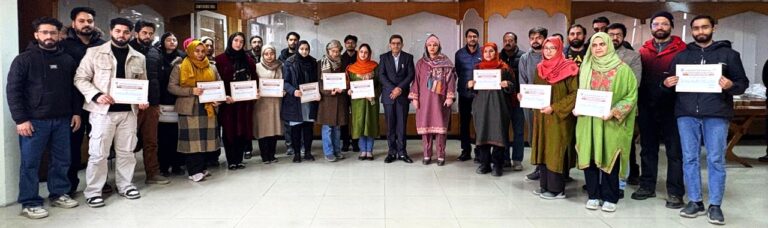
The CSIR–Indian Institute of Integrative Medicine (CSIR-IIIM), Srinagar Branch, successfully concluded its three-day Skill Development Training Programme on quantitative real-time PCR (qRT-PCR). The programme brought together around 20 participants from across India, including students, research scholars, and laboratory professionals, intending to strengthen practical competencies in advanced molecular biology techniques.


The training was meticulously designed to provide participants with comprehensive, bench-level proficiency in gene expression analysis—from sample preparation to result interpretation. Over three intensive days, participants were guided through the complete experimental workflow. The programme commenced with detailed sessions on RNA isolation, focusing on high-quality extraction, contamination control, and yield optimisation. Participants were also trained in Good Laboratory Practices, with special emphasis on reproducibility, contamination prevention, and quality assurance protocols.


The programme featured extensive wet-lab training in RNA isolation, cDNA synthesis, and qRT-PCR, along with interactive troubleshooting clinics and data interpretation workshops, underscoring CSIR-IIIM’s commitment to capacity building in cutting-edge molecular techniques.


Dr. Zabeer Ahmed, Director, CSIR-IIIM, who attended the valedictory session as Chief Guest, highlighted qRT-PCR as a transformative technology shaping advancements in agriculture, healthcare, and applied life sciences. He noted its growing relevance in diagnostics, translational research, climate resilience, and public health. Encouraging participants to apply their newly acquired skills, he stated that mastering such technologies contributes to India’s broader vision of technological empowerment under “Viksit Bharat @ 2047.”


Dr. Nasheeman Ashraf, Senior Principal Scientist and Programme Organiser, delivered the concluding remarks and urged participants to integrate advanced molecular tools into their professional work to strengthen national research capacity. The programme was co-organised by Dr. Syed Riyaz Ul Hassan, Senior Principal Scientist, and Dr. Phalisteen Sultan, Principal Technical Officer, who led the hands-on laboratory sessions.


The valedictory function was attended by Dr. Fayaz Malik, Chief Scientist; Dr. Qazi Parvaiz, Senior Principal Scientist; along with other senior scientists, technical and administrative staff of CSIR-IIIM Srinagar Branch. The programme was conducted under the overall patronage of Er. Abdul Rahim, Chief Scientist and Head, CSIR-IIIM Srinagar Branch, and coordinated by Dr. Nasir Ul Rasheed, Principal Scientist and Nodal Officer for Skill Development. The session was moderated by Dr. Ishfaq Majid Hurrah, Project Associate-I.