spot_imgspot_img
spot_img
Home Blog Page 66

Dismantle drug trafficking networks in J&K: LG Sinha to law enforcing agencies

0

Chairs high-level meeting with Deputy Commissioners, SSPs, senior officials at Lok Bhavan

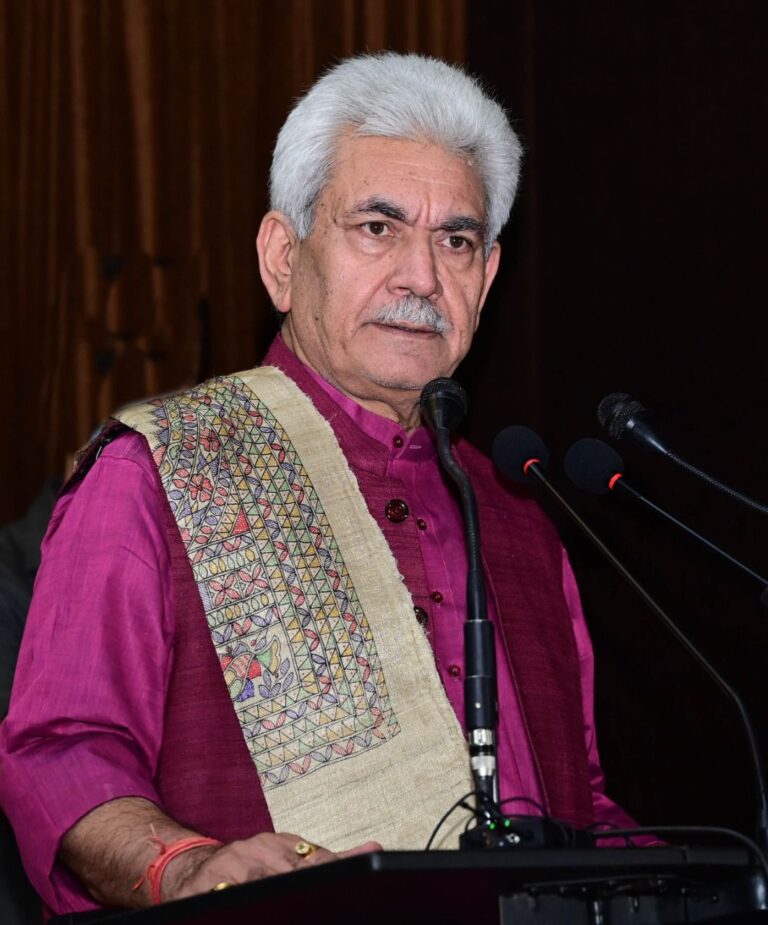
Jammu, Apr 01: Asking the law enforcing agencies to dismantle trafficking networks in Jammu and Kashmir, Lieutenant Governor Manoj Sinha on Wednesday said that action against drug abuse must be the top priority.

Chairing a high-level meeting with Deputy Commissioners, SSPs and senior officials of the civil and police administration at Lok Bhavan here, LG Sinha, directed for adopting a ‘Zero Tolerance’ Policy against the drug menace in the Union Territory.

The Lieutenant Governor emphasized on a multi-pronged strategy: Strengthening law enforcement to dismantle trafficking networks, Intensive mass awareness campaigns to deter potential users, enhancing treatment and counselling and rehabilitation, to make Jammu Kashmir a drug-free UT.

“Action against drug abuse must be our top priority. We need a collective mechanism to safeguard our youth and ensure a healthy future for Jammu & Kashmir,” the Lieutenant Governor said.

He also directed for strengthening grassroots intelligence and coordinated and stringent action against drug smugglers.

The meeting discussed the series of activities planned for a dedicated three-month campaign under Nasha Mukt Bharat Abhiyaan. The Lieutenant Governor exhorted the senior officials to lead the campaign from the front and ensure participation of every section of the society and stakeholders to make this campaign a people’s movement.

The meeting was attended by Atal Dulloo, Chief Secretary; Nalin Prabhat, DGP; Chandraker Bharti, Principal Secretary Home; S.J.M Gillani, Special DG (Coordination); M.K. Sinha, ADGP Headquarters; Nitish Kumar, ADGP CID; Dr. Mandeep K. Bhandari, Principal Secretary to Lieutenant Governor; Divisional Commissioners, IGPs, DIGs, Deputy Commissioners, Director Information, SSPs and other senior officials—(KNO)

Jammu Panthers Set Up Final Showdown With Jammu Tigers in CPL

0

Jammu, April 1: The road to a champion has narrowed to a single strip of pitch, 22 yards that will decide everything.

On Saturday, April 4, under the rising roar of a cricket-hungry crowd, the YSS-JKSC Cricket Premier League will crown its first true titan at M A Stadium.

And if the journey here has been electric, the final promises something louder, faster, and unforgettable.

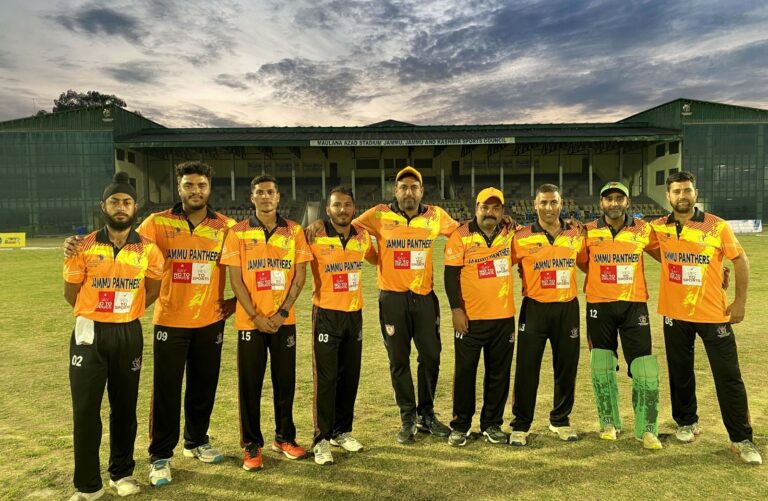
Jammu Panthers will take on Jammu Tigers.

Eighteen teams entered this league with ambition stitched into their jerseys – Jammu Tigers, Jammu Panthers, Jammu Nawabs, Jammu Sultans, Jammu Swords, Jammu Wolves, Rajouri Leopards, Rajouri Indians, Doda Lions, Doda Bhaderwah Warriors, Poonch Giants, Poonch Badshahs, Kishtwar Kings, Ramban Eagles, Banihal Kites, Samba Jets, Udhampur Fighters, and Kathua Heroes.

Over 22 matches, the tournament evolved into a proving ground of grit, nerve, and raw talent.

Now, only two remain.

The Panthers have been resilient, unpredictable, and battle-tested, the Tigers explosive, dominant, and ruthless.

This isn’t just a final, it’s the collision of two identities forged under pressure.

On their way to the finals, the Panthers defeated Kathua Heroes in the semifinal. Chasing 133, the Panthers bent but never broke.

Early wickets rattled their chase, but Varun Kumar’s fearless 40 shifted the momentum.

Samiullah steadied the innings.

And when the game tightened into a nerve-wracking finish, the Panthers held their breath and their nerve.

Their bowling was clinical when it mattered most.

Deep’s four-wicket spell dismantled Kathua’s structure, while captain A N Ahanger led with authority.

The Panthers don’t dominate games.

They outlast them.

And in a final, that might be the most dangerous trait of all.

If the Panthers are survival artists, the Tigers are statement makers.

In their semifinal, they didn’t edge past Udhampur Fighters, they overwhelmed them.

A towering 205/2 lit up the scoreboard, powered by Shaurya’s composed fifty, Akash Choudhary’s control, and A G’s blistering unbeaten 65 that turned acceleration into annihilation.

Even when challenged in the chase, the Tigers struck back with authority with quick wickets, sharp spells, and no panic.

They don’t wait for moments.

They create them.

There’s something about M A Stadium on a big day.

The stands don’t just fill, they pulse.

The chants don’t echo, they shake.

And when two hometown giants step onto that field, the atmosphere transforms into something almost cinematic.

“This league is more than a competition. It is a pathway of hope for the youth of Jammu,” said Secretary, Jammu and Kashmir Sports Council, Nuzhat Gul.

“When young boys and girls step onto grounds like M A Stadium, they are choosing discipline over distraction, purpose over peril. Sports give them identity, direction, and the belief that their dreams can carry them from these grounds to national colours and even the global stage,” she said. “Initiatives like this are our strongest answer to the menace of drug addiction because when youth are chasing excellence, they are not losing themselves. They are building a future that will make Jammu and Kashmir and the entire country proud.”

Wear your colours, pick your side because this isn’t just a match anymore, it’s a movement.

This is the 23rd match of the league, the final chapter, the last word.

For the Panthers, winning will be redemption through resilience.

For the Tigers, it will be validation through dominance.

For everyone else, a front-row seat to history.

Cricket in Jammu has been building toward a moment like this, a night where talent meets tension, and passion spills from the stands onto the field.

On April 4, it all comes down to one question: Who owns the moment when everything is on the line?

Because when the lights blaze and the crowd roars inside M A Stadium, only one team will walk away as champions.

And the other will be remembered for how close they came.

Shreya Singhal Takes Over as Director Information

0

JAMMU, APRIL 01: Shreya Singhal, an Indian Administrative Service (IAS) officer, assumed the charge as Director of Information, Jammu and Kashmir, here on Tuesday.

Upon taking over, Ms. Singhal held an introductory meeting with senior officers and officials of the Directorate of Information and Public Relations (DIPR). She underscored the need for transparent, timely, and people-centric dissemination of information, emphasising the department’s crucial role as a vital bridge between the government and citizens.

Stating that effective communication is key to promoting awareness about developmental initiatives and welfare programmes, she reiterated her commitment to modernising communication strategies.This, she said, would be achieved by integrating digital platforms, enhancing media coordination, and encouraging constructive engagement with stakeholders.
Senior officers present on the occasion included Joint Director Information (Headquarters), Dr. Zahoor Ahmad Raina; Joint Director Information Jammu, Deepak Dubey; and Deputy Director Information (PR&AV), Javid Ahmad Rather, along with other senior functionaries of the DIPR.

NHM Employees Hold 48-Hour Strike Across J&K, Health Services Affected

0

Tauseef Ahmad

Srinagar, Apr 1: National Health Mission (NHM) employees on Wednesday staged protests across Kashmir, demanding job security, social security benefits and pay revision, with the agitation affecting health services in several districts of the Valley.

The protests were part of a 48-hour strike called by the UT Level Coordination Committee of the All J&K National Health Mission Employees Association (JKNHMEA), with employees assembling at various district headquarters and health institutions and raising slogans in support of their long-pending demands.

Protesting employees said NHM workers have been serving in the health sector for years under uncertain conditions, without a clear policy for regularisation or adequate social security cover.

“We are demanding job security, social security and pay revision. While other government employees are talking about the 8th Pay Commission, NHM employees are still struggling for basic job security and a proper policy,” said Dr Shahnaz Gul, district president of the NHM Employees Association Bandipora.

In Srinagar, an NHM employee said the issue was not limited to one district but concerned thousands of workers across Jammu and Kashmir. “NHM employees have been working on the frontlines for years, but there is still no job security or social protection for us. The government must frame a clear policy and address our demands at the earliest,” the employee said.

Another protester, Dr Imtiyaz, said NHM staff have played a vital role in strengthening healthcare services but continue to face neglect. “Despite years of service, we are still working without security and benefits. Our genuine demands must be addressed without further delay,” he said.

Meanwhile, similar protests were reported from Jammu division where NHM employees observed the strike at district and block headquarters in support of their demands. The protest there was led by Provincial President NHM Jammu Division Dr Vikas Sharma, who said employees have been working for nearly two decades and have played a key role in strengthening the public healthcare system despite difficult conditions.

The employees are demanding formulation of a comprehensive job policy, immediate pay revision, extension of EPF benefits to all cadres, implementation of “equal pay for equal work”, loyalty benefits and retirement benefits.

Employee organisations including the J&K Medical Employees Federation and J&K EJAC also extended support to the protesting NHM workers.

Government Counters Misinformation; PIB Fact-Check Unit Issues Over 2,900 Fact Checks

0

Vinod Bhat

New Delhi: A Fact Check Unit (FCU) functions under Press Information Bureau, Ministry of Information and Broadcasting. FCU identifies fake news, misinformation relating to the Central Government. After verifying the authenticity of news from authorized sources, FCU publishes correct information on its social media platforms. Additionally, it encourages citizens to report suspicious content for verification, thereby strengthening public participation in combating misinformation.

FCU has identified various fake claims related to the Government of India including deepfakes, AI-generated and misleading videos, notifications, letters and websites. A total of 2913 fact- checks have been published so far. All fact-checks are available across PIB Fact Check official social media platforms, including X, Facebook, Instagram, Telegram, Threads and WhatsApp Channel.

During Operation Sindoor, the PIB Fact Check Unit actively identified misinformation and hostile narratives circulating online. It promptly acted on fact-checking false claims, providing authentic information, and ensuring accurate public communication, thereby helping prevent the spread of misleading and anti-India narratives. Ministry also issued directions for blocking of over 1,400 such URLs on digital media during Operation Sindoor.

For the publishers of news and current affairs on digital media and publishers of online curated content, the Information Technology (Intermediary Guidelines and Digital Media Ethics Code) Rules, 2021 (IT Rules, 2021) provides for a Code of Ethics along with a three-level institutional mechanism for redressal of grievance relating to violation of Code of Ethics by such publishers.

Government’s Semicon India Programme to develop a complete ecosystem ranging from design to manufacturing

0

Vinod Bhat

New Delhi: India’s electronic manufacturing strategy is driven by the Prime Minister’s vision of AtmaNirbhar Bharat and Making India a global manufacturing hub. The Government adopted a structured and targeted policy for electronics manufacturing across the entire value chain including semiconductors.

As a result of these policies, electronics manufacturing in India has expanded significantly in the last 11 years. It can be seen from the following statistics:


# 2014-15 2024-25 Remarks
Production of electronics goods (₹) ~1.9 Lakh Cr ~12 Lakh Cr Increased 6 times
Export of electronics goods (₹) 38 thousand Cr ~3.3 Lakh Cr Increased 8 times
Production of mobile phones (₹) 18 thousand Cr 5.45 Lakh Cr Increased 28 times
Export of mobile phones (₹) 1,500 Cr. 2 Lakh Cr Increased 127 times
Mobile Phone imported (units) 75% of the total demand 0.02% of the total demand  


Semicon India Programme

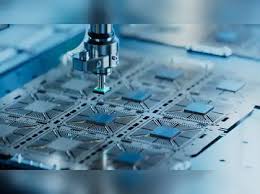
Semiconductors is a foundational and strategic industry. Semiconductors are used in almost every device.

To promote the development of its manufacturing ecosystem in India, the Government launched Semicon India Programme in January 2022. It aims at developing a complete ecosystem, ranging from design, fabrication, assembly, testing, packaging and module manufacturing.

In a short span of four years, the Government has approved 10 projects with investment commitments of about ₹1.6 lakh crore. Commercial production from two plants (Micron and Kaynes) has commenced with 2 more plants to start commercial production this year.

The details of the approved Semiconductor manufacturing units are placed at Annexure I.

Developing India’s chip design ecosystem:

Government is developing India’s chip design ecosystem in two ways:

1. Supporting Indian design engineers through chip design tools

In a one of its kind initiative in the world, Government has provided cutting edge chip design tools from 8 different companies to 315 universities at no cost. So far, their usage has exceeded 200 lakh hours.

Using these tools 211, chips have been taped out by 75 institutions across India including 149 chips at 180nm, SCL Mohali and 62 chip at overseas foundries.

2. Supporting Indian design companies through grant, free design tool and fabrication support:

Government has approved 24 projects for the design of semiconductor chips and SoCs. These projects address critical sectors such as video surveillance, drone detection, energy metering, microprocessors, satellite communications, and broadband and IoT SoCs.


Out of 24 projects, 14 companies have raised venture capital funding of more than Rs 650 Cr to scale up and productize their solutions. Seven (7) chips have been successfully fabricated at various nodes including advanced nodes such as 12 nm.


Further, to enhance bilateral collaboration on opportunities to advance resilient semiconductor supply chains and leverage complementary strengths, the Government has entered into MoU with United States, Japan, European Union, Singapore and Netherlands.


Employment generation

The growth of the electronics manufacturing sector has led to substantial employment generation. As per industry estimates, it supports around 25 lakh jobs, including direct and indirect employment.

Out of this, the mobile phone manufacturing sector alone supports around 12 lakh jobs, across manufacturing, logistics, supply chains and allied services.


Apart from this, the Government is implementing flagship schemes to further boost employment by attracting investments.


Under the India Semiconductor Mission (ISM), 10 semiconductor units are under construction. As a foundational industry, semiconductor manufacturing is expected to have a cascading impact on employment generation across the supply chain and allied sectors, leading to significant indirect job creation.

Similarly, under Electronics Component Manufacturing Scheme (ECMS), 249 applications have been received for components, base materials and capital equipments such as PCBs, capacitors, laminates etc.


India Semiconductor Mission 2.0: Building on the success of Semicon India Programme and further enhance the capabilities in semiconductors, FM, in the Union Budget 2026-27, announced India Semiconductor Mission 2.0 for manufacture of equipment and materials, design full stack, Indian IP and fortify supply chains.
****


Annexure-I

Details of approved semiconductor manufacturing projects:


1.  Micron Technology Inc. is establishing semiconductor manufacturing facility in Gujarat with an investment of Rs.22,516 crore. Micron’s facility in India will enable assembly and test manufacturing for both DRAM and NAND products and address demand from domestic and international markets. The production capacity is around 14 million units per week.

2. Tata Electronics Private Limited (TEPL) is establishing semiconductor manufacturing facility in Gujarat with an investment of Rs. 91,526 crore. The fab facility will be set up in technology partnership with PSMC, Taiwan. The production capacity of the project would be around 50,000 wafer starts per month (WSPM).

3. Tata Electronics Private Limited (TEPL) is establishing semiconductor manufacturing facility in Assam with an investment of Rs.27,120 crores. The facility will use indigenous semiconductor packaging technologies with a production capacity of 48 million units per day.

4. CG Power and Industrial Solutions Limited is establishing semiconductor manufacturing facility in Gujarat with an investment of Rs. 7,584 crore. The facility will be set up as a joint venture partnership with Renesas Electronics America Inc., USA, and STARS Microelectronic, Thailand. The Technology would be provided for this facility by Renesas Electronics Corporation, Japan and STARS Microelectronic, Thailand. The production capacity would be around 15.07 million units per day.

5. Kaynes Technology India Limited (KTIL) is establishing semiconductor manufacturing facility in Gujarat with an investment of Rs. 3,307 crores for Wire bond Interconnect, Substrate Based Packages. The Technology would be provided by ISO Technology Sdn. Bhd. and AOI Electronics Co. Ltd. (AOI). The facility will have the capacity to produce more than 6.33 million chips per day.

6. Vama Sundari Investments (Delhi) Private Limited (VSIPL) is establishing semiconductor manufacturing facility in Uttar Pradesh with an investment of Rs 3,706 crores for display driver ICs (DDIC) using Gold (Au) Bump technology along with chip probing facilities and die processing services. The Technology would be provided by Hon Hai, Taiwan. The facility will be set up as a joint venture partnership between VSIPL and Foxconn, India. The production capacity would be around 20K wafers per month/36 million chips per month.

7. 3D Glass Solutions Inc. (3DGS) is establishing semiconductor manufacturing facility in Odisha with an investment of Rs. 1,943 crores. The plant will handle the assembly of packaged products such as Flip Chip Ball Grid Array (FCBGA) assembly, Radio Frequency System in Package (RF SiP), Antenna in Package System in Package (AiP SiP), glass interposers with passives and silicon bridges and 3D Heterogeneous Integration (3DHI) modules. The Proposed installed capacity for glass panel substrate production, assembly and 3DHI is around 5800 panels per month, 4.20 million units per month, and 1100 units per months respectively.

8. SiCSem Private Limited is establishing semiconductor manufacturing facility in Odisha with an investment of Rs. 2,066 crores. The facility will be set up in technology partnership with Clas-SiC Wafer Fab Ltd. for SiC fab and Continental Device India Pvt. Ltd. for packaging. The production capacity is 5,000 wafers/month, and the packaging capacity is 8 million units/month.

9. Continental Device India Private Limited (CDIL) is expanding its semiconductor manufacturing facility in Punjab, with an investment of Rs. 117 crores. The facility will manufacture high-power discrete semiconductor devices such as MOSFETs, IGBTs, Schottky Bypass Diodes, and transistors, both in Silicon and Silicon Carbide. The production capacity will be around 158.38 million units/annum.

10. Advanced System in Package Technologies Private Limited (ASIP) is establishing semiconductor manufacturing facility in Andhra Pradesh, with an investment of Rs. 480 crores. The facility will be set up in technology partnership with APACT Co. Ltd, South Korea. The production capacity of the facility would be around 96 million units/annum.
Impactful AI solutions being promoted and developed under IndiaAI Mission to address major societal challenges, including in healthcare

0

Vinod Bhat

New Delhi: India’s AI strategy is based on the Hon’ble Prime Minister’s vision to democratize the use of technology. It aims to address India centric challenges, create economic and employment opportunities for all Indians.

The Government approved the IndiaAI Mission on 7th March 2024. The Mission is built on seven pillars focused on compute access, foundational models, datasets, talent development, startups and industry partnerships, development of applications, and ethical AI. These efforts aim to build a self-reliant and globally competitive AI ecosystem in the country.

Impactful AI solutions are being promoted and developed under IndiaAI Mission to address major societal challenges, including in healthcare.

IndiaAI–NCG Cancer AI & Technology Challenge (CATCH) has been launched in collaboration with the National Cancer Grid. The partnership supports joint proposals from AI innovators and clinical institutions for development and validation of AI solutions across the cancer care continuum.

The initiative addresses the critical gaps across the cancer care continuum in a balanced and impact-oriented manner. It provides grant support and access to clinical validation environments, thereby enabling real-world testing, scale-up and adoption of AI tools in public health settings.

A total of 299 proposals were received under the Cancer AI & Technology Challenge (CATCH) Grant challenge from a wide range of stakeholders including startups, academic institutions, healthcare providers, and industry participants across the country.

Following a rigorous multi-stage evaluation process, 10 solutions have been selected for grant support. These selected proposals represent diverse thematic areas across the cancer care continuum and reflect a broad-based participation from different regions and categories.

The CATCH grant was conducted across 7 priority tracks viz. Screening, Diagnostics, Clinical Treatment, Patient Engagement, Research Enablement, Operational Efficiency, Data Curation.

The evaluation framework does not exclusively prioritize any single category. Instead, proposals are assessed holistically based on their potential for clinical impact, scalability, innovation, and alignment with national health priorities.

The Programme incorporates a structured, phased support mechanism to assess and strengthen the operational readiness and scalability of selected solutions.

In the initial phase, selected teams are provided grant support of up to ₹50 lakh per solution, disbursed in milestone-linked tranches, to enable development, validation, and pilot deployment.

Based on demonstrated performance, selected solutions may be considered for an enhanced grant support of up to ₹1 crore per solution for scale-up. The evaluation framework includes technical assessment, clinical validation in collaboration with relevant institutions, and real-world pilot testing.

The Government envisages that successful solutions emerging from the Programme will be progressively scaled through appropriate institutional partnerships and integration pathways.

The scale-up approach will be guided by evidence generated during pilot deployments, clinical validation outcomes, and alignment with national and state-level health system priorities.

Efforts are being undertaken to ensure that solutions developed under the Programme are aligned with existing clinical workflows and public health systems. This includes engagement with relevant stakeholders to facilitate interoperability, adherence to clinical standards, and integration within healthcare delivery settings, subject to validation and regulatory considerations.

The Government places strong emphasis on the ethical and responsible use of health data. Appropriate safeguards are being incorporated within the Programme design, including adherence to applicable data protection frameworks, anonymization protocols, and oversight mechanisms during data collection, model development, and deployment stages.

All approved projects must submit a study protocol to the Institutional Ethics Committee (IEC) of the participating hospital or institution. IEC clearance is mandatory prior to the release of funds and project commencement.  Upon receipt of IEC approval, selected teams will receive a formal grant award letter.

Railways Sets New Record in Passenger Traffic as well as Cargo Transport in 2025–26

0

Vinod Bhat

New Delhi: Indian Railways has achieved significant milestones in both passenger operations and freight during 2025–26, setting new records in cargo transport while also reporting robust growth in passenger traffic and revenue. These achievements reflect sustained improvements in operational efficiency, capacity enhancement, and the growing reliance on rail-based transportation by both key sectors of the economy and everyday commuters. Together, they underscore Railways’ pivotal role as a backbone of the nation’s logistics network and a provider of safe, reliable, and accessible mobility for citizens across the country.

Increased Passenger Traffic and Revenue Growth

Indian Railways has reported robust growth in passenger traffic and revenue for the fiscal year. The total number of passengers carried rose to 741 crore in 2025–26, a 3.54% increase over 716 crore in 2024–25, reflecting sustained growth in rail usage across the country. Correspondingly, total revenue reached approximately ₹80,000 crore in 2025–26, marking a 5.96% increase from ₹75,500 crore in 2024–25, driven by strong passenger traffic and earnings. These figures underscore Indian Railways’ expanding role in passenger mobility and its improving financial performance year-on-year.

Freight Growth Highlights Increasing Logistics Demand

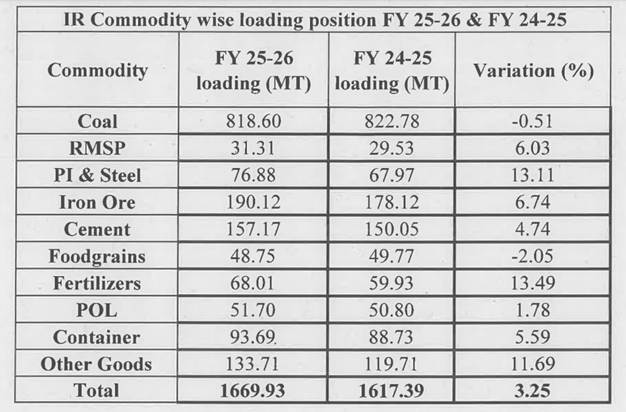
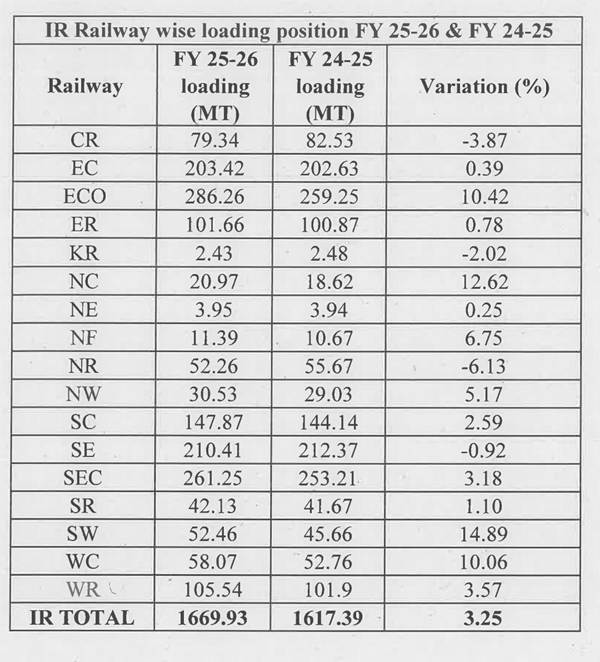
During 2025–26, Indian Railways carried a record 1670 Million Tonnes (MT) of freight, registering a growth of 3.25% over the previous year. This strong performance was complemented by a 4.56% increase in the number of wagons handled, which rose from 2,79,12,271 in 2024–25 to 2,91,86,475 in 2025–26. The steady rise in freight loading highlights the increasing demand for reliable, cost-effective, and efficient logistics solutions, positioning Railways as a preferred mode of transport for bulk commodities.

Fertilisers, Pig Iron, and Finished Steel Drive Impressive Growth

The growth has been largely driven by key sectors such as Fertilisers (13.49%), ‘Pig Iron and Steel’ (13.11%). This reflects both the rising demand for agricultural inputs across regions and the continued expansion of industrial activity, particularly in the steel sector.

Iron Ore and Cement Sustain Infrastructure Momentum

Core infrastructure commodities have also played a crucial role in sustaining this momentum. Iron Ore transportation increased by 6.74%, reaching 190.12 MT, while Cement loading grew by 4.74% to 157.17 MT. These trends indicate ongoing infrastructure development and construction activity across the country, where Railways continues to serve as a vital logistics partner.

Balanced Growth Across Railway Zones

Zone-wise loading performance during 2025–26 reflects broad-based growth across several regions, with South Western Railway (SWR) recording the highest increase of 14.89% over the previous year. Other zones demonstrating strong double-digit growth include North Central Railway (NCR) at 12.62%, East Coast Railway (ECoR) at 10.42%, and West Central Railway (WCR) at 10.06%. Additional zones that registered positive growth include Eastern Railway (ER) (0.78%), East Central Railway (ECR) (0.39%), North Eastern Railway (NER) (0.25%), Northeast Frontier Railway (NFR) (6.75%), North Western Railway (NWR) (5.17%), South Central Railway (SCR) (2.59%), South East Central Railway (SECR) (3.18%), Southern Railway (SR) (1.10%), and Western Railway (WR) (3.57%). This widespread improvement across zones highlights balanced regional development and enhanced freight handling capacity across the Indian Railways network.

Strong Growth in Freight Earnings

In addition to strong loading performance, Indian Railways has also registered robust freight earnings, which have reached approximately ₹1,77,754 crore in 2025–26, reflecting a 1.44% increase over ₹1,75,302 crore in 2024–25. Among commodities, Iron Ore emerged as the highest revenue contributor with earnings of ₹14,600.51 crore, followed by Cement (₹13,599 crore), Pig Iron & Finished Steel (₹12,181 crore), Fertilisers (₹9,039 crore), Food Grains (₹8,312.5 crore), and Mineral Oil (₹7,249.54 crore).

Railways Continues to Drive Growth and Connectivity

Building on its achievements in freight, Indian Railways has also seen sustained growth in passenger traffic and revenue, reflecting its expanding role in providing reliable and efficient mobility across the country. This consistent performance underscores Railways’ pivotal contribution to the nation’s economic development, enhancing connectivity, reducing logistics costs, and supporting a more sustainable and efficient transport ecosystem.

Over 140 TV Violations Acted Upon Under Programme and Advertising Codes in Past Five Years

0

Vinod Bhat

New Delhi: The private television channels are required to adhere to the Programme Code and Advertising Code framed under the Cable Television Networks (Regulation) Act, 1995. The Programme Code provides that programme which contains any of the following should not be telecast on a private television channel:

Obscenity

      • Attack on religions or communities
      • Visuals or words contemptuous of religious groups
      • Content which promotes communal attitudes
      • Content which criticizes, maligns or slanders any individual in person or certain groups, segments of social, public and moral life of the country


Further, the Advertising Code, inter-alia, stipulates that indecent, vulgar, suggestive, repulsive or offensive themes or treatment shall be avoided in all advertisements.

The Central Government has also established a statutory mechanism for redressal of grievances/ complaints of violation of Programme and Advertising Codes. As per the three-level grievance redressal mechanism, any complaints regarding the content broadcast by private satellite TV channels, are dealt as follows:


        • Level-I: directly received and disposed of by the Broadcaster
        • Level -II: Self-Regulating Bodies of the Broadcasters
        • Level-III provides for Oversight mechanism by the Central Government.


The Government acts against private satellite TV channels by issuance of advisories, warnings, apology scroll orders and off-air orders etc. The Ministry also issues Advisories from time to time to private satellite TV channels for adhering to the Programme Code and Advertising Code.

The details of action taken by this Ministry in last 5 years in respect of all violations of the Programme Code and Advertising Code as under:


S. No. Description 2021 2022 2023 2024 2025 Total
1 Advisories to specific

channels

5 7 14 3 6 35
2 Warnings 25 6 17 1 1 50
3 Orders for Apology Scrolls 11 39 3 1 54
4 Off-air Orders 3 3
5 Cancellation of permission 1 1
6 Order for disclaimer 1 1
  TOTAL 43 52 37 4 8 144


Apart from above, the Government takes all possible steps to curb violations by other media platforms, which include:

  • Print media: Newspapers have to adhere to “Norms of Journalistic Conduct” brought out by the Press Council of India (PCI). These norms, inter-alia, restrain publication of fake/ defamatory/ misleading news. The Council holds inquiry into alleged violations of the norms, as per section 14 of the PCI Act, and may warn, admonish or censure the newspaper, editors, journalists, etc. as the case may be.
  • Digital media: For the publishers of news and current affairs on digital media and publishers of online curated content, the Information Technology (Intermediary Guidelines and Digital Media Ethics Code) Rules, 2021 (IT Rules, 2021) provides for a Code of Ethics along with a three-level institutional mechanism for redressal of grievance relating to violation of Code of Ethics by such publishers.

CEO SSCL Conducts On-Ground Inspection at Lal Chowk; Orders Immediate Redressal of Public Grievances

0

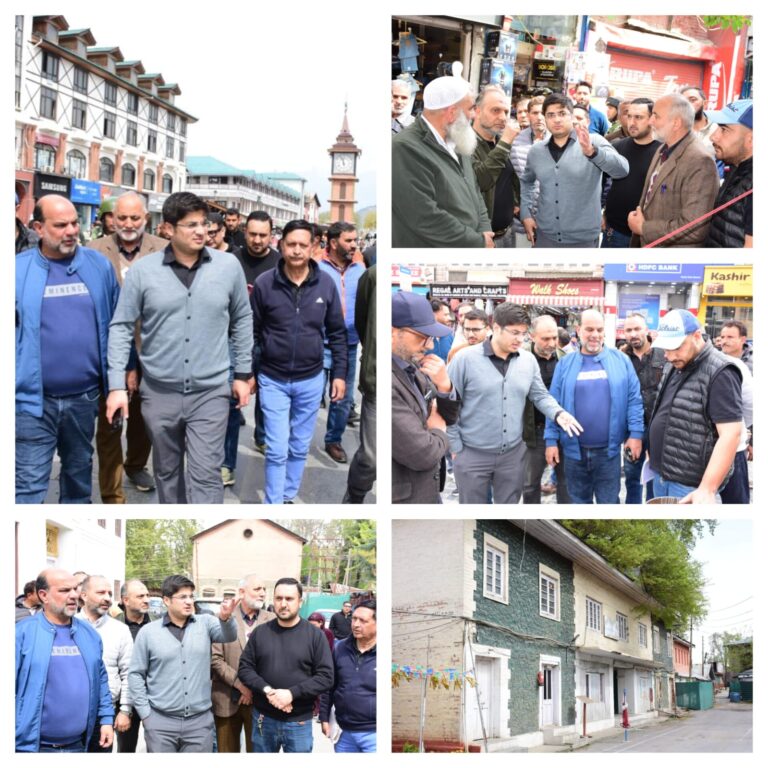
Srinagar, April 1: In a proactive move to strengthen civic service delivery and ensure responsive governance, Faz Lul Haseeb, Chief Executive Officer of Srinagar Smart City Limited, conducted a comprehensive on-ground inspection at Lal Chowk, the city’s central commercial hub.

During the visit, the CEO engaged directly with traders, shopkeepers, and other stakeholders to gather first-hand feedback on pressing civic issues, including sanitation, drainage, and public utility services. The interaction provided a platform for stakeholders to voice their concerns, which were attentively heard and acknowledged on the spot.

Traders and business owners welcomed the initiative, appreciating the administration’s hands-on approach and commitment to resolving long-standing issues through direct field engagement.

Taking immediate cognizance of the grievances raised, the CEO issued on-the-spot directions to the concerned departments for swift and effective redressal. The Drainage Wing was instructed to urgently address bottlenecks and ensure the proper functioning and maintenance of the drainage network in and around Lal Chowk.

The Chief Sanitation Officer of Srinagar Municipal Corporation was directed to further intensify sanitation drives and maintain sustained cleanliness standards in the area, keeping in view its significance as a high-footfall commercial and public space.

Additionally, officials of SSCL were directed to prioritize the resolution of electrical and allied infrastructure issues to ensure seamless public utility services for traders, commuters, and visitors alike.

The inspection underscores the administration’s continued focus on robust field monitoring, inter-departmental coordination, and time-bound grievance redressal, aimed at enhancing the quality of urban services and improving the overall civic experience in Srinagar.

The CEO was accompanied by the Chief Engineer, SSCL; Chief Sanitation Officer, SMC; Executive Engineer, Drainage Wing; and other senior officials from SSCL and SMC.