Gurez Calligrapher revives Islamic heritage through art
SEERAT-UN-NISA
BANDIPORA, Sep 8: In recent years, self taught calligraphy has earned renewed fame in Kashmir, where a growing number of artists did not only revive a centuries old art but have earned global recognition.
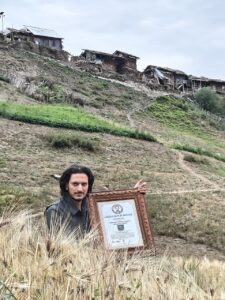
Among these artists is self taught artist Mustafa Ibni Jameel, 28 year old from Kilshay village of Gurez valley, a village located near Line of Control in North Kashmir’s Bandipora district.
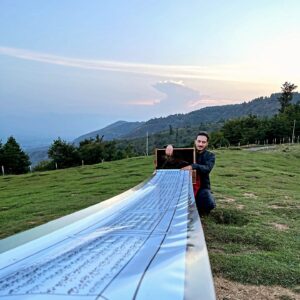
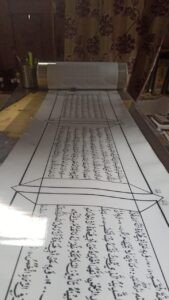
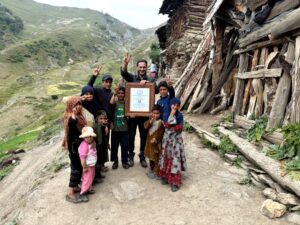
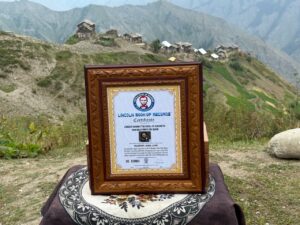
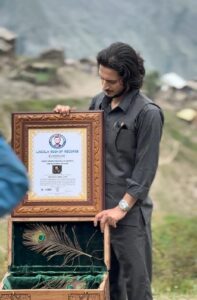
Belonging from a village where limited resources reach Mustafa have scripted history by his calligraphy projects. He earlier made headlines by entering his name in Lincoln Book of records for writing the longest hand written book of Holy Quran on a single scroll of 500 meter long paper in seven months.
His current project has also been entered in Lincoln book of world records and it has the tag of longest hand written book in the world.
Speaking about his journey with Kashmir Despatch, Mustafa shared that his interest in Calligraphy grows in 2017 when he starts with alphabets with limited resources. “I am still learning. I bought a calligraphy chart and tried to improve my handwriting before writing the Holy Book of Quran.”
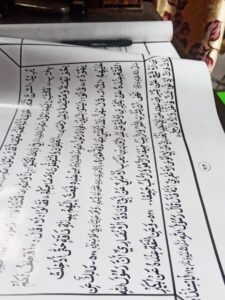
In his latest achievement Mustafa has completed the ALMUWATTA series on a 1.3 kilometer long calligraphic single sheet of the Muwatta of Imam Malik on of the first Books of Hadees in Islamic history.
He said that this part of the ALMUWATTA series features the transmission of Ibni Qadim. “My work is not just about breaking world records,” Mustafa says. “It’s about representation telling the world about our religion, our identity, and our struggle through art.”
He shared that even though he belongs to the forgotten corner of the world , he can proudly say that they are part of the 2.1 billion Muslim Ummah.
“Through these long form projects and the reason behind choosing these projects only, I want to highlight these teachings in the current generation where we are less interested in learning the teaching of our Prophets.”
“We want the world to know that we still exist, that we still carry a shared culture,” he says. “Our aim is to leave a mark in history that will remain till the Day of Judgment.”
Mustafa concluded that to keep the traditional art alive the artists have to work hard and take their projects to the global level so that this art will continue and will be remembered by future generations.